Input Hypothesis: Why Comprehensible Input Beats Drilling
The Drill Trap
You'''ve been there. Open Duolingo, complete the lesson, get the dopamine hit from the completion screen. Repeat tomorrow. After six months, you can barely order a coffee in Spanish.
This is the drilling trap. You'''re learning to complete exercises, not to use the language.
What Stephen Krashen Discovered
In the 1970s, linguist Stephen Krashen proposed the Input Hypothesis: we acquire language when we understand messages, not when we memorize grammar rules or vocabulary lists.
The magic phrase is comprehensible input—language that'''s slightly above your current level, but understandable through context.
Krashen'''s research showed that traditional drilling produces learning (conscious knowledge of rules) but not acquisition (unconscious ability to use the language). You can know every Spanish verb conjugation and still not understand a native speaker.
Why Most Apps Get This Wrong
Most language apps are built on the drilling model:
- Translate this sentence
- Fill in the blank
- Match the word to the picture
These exercises feel productive. They'''re measurable. You can track your streak. But they'''re not how humans actually acquire language.
Think about how you learned your first language. You didn'''t drill vocabulary. You listened to your parents, understood the context, and gradually started using words yourself.
What Actually Works
The research is clear. Language acquisition happens through:
1. Massive comprehensible input
Listen to and read content you mostly understand. Not 100%—that'''s too easy. Aim for 80-90% comprehension. The unknown 10-20% is where growth happens.
2. Focus on meaning, not form
Don'''t stop to look up every word. Guess from context. The goal is understanding the message, not analyzing the grammar.
3. Interesting content
If you'''re bored, your brain checks out. Watch shows you'''d watch anyway. Read about topics you care about. The language is the vehicle, not the destination.
My Switch to Comprehensible Input
I spent six months drilling Duolingo. I could ace the exercises. Then I tried watching a Spanish YouTube video and understood maybe 20%.
So I changed my approach. Instead of 30 minutes of drilling, I did:
- 20 minutes of Spanish TV with subtitles
- 10 minutes of reading simple Spanish articles
- 5 minutes of reviewing what I'''d absorbed
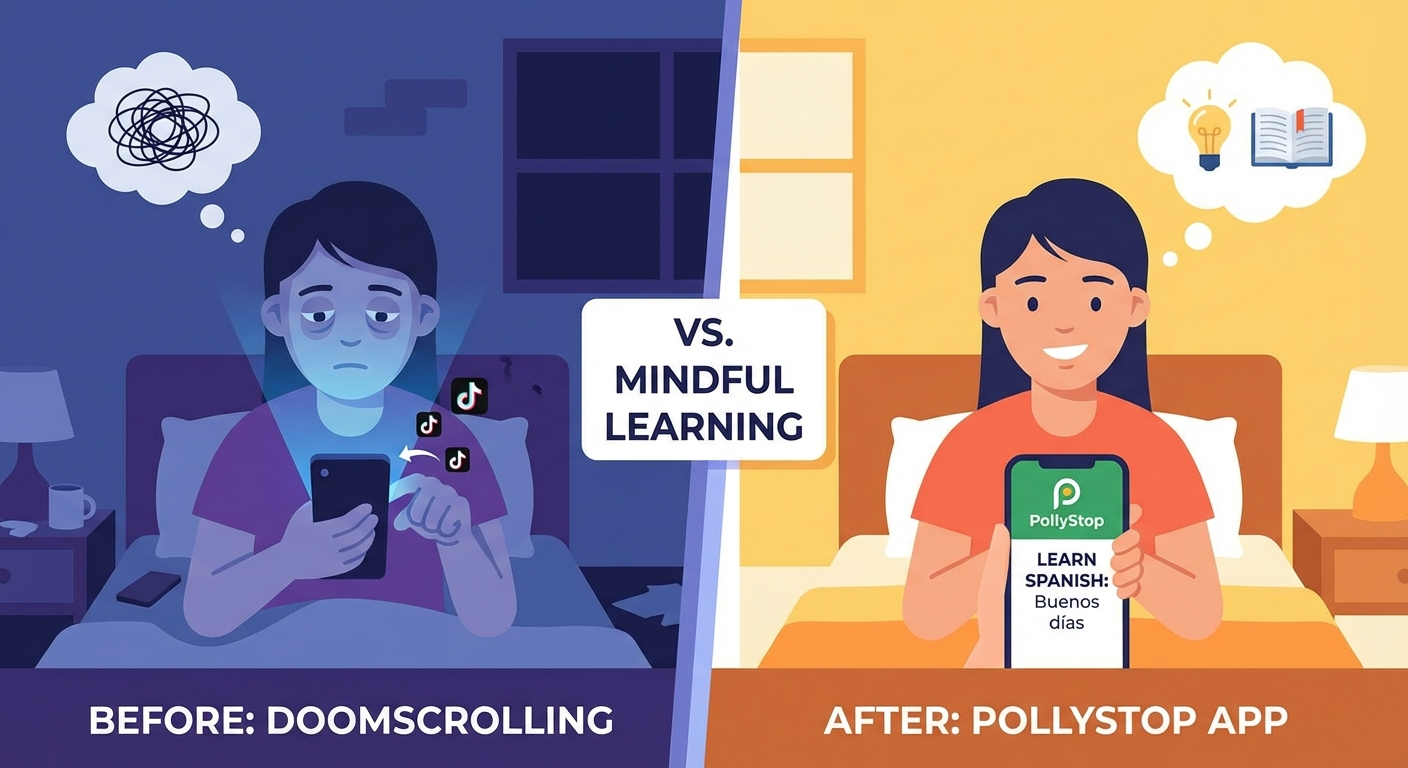
I used PollyStop to block distracting apps during this time—because comprehension requires focus. You can'''t understand a new language while doom-scrolling.
The Results
After three months of comprehensible input:
- Could understand 60-70% of native content (vs. 20% before)
- Started thinking in Spanish occasionally
- Could actually hold conversations without translating in my head
The drilling gave me vocabulary. The input gave me language.
How to Implement This
- Find content at your level
Netflix with Spanish audio + subtitles, YouTube channels for learners, graded readers - Don'''t pause to look up words
Guess from context. If you'''re lost, the content is too hard. Switch to something easier. - Block distractions
Use PollyStop during input time. Comprehension requires sustained attention. - Review passively
Re-watch the same episode. Read the same article. Familiarity builds fluency.
The Bottom Line
Drilling exercises feels like progress. It'''s measurable, trackable, gamifiable. But it'''s not how you acquire language.
Comprehensible input is messier. You can'''t track it with streaks. But it'''s how your brain actually learns to use a language, not just know about it.
Struggling to focus on your language learning?
PollyStop blocks distracting apps while you study—so you actually finish your Duolingo lesson instead of doom-scrolling.
Try PollyStop Free →