
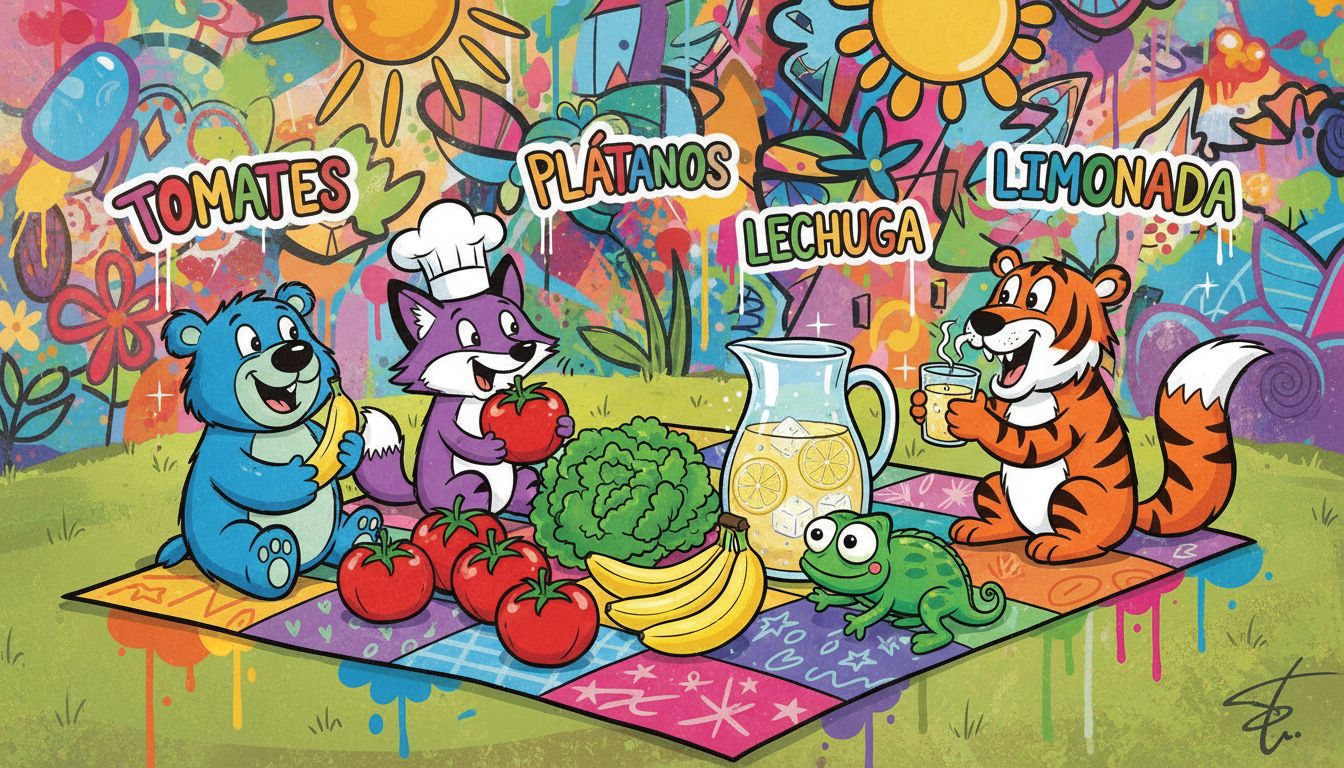
What Are Common Words for Food and Drinks in Spanish?
Quick Answer
To learn words about food and drinks in Spanish, start with basics like 'comida' (food) and 'bebidas' (drinks). Common examples include 'pan' (bread), 'agua' (water), and 'manzana' (apple).
Learning vocabulary related to food and drinks is a fun and essential part of mastering a new language, especially Spanish. Food ('comida') and drinks ('bebidas') are universal topics that everyone can relate to, making them perfect for beginners.
Let's start with some fundamental words: 'bread' translates to 'pan' in Spanish, while 'water' is 'agua.' These words are not only useful when ordering in a restaurant but also when discussing daily meals. Expanding your vocabulary will help you navigate various scenarios, from grocery shopping to cooking.
Here are some more examples to get you started:
- 'milk' is 'leche'
- 'fruit' is 'fruta'
- 'juice' is 'jugo'
- 'vegetable' is 'vegetal'
- 'meat' is 'carne'
- 'chicken' is 'pollo'
- 'fish' is 'pescado'
In addition to individual words, you can practice forming simple sentences. For instance, you can say, 'Me gusta el pan,' which means 'I like bread.' This practice not only reinforces your vocabulary but also helps you understand sentence structure in Spanish.
Understanding food and drink vocabulary is crucial for various real-world applications. Whether you're traveling to a Spanish-speaking country or just trying to impress your friends with your language skills, knowing these words will enhance your experience. You can use them to order meals, read menus, or even share recipes.
Moreover, learning about food can also introduce you to the culture of Spanish-speaking countries. Each region has its own specialties, and knowing the words for these foods can enrich your culinary experience. For example, 'taco' is the same in both languages, but exploring its origins and varieties in Mexico provides deeper cultural insights.
In conclusion, building your vocabulary around food and drinks is not only practical but also enjoyable. As you continue to learn, remember that practice makes perfect. Try labeling items in your kitchen in Spanish or creating flashcards to reinforce your memory. Enjoy your learning journey, and remember that God created these wonderful foods for us to enjoy and share!
Was this answer helpful?