
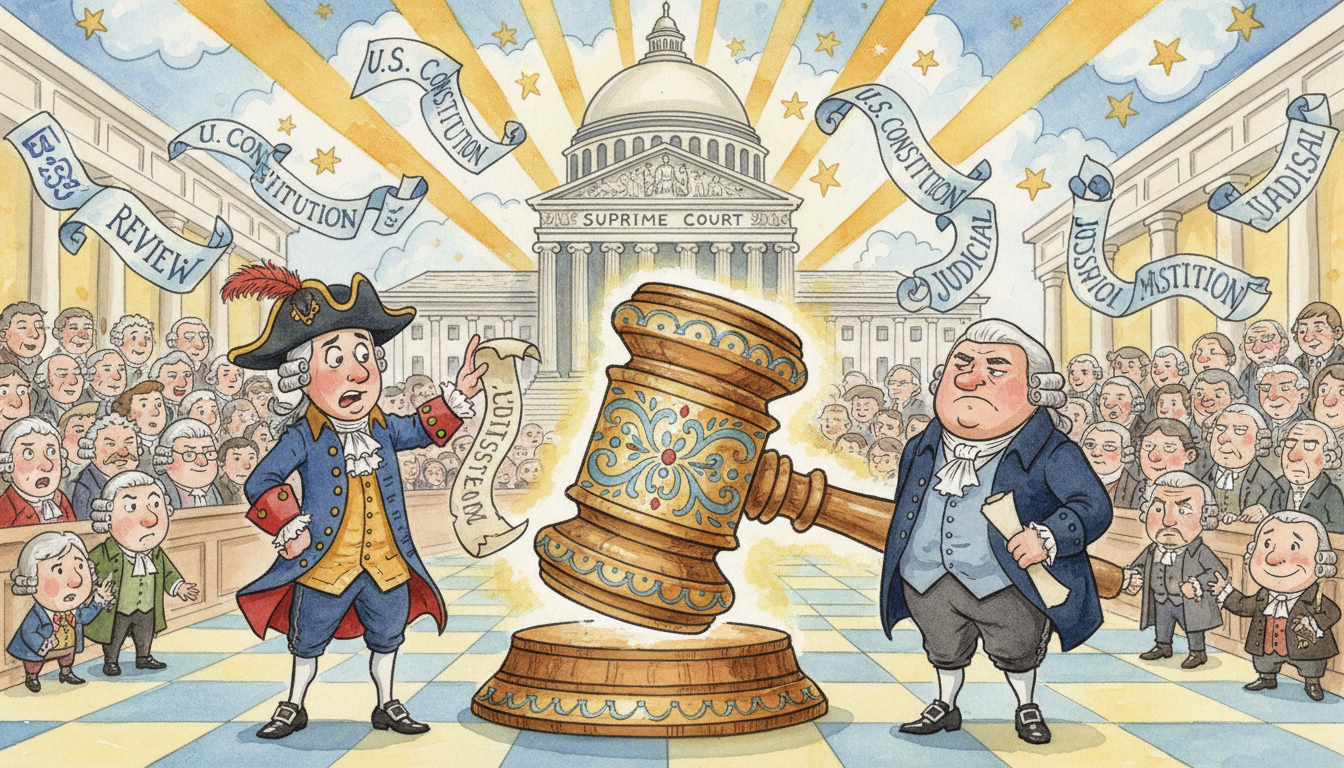
How Does a Cartoon Illustrate Marbury v. Madison?
Quick Answer
A cartoon related to Marbury v. Madison often illustrates key themes of judicial review and the Supreme Court's power to interpret the law. This landmark case established that the Court could declare acts of Congress unconstitutional, emphasizing its role in the government.
To understand how a cartoon relates to *Marbury v. Madison*, let’s first look at the context of this landmark Supreme Court case. In 1801, as President John Adams was leaving office, he appointed William Marbury as a justice of the peace. However, when Thomas Jefferson became president, he instructed his Secretary of State, James Madison, not to deliver Marbury's commission. Frustrated by this, Marbury petitioned the Supreme Court for a writ of mandamus, which is an order that would compel Madison to deliver the commission.
When the case reached the Supreme Court, it was a pivotal moment in American history. Chief Justice John Marshall ruled that while Marbury was entitled to his commission, the part of the Judiciary Act of 1789 that allowed Marbury to bring his claim directly to the Supreme Court was unconstitutional. This was significant because it was the first instance where the Supreme Court declared an act of Congress unconstitutional, thereby establishing the principle of **judicial review**.
Now, regarding the cartoon, it likely depicts themes around the Supreme Court's power and its role as the final arbiter of the law. Cartoons often use satire or exaggerated representations to convey complex ideas, and in this case, the imagery may illustrate the conflict between the executive branch and the judiciary, highlighting how the Supreme Court can check the powers of the other branches of government.
For example, a cartoon might show the Supreme Court as a referee in a sports game, emphasizing that it has the authority to enforce the rules (the Constitution) and ensure fairness. This visual metaphor helps viewers understand that the Court is not just a passive observer but an active participant in maintaining the rule of law.
In essence, the cartoon serves as a tool to explain the impact of *Marbury v. Madison* on the American legal system and how it set the precedent for the judiciary's role in interpreting the Constitution. It represents the ongoing importance of judicial review in safeguarding democracy and the rule of law, illustrating that the Supreme Court is empowered to decide what the law is, regardless of the political climate.
Understanding this connection through visual representation can make the concepts more relatable and easier to digest, especially for students learning about the complexities of the U.S. government and its foundational principles. This case continues to resonate today, as the Supreme Court remains a critical check on legislative and executive power, ensuring that all actions are in line with the Constitution.
Was this answer helpful?