
How to Understand Fractions: A Student's Guide
Quick Answer
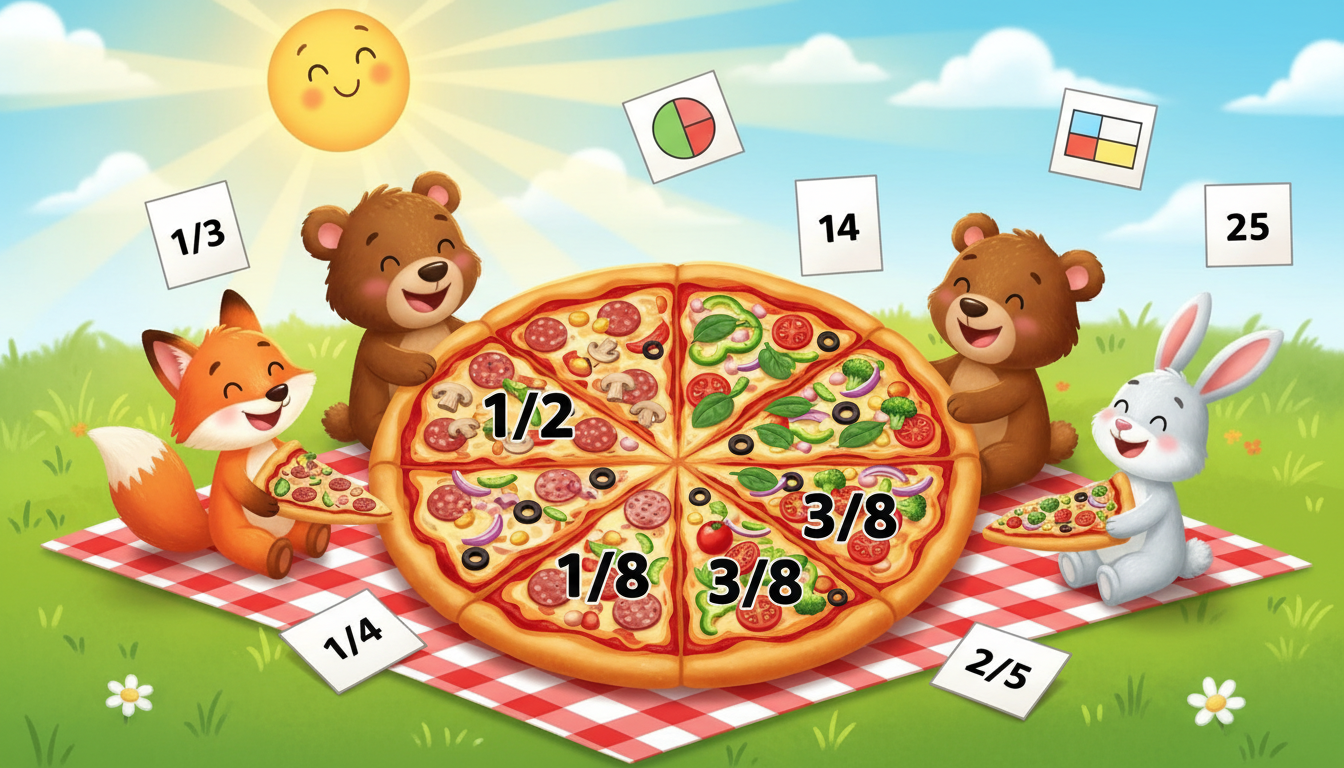
Fractions represent parts of a whole, like slices of pizza. The numerator shows how many parts you have, while the denominator shows the total parts. Understanding these basics helps you add, subtract, multiply, and divide fractions easily.
Understanding fractions can seem challenging at first, but with some simple concepts and practice, you can master them! A fraction consists of two main parts: the numerator and the denominator. The numerator, the top number, indicates how many parts you have, while the denominator, the bottom number, signifies the total number of equal parts in the whole.
To visualize this, imagine a pizza cut into 8 equal slices. If you eat 2 slices, you have consumed 2 out of the 8 slices, which is represented as the fraction 2/8. This can also be simplified to 1/4, meaning you have eaten one quarter of the pizza. This simplification is essential as it helps in performing operations with fractions.
You can add or subtract fractions, but they must have the same denominator (the bottom number). For example, to add 1/4 and 2/4, you just add the numerators: 1 + 2 = 3, keeping the denominator the same. Thus, 1/4 + 2/4 = 3/4. However, if the fractions have different denominators, you’ll need to find a common denominator before performing the operation.
Multiplying fractions is straightforward: simply multiply the numerators together and the denominators together. For instance, multiplying 1/2 by 3/4 involves multiplying 1 by 3 (which equals 3) and 2 by 4 (which equals 8), giving you 3/8.
Dividing fractions requires you to multiply by the reciprocal of the second fraction. If you divide 1/2 by 3/4, you flip 3/4 to become 4/3, then multiply: 1/2 * 4/3 = 4/6, which can be simplified to 2/3.
Fractions are not only a mathematical concept; they also have practical applications in everyday life. For example, when cooking, you might need to measure ingredients in fractions of cups or tablespoons. Or, in shopping, discounts can often be represented as fractions.
If you’re still feeling uncertain about fractions, don’t worry! Practice is key. Start with simple problems and gradually work your way up to more complex ones. Remember, it’s perfectly okay to ask for help when needed, whether from a teacher, a tutor, or even online resources. By practicing regularly, you’ll develop a better understanding and confidence in using fractions. Let’s practice some together to solidify your skills!
Was this answer helpful?