
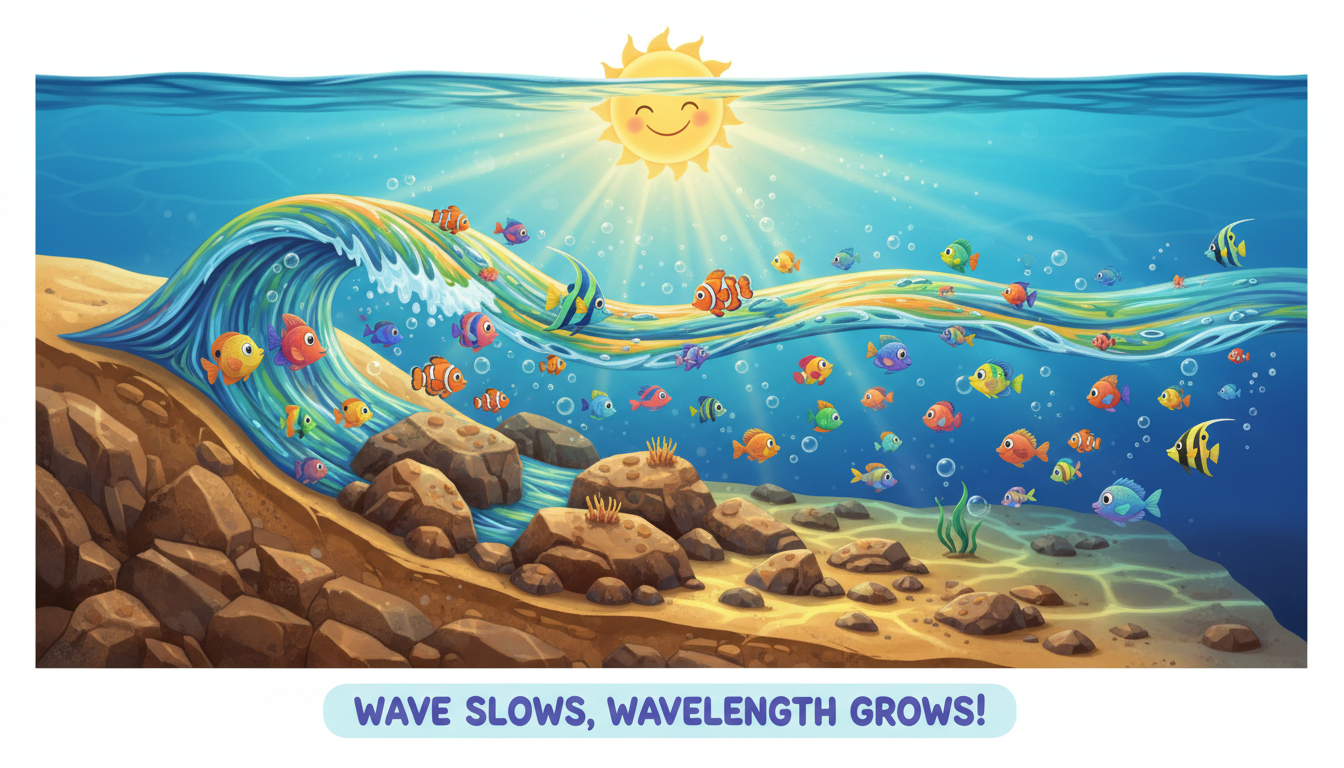
What Happens to Wave Speed and Wavelength When Crossing Mediums?
Quick Answer
When a wave crosses from one medium to another, its frequency remains constant while its speed and wavelength can change. Specifically, if the wavelength decreases, the speed may increase depending on the properties of the new medium.
When studying waves, it's essential to understand the relationship between wave speed, frequency, and wavelength. The fundamental equation governing this relationship is:
$$v = f \lambda$$
Where:
- **v** is the wave speed,
- **f** is the frequency,
- **λ** (lambda) is the wavelength.
### What Happens When a Wave Enters a New Medium?
When a wave moves from one medium (like one type of rope) to another, several changes can occur. The most critical aspect to remember is that the **frequency of the wave remains constant**. This is because frequency is determined by the source of the wave and does not change when the wave's medium changes.
However, both the **speed** and the **wavelength** can change because different materials have different properties. For example, if we take a wave traveling through a light rope and then transition it to a denser rope, we may observe the following:
- The **wavelength decreases** if it becomes one-fourth of its original value, as stated in the question.
- The **speed of the wave may increase or decrease** based on the properties of the new medium.
### Using the Wave Equation to Understand Changes
To see how speed and wavelength are related when entering a new medium, we can set up the equations for both mediums.
1. In the first medium (rope 1):
$$v_1 = f \lambda_1$$
2. In the second medium (rope 2):
$$v_2 = f \lambda_2$$
Since the frequency (f) remains unchanged, we can compare the two scenarios by dividing the equations:
$$\frac{v_2}{v_1} = \frac{f \lambda_2}{f \lambda_1} = \frac{\lambda_2}{\lambda_1}$$
This tells us that the ratio of speeds is equal to the ratio of wavelengths. If the wavelength becomes one-fourth, we can substitute this into our equation:
If $$\lambda_2 = \frac{1}{4} \lambda_1$$, then:
$$\frac{v_2}{v_1} = \frac{\frac{1}{4} \lambda_1}{\lambda_1} = \frac{1}{4}$$
This indicates that the speed of the wave in the second medium, if the wavelength decreases to one-fourth, would **actually decrease** to one-fourth of its original speed in the first medium, not increase. Understanding these relationships is crucial in physics and helps explain various phenomena in real life, such as how sound travels through different materials or how light behaves in different mediums.
### Real-World Applications
This knowledge is not just academic; it has real-world applications. For instance, in telecommunications, understanding how signals travel through various materials can significantly affect the design of cables and antennas. In medicine, ultrasound waves behave similarly when they pass from skin to muscle, and knowing the changes in speed and wavelength helps in interpreting the images produced.
In summary, when a wave crosses into a new medium, remember that while the frequency stays constant, the speed and wavelength adjust according to the properties of the new medium. By grasping these concepts, you can better understand wave behavior in various scientific contexts.
Was this answer helpful?