
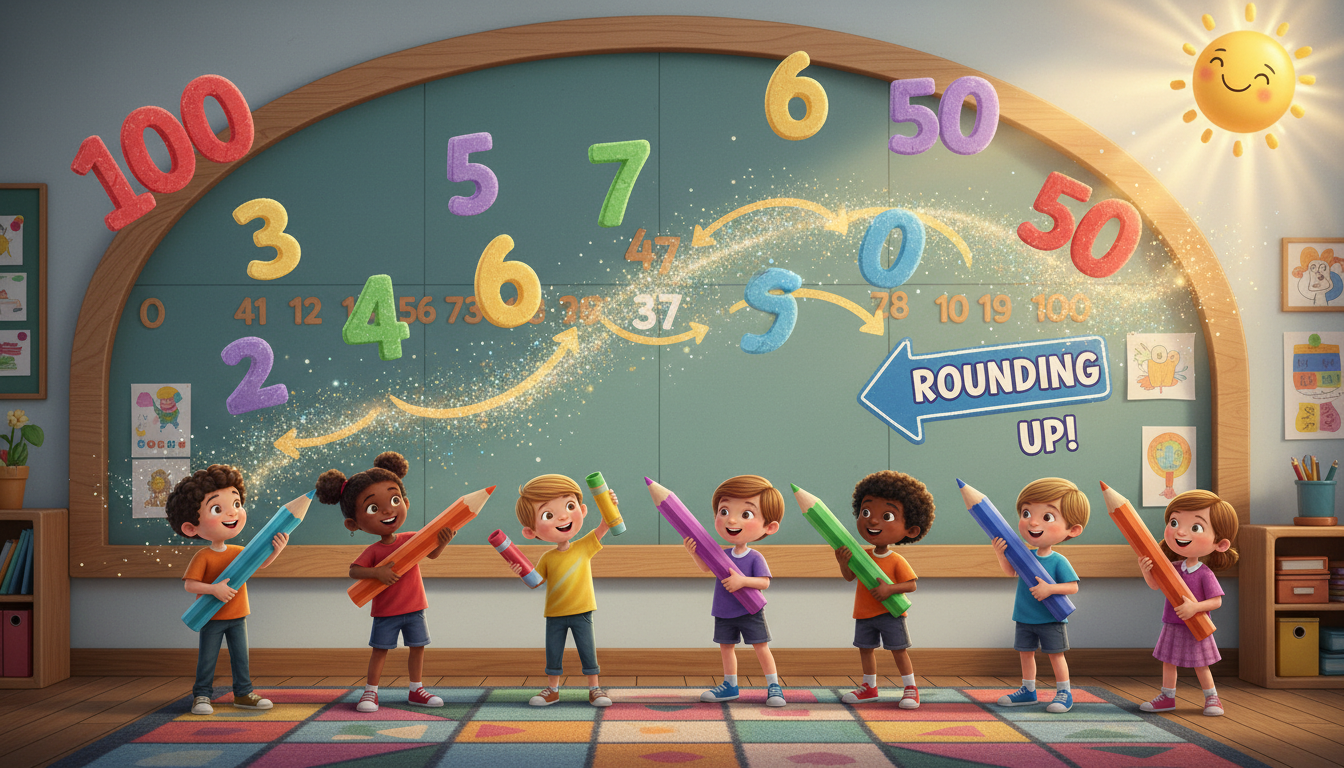
How to Round Numbers Correctly: A Student's Guide
Quick Answer
To round numbers correctly, identify the place value you need to round to and look at the digit immediately to the right. If it's 5 or higher, round up; if it's lower than 5, round down.
Rounding numbers is a fundamental math skill that's useful in everyday life, from budgeting to estimating distances. To round a number effectively, you need to identify the place value you are rounding to and examine the digit that follows it. Here's how to do it step-by-step:
1. **Identify the Place Value**: Determine whether you are rounding to the nearest ten, hundred, thousand, tenth, hundredth, etc. For example, if you're rounding the number 38.35285 to the nearest tenth, you focus on the first digit after the decimal point (which is the tenths place).
2. **Check the Next Digit**: Look at the digit immediately to the right of the target place value. If it’s 5 or greater, you round up the target digit. If it’s less than 5, you keep the target digit as is.
- For instance, when rounding 38.35285 to the nearest tenth, the tenths place is 3, and the next digit (hundredths place) is 5. Since 5 is equal to 5, you round up the 3 to 4, making it 38.4.
3. **Apply the Rules for Different Place Values**: Each place value has its own rounding rules.
- **Nearest Hundredth**: For 38.35285, the hundredths place is 5, and the next digit (thousandths) is 2, which is less than 5, so you round down to 38.35.
- **Nearest Dollar**: Rounding to the nearest dollar means looking at the tenths place. Here, it’s 3, and since the next digit is also lower than 5, you round down to 38.
- **Nearest Cent**: When rounding to the nearest cent, again look at the thousandths place. Here, it’s 2, so you round down to 38.35 instead of rounding up to 38.40.
4. **Practice with Examples**: The more you practice rounding, the better you'll get! Try rounding these numbers: 45.678 to the nearest tenth, 123.456 to the nearest hundredth, and 87.654 to the nearest dollar.
5. **Real-World Applications**: Rounding is not just a classroom skill; it’s used in real life for budgeting, estimating expenses, calculating distances, and even cooking! For instance, when shopping, you might round prices to the nearest dollar to estimate your total cost quickly.
By mastering rounding, you will enhance your mathematical skills, making it easier to handle everyday calculations and improving your overall confidence in math. Remember to practice regularly to become proficient in this essential skill!
Was this answer helpful?