
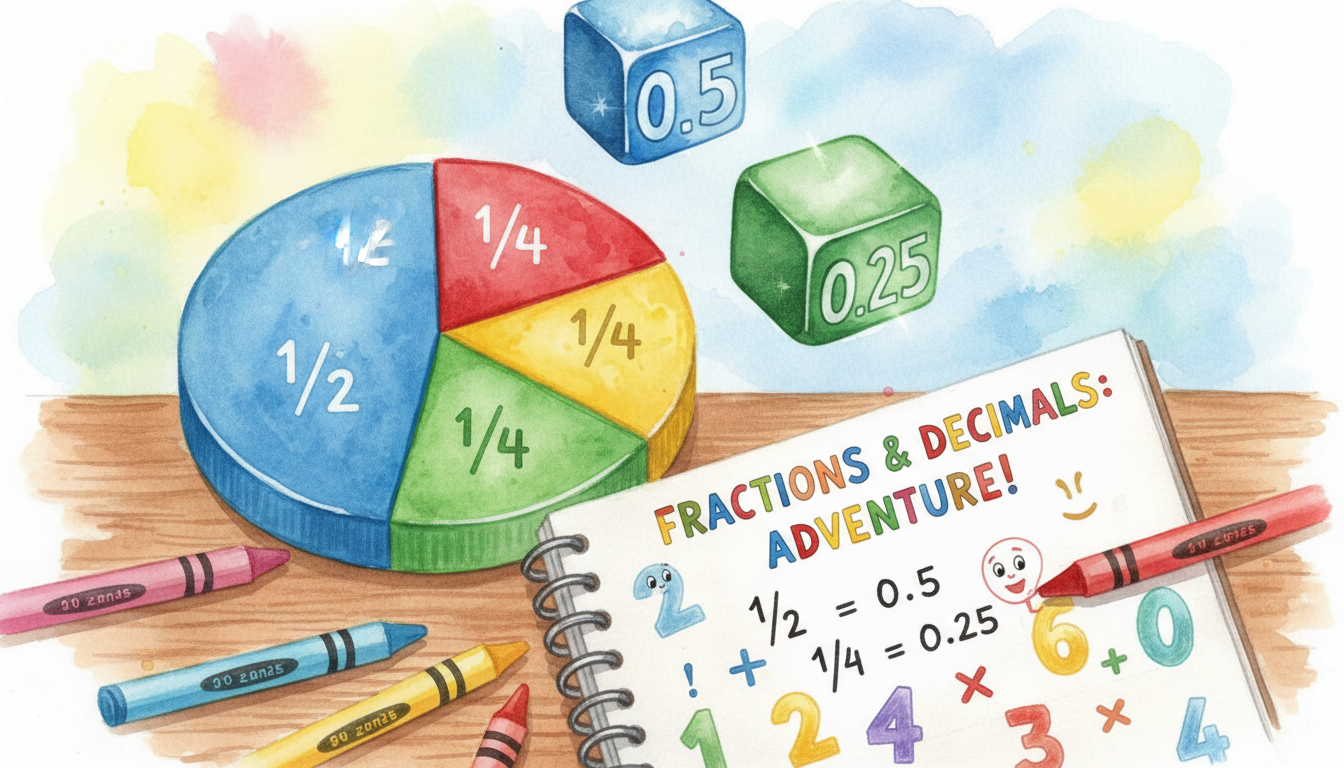
Understanding Decimals and Fractions: A Student's Guide
Quick Answer
To convert decimals to fractions, identify the place value of each digit. For example, 1.31 equals 1 unidad, 3 décimos, and 1 centésimo. You can plot decimals like 1.24 on a number line for better understanding.
Understanding decimals and fractions is essential in mathematics, as they are two different ways to represent numerical values. In this guide, we'll break down how to convert decimals into fractions and how to plot them accurately on a number line.
### Converting Decimals to Fractions
When dealing with decimals, each digit has a specific place value. For instance, in the decimal 1.31:
- The digit '1' is in the units place (or whole number).
- The digit '3' is in the tenths place, representing three tenths or 0.3.
- The digit '1' is in the hundredths place, representing one hundredth or 0.01.
So, we can express 1.31 as a sum of its parts: 1 unidad, 3 décimos, and 1 centésimo, which equals 1.31 in decimal form.
Now, let’s look at another example: 3.02. Here:
- The '3' is in the units place (whole number).
- The '0' in the tenths place represents zero tenths.
- The '2' in the hundredths place represents two hundredths or 0.02.
Thus, 3.02 can be expressed as 3 unidades and 2 centésimos. In fraction form, that is also represented as 3 2/100.
### Plotting Decimals on a Number Line
Plotting decimals on a number line helps visualize their value. For example, to plot 1.24:
1. Draw a number line segment between 1 and 2.
2. Divide this segment into 100 equal parts (each representing one hundredth).
3. Count 24 parts from 1, and place a point there to represent 1.24.
For 1.05:
- Again, split the segment between 1 and 2 into 100 parts.
- Count 5 parts from 1 to mark 1.05.
### Real-World Applications
Understanding decimals and fractions is not just crucial for academic success, but also for everyday life. Whether you're shopping and need to calculate discounts, cooking and measuring ingredients, or managing finances, these skills are vital.
By mastering these concepts, you build a strong foundation for more advanced mathematical topics. So, practice converting and plotting decimals, and soon enough, you’ll find it second nature. Remember that every time you encounter a decimal, you can think of it as a fraction, making it easier to manage in calculations and real-life applications.
Was this answer helpful?