
What Are Fractions? A Simple Guide for Students
Quick Answer
Fractions represent parts of a whole and consist of a numerator (top number) and a denominator (bottom number). They help us understand quantities in everyday situations, like sharing food or measuring ingredients.
Fractions are an essential concept in mathematics that allow us to describe parts of a whole. They are used in various everyday situations, from cooking to sharing items like pizza or cake. When you divide something into equal parts, each part represents a fraction of the whole.
A fraction consists of two main components: the numerator and the denominator. The numerator is the top number, which indicates how many parts you have, while the denominator is the bottom number, representing how many equal parts the whole is divided into. For example, if you have a pizza cut into 8 equal slices and you eat 3 of them, you can express this as the fraction 3/8. Here, 3 is the numerator (the slices you ate), and 8 is the denominator (the total slices in the pizza).
Fractions can be categorized in several ways:
1. **Proper Fractions:** These are fractions where the numerator is less than the denominator, like 3/8.
2. **Improper Fractions:** These occur when the numerator is equal to or greater than the denominator, such as 5/4 (which can also be expressed as a mixed number: 1 1/4).
3. **Mixed Numbers:** These combine a whole number and a proper fraction, for instance, 2 1/2.
Understanding fractions is crucial as it lays the groundwork for more advanced mathematical concepts like decimals and percentages. In real life, you encounter fractions regularly. For example, recipes often require measurements in fractions (like 1/2 cup of sugar), and knowing how to work with these fractions ensures you can cook or bake successfully.
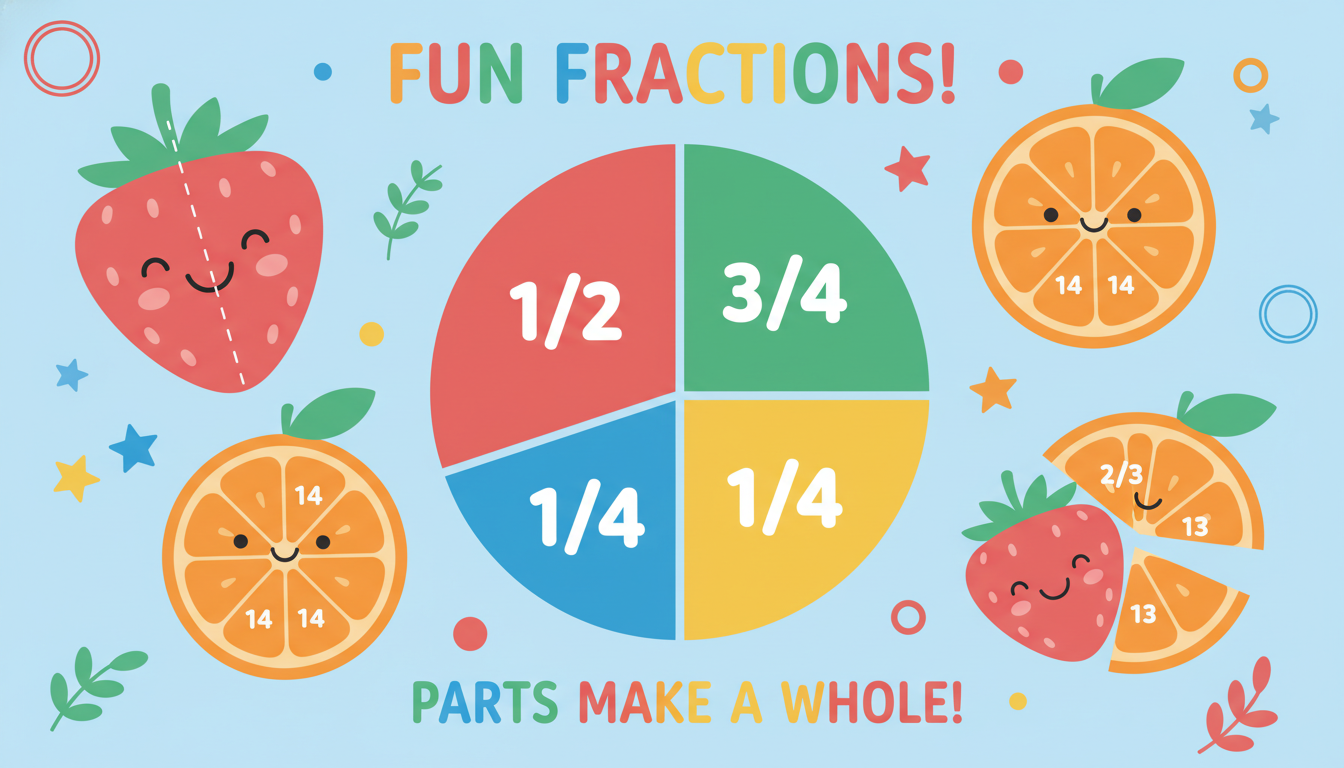
To visualize fractions, think of a pizza again. If you have a whole pizza and cut it into 4 equal parts, each slice represents 1/4 of the pizza. If you eat 2 slices, you have consumed 2/4 of the pizza, which can also be simplified to 1/2. This shows how fractions can be simplified to make calculations easier.
Another example is when you need to divide a chocolate bar among friends. If you have a bar split into 6 pieces and you give away 4 pieces, you can represent what you have left as 2/6, which simplifies to 1/3 of the chocolate bar.
In conclusion, fractions are more than just numbers; they are a way to express parts of a whole in various contexts. Mastering fractions not only enhances your math skills but also equips you with practical knowledge for everyday life. Don't hesitate to practice with real-life examples to become more comfortable with using fractions!
Was this answer helpful?