
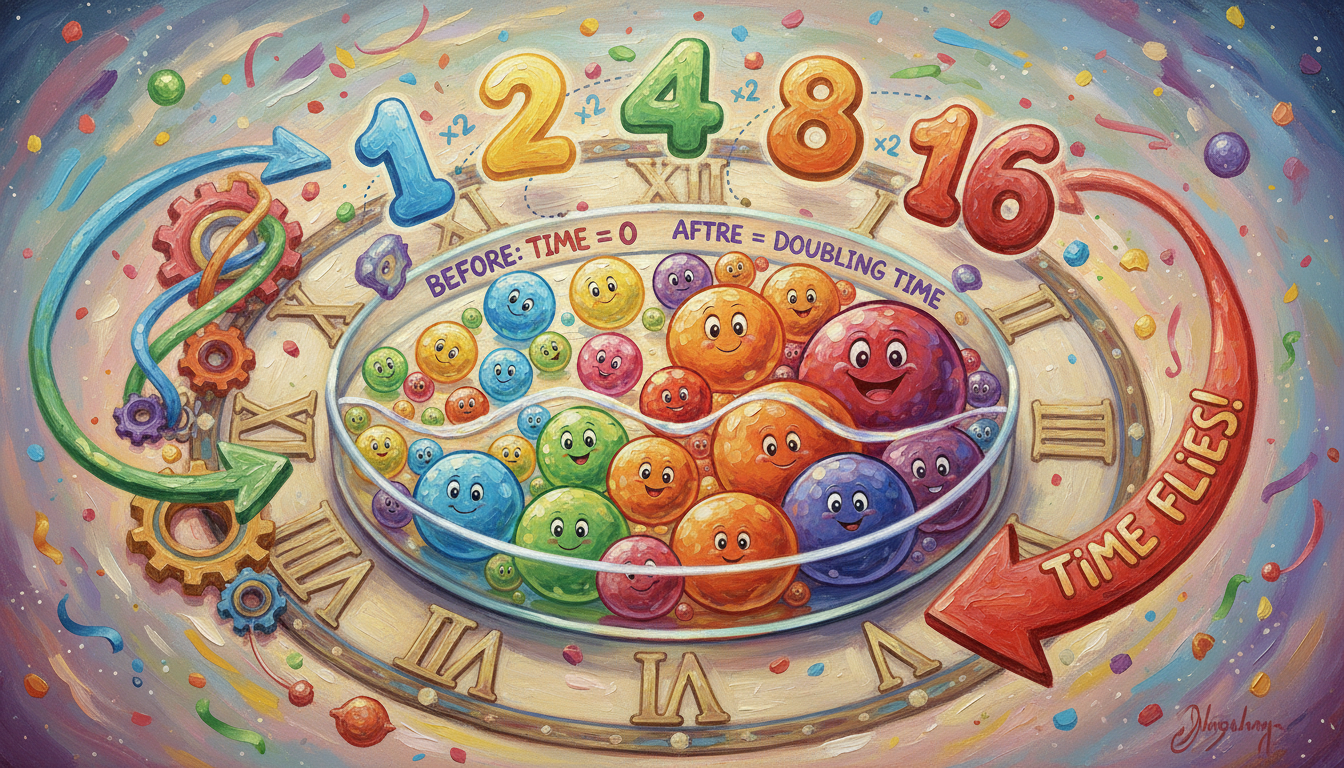
How to Calculate Bacterial Growth: Understanding Doubling Time
Quick Answer
To find the bacterial population after 1,000 hours when it doubles every 500 hours, start with 30 bacteria. After 1,000 hours, the population would be 120 bacteria, calculated as 30 × 2^2.
Calculating bacterial growth can seem tricky, but it becomes easy once you understand the concept of doubling time. In your scenario, you start with a population of 30 bacteria. The question states that this population doubles every 500 hours. Let's break it down step-by-step to understand how we arrive at the final answer of 120 bacteria after 1,000 hours.
First, let’s establish some key points:
1. **Initial Population**: At time zero, you have 30 bacteria.
2. **Doubling Period**: The bacteria double every 500 hours.
3. **Total Time**: You want to know the population after 1,000 hours, which consists of two 500-hour periods.
Now, let’s go through the calculations:
- **After the first 500 hours**: The population doubles from 30 to 60 bacteria (30 × 2 = 60).
- **After another 500 hours (1,000 hours total)**: The population doubles again from 60 to 120 bacteria (60 × 2 = 120).
Your final answer of 120 bacteria is correct!
To explain why we can use the formula for exponential growth, we can express this mathematically. When we say that the population doubles, we can represent this with the equation:
**Population = Initial Population × 2^n**
Where:
- **Initial Population** is the starting number of bacteria (30 in this case).
- **n** is the number of doubling periods.
In your situation, since you are looking for the population after 1,000 hours, and there are two 500-hour periods in 1,000 hours, we set n = 2. Thus, the formula becomes:
**Population = 30 × 2^2**
Calculating this gives:
- 2^2 = 4
- Therefore, 30 × 4 = 120 bacteria.
This method not only applies to bacteria but can also be used in various real-world scenarios, such as population growth in animals or even the spread of viral infections, where the growth pattern follows similar exponential principles.
Understanding these concepts helps in grasping more complex topics in biology and mathematics. If you have any further questions or need clarification on any part of this topic, feel free to ask!
Was this answer helpful?