
What Are Geological Agents That Change Landscapes?
Quick Answer
Geological agents that change landscapes are classified into two categories: internal and external. Internal agents, like earthquakes and volcanoes, originate from within the Earth, while external agents, such as water, shape the surface through processes like erosion and sediment transport.
Geological agents play a crucial role in shaping the landscapes we see around us. These agents can be divided into two main categories: internal and external. Understanding these agents helps us appreciate the dynamic nature of the Earth's surface.
### Internal Geological Agents
Internal geological agents refer to processes that occur beneath the Earth's surface. The two primary examples of internal agents are earthquakes and volcanoes.
1. **Earthquakes**: These are sudden shaking events caused by the movement of tectonic plates. When the stress on the edges of tectonic plates builds up, it is released in the form of seismic waves, causing the ground to shake. Earthquakes can lead to significant changes in the landscape, such as the formation of faults and new landforms.
2. **Volcanoes**: When magma from the Earth's interior escapes to the surface, it results in volcanic eruptions. These eruptions can create new landforms, such as mountains and islands, and can also reshape existing landscapes through the deposition of lava and ash. For instance, the eruption of Mount St. Helens in 1980 dramatically altered the surrounding landscape.
### External Geological Agents
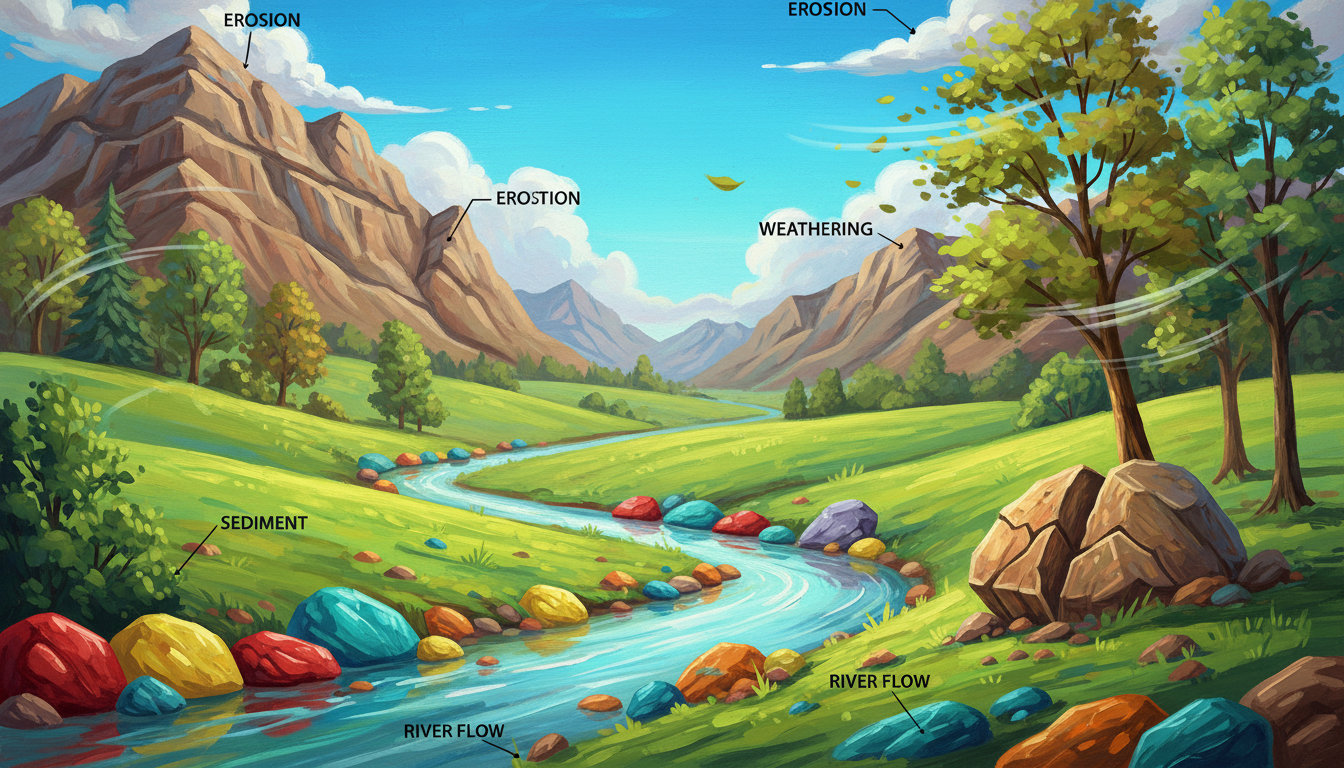
External geological agents are those that act on the Earth's surface. The most significant external agent is water, which can take various forms, including rivers, rain, and glaciers. Here are some examples of how external agents affect landscapes:
1. **Water**: Water is a powerful force in shaping the landscape. It can transport sediments, erode rock formations, and alter river paths. For example, rivers carve valleys and canyons over time through a process known as erosion. The Colorado River, which formed the Grand Canyon, is a prime example of this.
2. **Wind**: In arid regions, wind can also be an important external agent. It can carry fine particles over long distances, leading to the formation of dunes and the erosion of rock surfaces. The Sahara Desert, for example, showcases how wind can shape landscapes over time.
3. **Ice**: Glaciers are massive bodies of ice that move slowly over land, carving out valleys and shaping mountains as they advance and retreat. The impact of glaciers can be seen in places like the Alps and the Rocky Mountains, where distinctive features such as U-shaped valleys and fjords are formed.
### Real-World Applications
Understanding geological agents is essential for various fields, including environmental science, geology, and civil engineering. For instance, knowing the risks of earthquakes can help in designing buildings that withstand seismic activity. Similarly, understanding erosion can assist in land management and conservation efforts.
By studying these geological agents, we can gain insights into the Earth's past, present, and future, helping us to adapt and respond to natural changes in our environment. Whether it's through the study of tectonic movements or the effects of water on our landscapes, geological agents provide a fascinating lens through which we can view the world around us.
Was this answer helpful?