
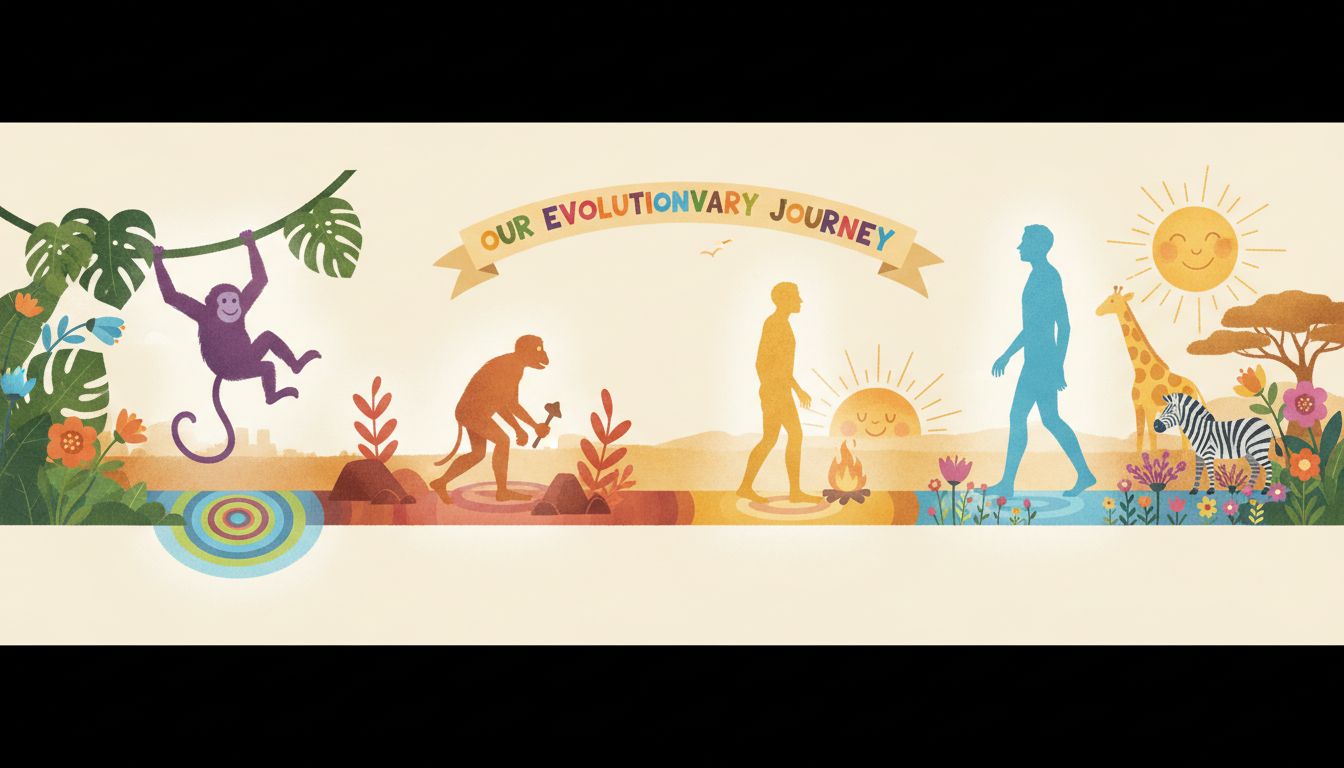
How Did Humans Evolve? Understanding Our Origins
Quick Answer
Humans evolved over millions of years through a process called evolution, sharing common ancestors with other species. While some believe in creationism, scientific evidence, including fossils and DNA, supports evolution as the primary explanation for human origins.
The question of how humans became humans is a fascinating topic that delves into the fields of science, anthropology, and even philosophy. Most scientists support the theory of evolution, which explains how species change over time through natural selection. This process means that over millions of years, certain traits become more common in a population because they offer advantages in survival and reproduction.
Humans, or Homo sapiens, are part of a long evolutionary lineage that traces back to common ancestors we share with other primates, such as chimpanzees and gorillas. However, it's important to clarify that we did not evolve directly from modern monkeys; rather, we share a common ancestor that existed millions of years ago. This evolutionary journey involved several stages, with early human-like species like Australopithecus and Homo habilis paving the way for later developments.
Fossil evidence is crucial in understanding this evolution. For instance, fossils have shown that our ancient ancestors walked upright and used tools, which were significant milestones in human evolution. Over time, as these hominins adapted to their environments, their brains grew larger, allowing for advanced thinking, problem-solving, and social behaviors that are hallmarks of modern humans.
In contrast to the scientific perspective, some people believe that humans were specially created by a divine being. This belief often stems from religious teachings that describe the origin of humanity in a way that emphasizes purpose and intention. Both perspectives—evolution and creationism—are discussed widely in various cultures and educational systems.
To illustrate evolution further, think about how a football team changes over the years. Players may come and go, strategies may evolve, but the team essence remains, much like how humans have adapted while retaining a connection through our shared ancestry. This analogy helps to visualize how evolution works: it’s a continuous process of change while maintaining a link to our past.
In summary, the scientific consensus is that humans evolved over millions of years through natural selection, supported by fossil evidence and genetic research. While creationism offers a different viewpoint, the wealth of evidence supporting evolution makes it a fundamental concept in understanding human origins. Engaging with both ideas can provide a broader perspective on the question of how we came to be.
Was this answer helpful?