
How to Find Protons, Neutrons, and Electrons in Atoms
Quick Answer
To find protons, neutrons, and electrons in an atom, use the atomic number for protons, adjust electrons based on charge, and subtract the atomic number from the mass number for neutrons.
Understanding the structure of atoms is fundamental in science, particularly in chemistry and physics. Atoms consist of three main subatomic particles: protons, neutrons, and electrons. Each of these particles plays a critical role in defining the properties of an element.
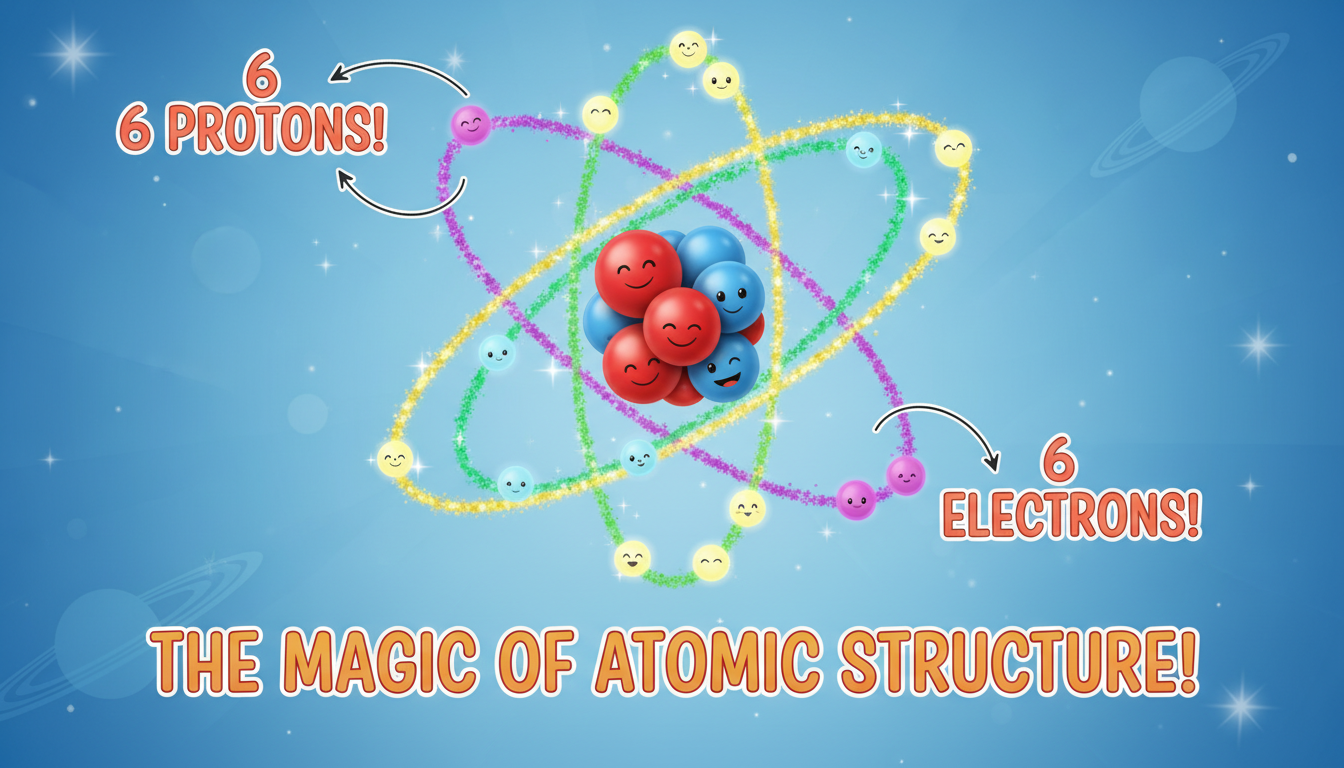
1. **Protons**: The number of protons in an atom is indicated by the atomic number, which is typically found on the bottom left of the element's symbol in isotope notation or in the periodic table. For example, in carbon-12 ($^{12}_6C$), the atomic number is 6, meaning there are 6 protons.
2. **Electrons**: In a neutral atom, the number of electrons is equal to the number of protons. However, if the atom is an ion (charged), you will need to adjust this number. For a positively charged ion (like H$^+$), you subtract electrons equal to the charge. Conversely, for a negatively charged ion (like O$^{2-}$), you add electrons. For example, H$^+$ has 1 proton and 0 electrons, while a neutral hydrogen atom ($^{1}H$) has 1 proton and 1 electron.
3. **Neutrons**: The number of neutrons can be found by subtracting the atomic number from the mass number. The mass number is usually shown on the top left of the isotope notation. For instance, in the carbon-12 example, the mass number is 12. Therefore, the number of neutrons would be calculated as follows: 12 (mass number) - 6 (atomic number) = 6 neutrons.
Let’s explore a few more examples:
- For $^2_1H$ (deuterium), there is 1 proton, 1 electron, and 1 neutron (2 - 1 = 1).
- For $^3_1H$ (tritium), there is 1 proton, 1 electron, and 2 neutrons (3 - 1 = 2).
This method can be applied to any element or ion. Understanding how to find these particles is crucial for grasping concepts like atomic mass, isotopes, and chemical behavior. This knowledge is not only foundational for chemistry but also has practical applications in fields like medicine and engineering, where atomic interactions play a significant role. By mastering these calculations, students will be well-prepared for more advanced topics in science.
Was this answer helpful?