
What Are the Moons of Mars? Facts About Phobos and Deimos
Quick Answer
Mars has two moons, Phobos and Deimos, which are small and irregularly shaped. They are thought to be captured asteroids and orbit very close to Mars.
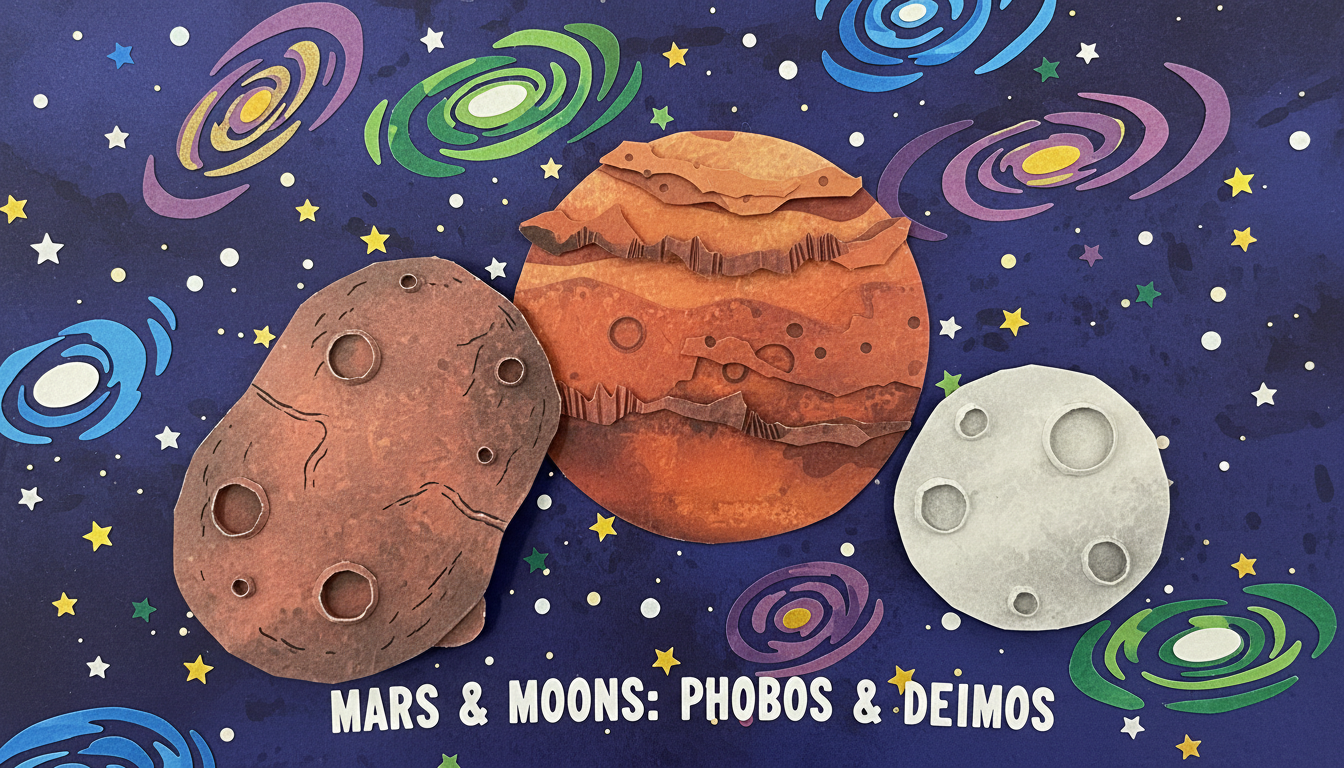
Mars, the fourth planet from the Sun, is unique not only for its reddish appearance but also for its two small moons, Phobos and Deimos. Both moons are significantly smaller than Earth's Moon and have irregular, potato-like shapes. This distinct shape is due to their insufficient mass; they lack the gravitational pull to form into a round shape.
Phobos, the larger and closer of the two moons, measures about 22 kilometers (14 miles) in diameter. It orbits Mars at an astonishingly close distance of just about 6,000 kilometers (3,700 miles) above the Martian surface. This proximity means that Phobos orbits Mars so quickly—completing a full orbit in just about 7 hours and 39 minutes—that it actually rises in the west and sets in the east on Mars more than once a day!
In contrast, Deimos is smaller, with a diameter of about 12 kilometers (7.5 miles), and orbits Mars at a more considerable distance of about 23,460 kilometers (14,570 miles). Its slower orbit takes about 30.3 hours to complete, allowing it to rise and set once every Martian day, similar to how our Moon behaves.
The origins of these moons are quite intriguing. Scientists believe that both Phobos and Deimos may have been asteroids that were captured by Mars's gravitational pull. This theory is supported by their irregular shapes and surface features, which resemble those of asteroids found in the asteroid belt.
Phobos's surface is covered in grooves and craters, the largest of which is Stickney Crater, measuring about 9 kilometers (5.6 miles) in diameter. On the other hand, Deimos has a smoother appearance with fewer craters, likely due to a layer of regolith (loose, fragmented material) that covers its surface, making it look less rugged than its sibling.
Understanding Mars's moons is not just an academic exercise; it has real-world implications for future space exploration. As scientists plan missions to Mars, including potential human landings, studying these moons can provide valuable insights into the Martian environment and the history of the Solar System. Additionally, Phobos is being considered as a possible location for future bases due to its proximity to Mars.
In summary, the moons of Mars, Phobos and Deimos, offer a fascinating glimpse into the dynamics of our Solar System. They remind us of the incredible diversity of celestial bodies and the mysteries that still await discovery in space.
Was this answer helpful?