
What Are the Planets in Our Solar System? A Student's Guide
Quick Answer
The Solar System contains eight main planets, divided into rocky planets and gas giants. Each planet is unique, with Earth being the only one known to support life.
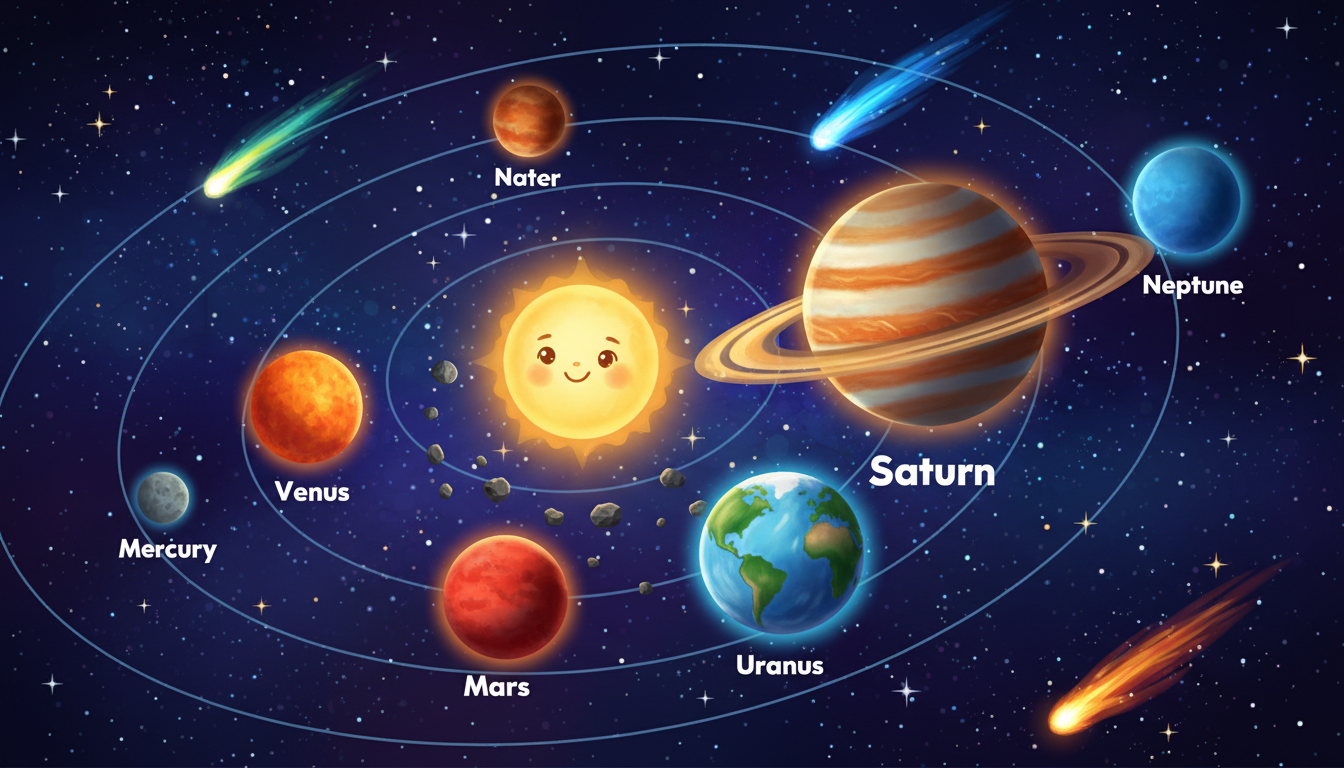
Planets are fascinating celestial bodies that orbit around stars, and in our case, the star is the Sun. In our Solar System, we have eight main planets that can be categorized into two groups: rocky planets, also known as terrestrial planets, and gas giants.
The rocky planets, Mercury, Venus, Earth, and Mars, are located closer to the Sun and have solid surfaces. For instance, Mercury is the smallest planet and has extreme temperature fluctuations, while Venus has a thick atmosphere that traps heat, making it the hottest planet. Earth, our home, is unique because it supports life, and Mars, often called the 'Red Planet,' is famous for its reddish appearance due to iron oxide (rust) on its surface.
On the other hand, the gas giants—Jupiter, Saturn, Uranus, and Neptune—are much larger and are primarily composed of gases. Jupiter is the largest planet in our Solar System and is known for its Great Red Spot, a massive storm that has been raging for centuries. Saturn is easily recognizable due to its stunning rings made of ice and rock particles. Uranus is unique because it rotates on its side, and Neptune, the farthest planet from the Sun, is known for its deep blue color and strong winds.
Each planet has its own set of characteristics and mysteries. For example, did you know that Jupiter has more than 75 moons? Or that Mars has the largest volcano in the Solar System, Olympus Mons? Exploring the planets not only helps us understand our own world better but also opens up questions about the possibility of life beyond Earth.
Studying the planets can inspire future scientists and astronomers to learn more about the universe. Whether it’s through observing the night sky, visiting planetarium shows, or reading books, there are countless ways to dive deeper into this exciting subject! So, let's continue to explore these amazing planets and their unique features together!
Was this answer helpful?