
Understanding Electric Circuits and Ohm's Law: A Student Guide
Quick Answer
Electric circuits are pathways for electric charges to flow, and Ohm's Law relates voltage, current, and resistance. Understanding these concepts is crucial for studying electricity.
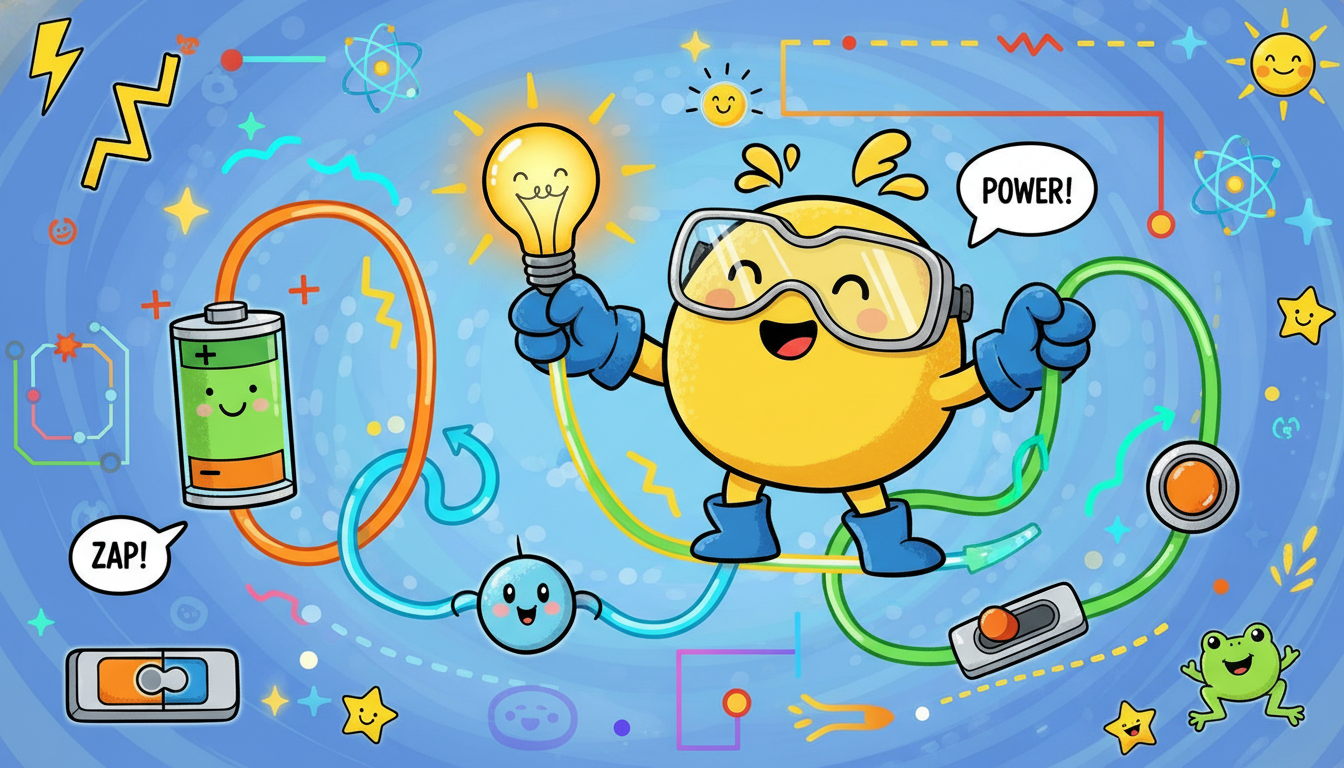
Electric circuits are fundamental to understanding how electricity works. They provide a closed path for electric charges to move, which is essential for powering devices in our daily lives. In essence, an electric circuit comprises a power source, conductors, and a load, like a light bulb or motor. For current to flow, the circuit must be complete, meaning there are no breaks in the path. If the circuit is incomplete, like when a light switch is off, the flow of electricity stops.
Now, let’s delve into the key components of electric circuits:
1. **Voltage (V)**: This is the force that pushes electric charges through the circuit. It can be compared to water pressure in a hose; the higher the pressure, the more water flows. In electrical terms, voltage is measured in volts (V).
2. **Current (I)**: This refers to the amount of electric charge flowing in a circuit per second, similar to how much water flows through a pipe. Current is measured in amperes (A). For instance, if you have a circuit with high current, it means a lot of charges are moving quickly.
3. **Resistance (R)**: Resistance is the opposition to the flow of current. It can be likened to a narrow pipe that restricts water flow. Materials with high resistance, like rubber, do not conduct electricity well, while those with low resistance, like copper, are excellent conductors. Resistance is measured in ohms (Ω).
4. **Ohm's Law**: This fundamental principle connects voltage, current, and resistance. The law states that the current (I) through a conductor between two points is directly proportional to the voltage (V) across the two points and inversely proportional to the resistance (R). Mathematically, this is expressed as V = I x R. Understanding this relationship helps explain how circuits operate and why certain materials are used in electrical applications.
Real-world applications of these concepts are abundant. For example, when designing electrical circuits for home lighting, understanding how to calculate voltage, current, and resistance can help ensure that the system is safe and functional. This knowledge is also vital in troubleshooting electrical issues, such as identifying why a light bulb won’t turn on (possibly due to a broken connection or an overloaded circuit).
In summary, grasping the basics of electric circuits and Ohm's Law is crucial for anyone studying electricity. It not only enhances academic knowledge but also empowers students to apply this understanding in practical, everyday situations. By learning these concepts, students can confidently engage with more complex topics in physics and engineering.
Was this answer helpful?