
Understanding Electromagnetic Waves: Key Concepts Explained
Quick Answer
Electromagnetic waves involve key concepts like wavelength, frequency, and energy, which are interconnected. Understanding these relationships is essential for studying quantum physics.
Electromagnetic waves are a fundamental concept in physics, encompassing various phenomena including light, radio waves, and X-rays. These waves are characterized by three primary properties: wavelength (λ), frequency (ν), and energy (E). Each of these properties plays a crucial role in the behavior and applications of electromagnetic waves.
**Wavelength and Frequency**: The wavelength is the distance between two consecutive wave crests, while the frequency indicates how many wave crests pass a fixed point in one second. The relationship between wavelength and frequency is inversely proportional; as one increases, the other decreases. This relationship can be expressed mathematically with the equation:
\[ c = λν \]
where \( c \) is the speed of light in a vacuum, approximately \( 3.00 × 10^8 \) meters per second. For example, if a wave has a frequency of 5 × 10^14 Hz, you can calculate its wavelength by rearranging the equation to:
\[ λ = \frac{c}{ν} \]
Substituting in the values gives you a wavelength of approximately 600 nm, which falls in the visible spectrum of light.
**Energy of Photons**: Energy is another essential aspect of electromagnetic waves. The energy of a photon can be calculated using Planck's constant (h), approximately \( 6.626 × 10^{-34} \) Joule·seconds, with the equation:
\[ E = hν \]
This means that as frequency increases, the energy of each photon also increases. For example, ultraviolet light has a higher frequency than visible light, translating to higher energy photons, which is why UV light can cause sunburn.
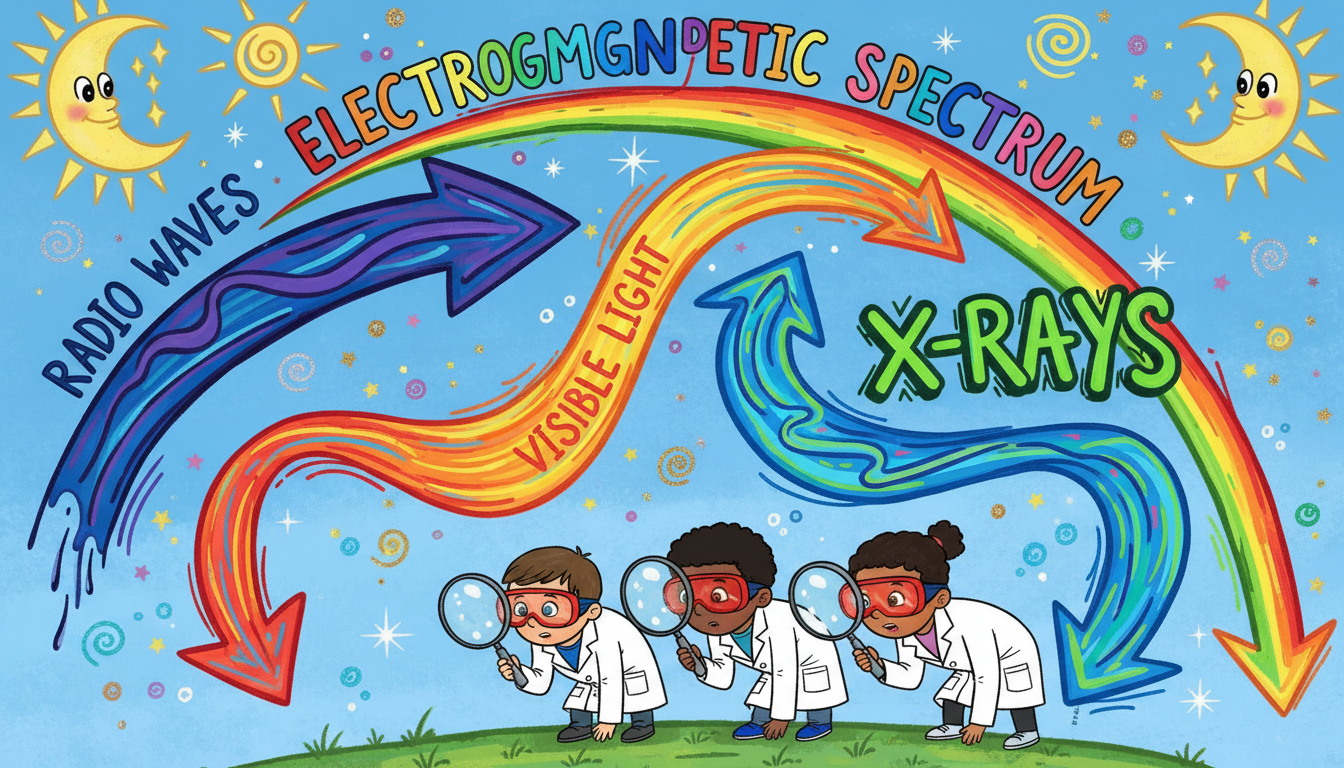
**The Electromagnetic Spectrum**: The electromagnetic spectrum encompasses all types of electromagnetic radiation, arranged from longest wavelength to shortest. Starting with radio waves, which have the longest wavelengths, we move through microwaves, infrared, visible light, ultraviolet, X-rays, and finally gamma rays, which have the shortest wavelengths and highest energy. Each type of wave has unique properties and applications, from communication technologies using radio waves to medical imaging employing X-rays.
**Real-World Applications**: Understanding electromagnetic waves is vital not just in theoretical physics but also in practical applications. For instance, radio waves enable wireless communication, microwaves are used for cooking, and X-rays are crucial in medical diagnostics. Moreover, the principles of electromagnetic waves are foundational for technologies like lasers and fiber optics.
In conclusion, grasping the concepts of wavelength, frequency, and energy is essential for diving deeper into the world of quantum physics and understanding how these waves interact with matter and energy. Whether you're studying for exams or just curious about the science behind everyday technologies, these concepts provide a solid foundation for further exploration.
Was this answer helpful?