
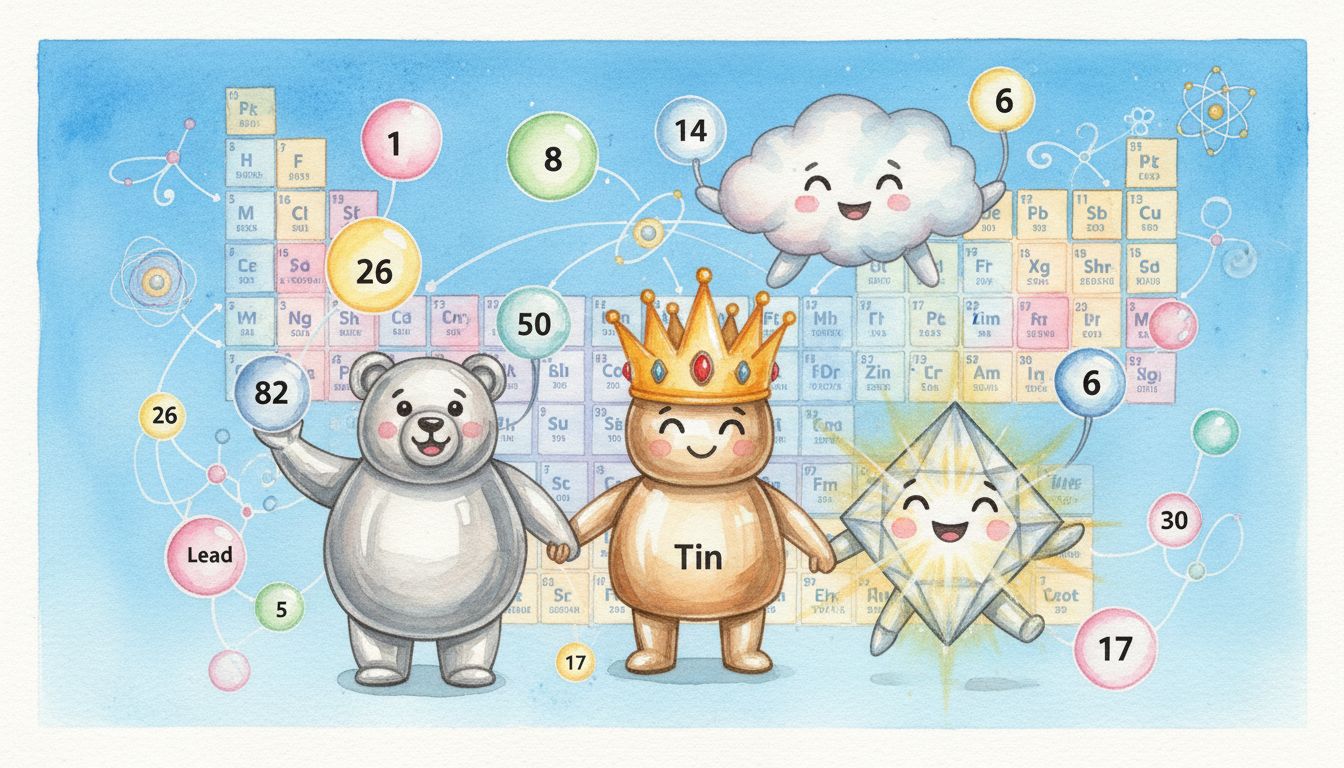
Understanding Group 14 Elements in the Periodic Table
Quick Answer
Group 14 elements in the periodic table have 4 valence electrons, not necessarily the same number of protons as their group number. For instance, carbon, which is also in this group, has 6 protons.
When studying the periodic table, it's important to understand the relationship between an element's group number and its properties. Group 14 elements, which include carbon, silicon, germanium, tin, lead, and flerovium, all share a common characteristic: they have 4 valence electrons. This is crucial for understanding how these elements interact chemically.
The confusion often arises because the group number can resemble the number of protons. However, that is not the case. For example, carbon, which is in Group 14, has an atomic number of 6, meaning it has 6 protons. The group number indicates the number of valence electrons for main group elements, not the total number of protons.
Valence electrons are the electrons in the outermost shell of an atom and play a vital role in chemical bonding and reactivity. The elements in Group 14 can form four bonds with other elements due to their four valence electrons. This unique ability contributes to the diverse range of compounds these elements can form.
For instance, carbon is known for its ability to form long chains and complex molecules, which are the foundation of organic chemistry. Silicon is widely used in electronics and computer technology due to its semiconductor properties. Understanding the behavior of these elements is essential for fields such as chemistry, physics, and engineering.
To visualize this better, consulting the periodic table can be quite helpful. Look at Group 14 and note how each of these elements has 4 electrons in their outer shell, regardless of their atomic number. This understanding is foundational when learning about chemical properties and reactions.
In summary, while the group number indicates the number of valence electrons, it does not provide the number of protons an element has. Always refer to the atomic number for information on protons. This clarity will enhance your understanding of the periodic table and help you navigate through chemistry more effectively.
Check out the equations section for a quick reference formula that can assist you in remembering how to determine the number of valence electrons based on group numbers! Remember, mastering these concepts is key to excelling in science.
Was this answer helpful?