
Understanding States of Matter and Chemical Reactions: A Student's Guide
Quick Answer
The physical state of matter refers to whether a substance is a solid, liquid, or gas, while a base of a solution indicates the main component in a mixture. Chemical reactions involve breaking and forming bonds, and balancing them ensures equal atom representation on both sides.
Understanding the differences between the physical states of matter, solutions, and chemical reactions is crucial for science students. Let’s unpack these concepts step-by-step.
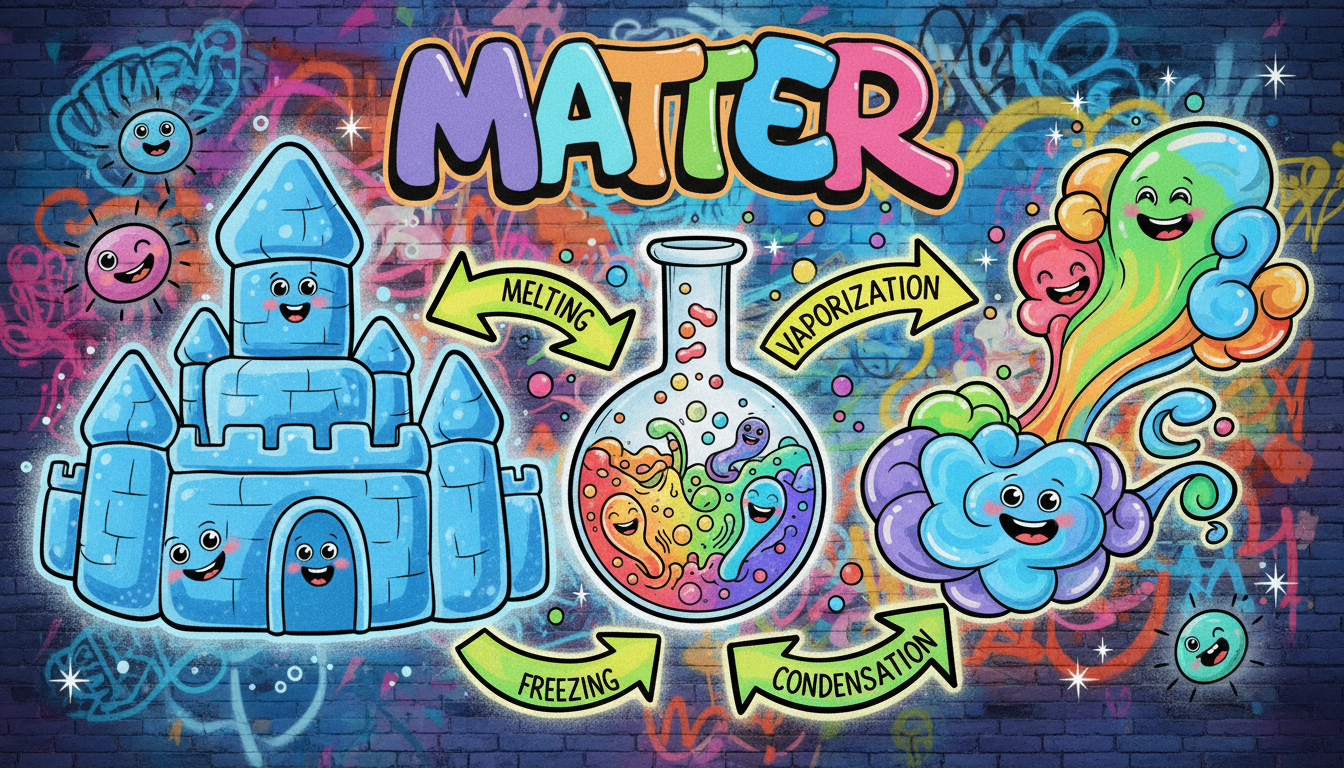
**Physical States of Matter**: Matter exists in four primary states: solid, liquid, gas, and plasma. Each state is characterized by the arrangement and energy of its particles.
- **Solids** have tightly packed particles that vibrate in place, giving them a definite shape and volume (e.g., ice).
- **Liquids** have particles that are close together but can move past each other, allowing liquids to flow and take the shape of their container (e.g., water).
- **Gases** consist of particles that are far apart and move freely, resulting in no fixed shape or volume (e.g., steam).
- **Plasma** is a high-energy state where electrons are stripped from atoms, commonly found in stars, including our sun.
**Bases of Solutions**: When discussing solutions, we refer to the components that make up a mixture. The solvent is the substance that is present in the greatest amount, while the solute is the substance that is dissolved. For example, in a saltwater solution, water is the solvent, and salt is the solute. The phase of a solution primarily pertains to the state of the solvent; in this case, it is liquid.
**Chemical Reactions**: A chemical reaction involves the rearrangement of atoms to form new substances. This process can be as simple as the rusting of iron or as complex as photosynthesis in plants. During a chemical reaction, existing bonds are broken, and new bonds are formed, resulting in the creation of different molecules.
**Balancing Chemical Equations**: When balancing a chemical equation, the goal is to ensure that the number of each type of atom is the same on both sides of the equation. This reflects the Law of Conservation of Mass, which states that matter cannot be created or destroyed in a chemical reaction. For example, in the reaction of hydrogen and oxygen to form water, the balanced equation is 2H₂ + O₂ → 2H₂O, indicating that two molecules of hydrogen react with one molecule of oxygen to produce two molecules of water.
**Real-World Applications**: Understanding these concepts is not just academic; they have practical applications in everyday life. For instance, knowing how different states of matter behave can help in cooking (like boiling water), while understanding chemical reactions is essential in fields ranging from medicine to environmental science.
To further your understanding, consider experimenting with simple chemical reactions at home or observing states of matter in your kitchen. For instance, freezing water to make ice or boiling water to produce steam illustrates these states in action.
In summary, grasping the differences between physical states of matter, solutions, and the mechanics of chemical reactions is fundamental to your science education and can enhance your overall understanding of the natural world.
Was this answer helpful?