
What You Need to Know About Jupiter: The Giant Planet
Quick Answer
Jupiter is the largest planet in our solar system, known as a gas giant primarily made of hydrogen and helium. It features a massive storm called the Great Red Spot and has at least 95 moons.
Jupiter, the fifth planet from the Sun, is a fascinating celestial body that stands out as the largest planet in our solar system. Classified as a gas giant, Jupiter is primarily composed of hydrogen and helium, resembling the makeup of a star rather than a rocky planet like Earth.
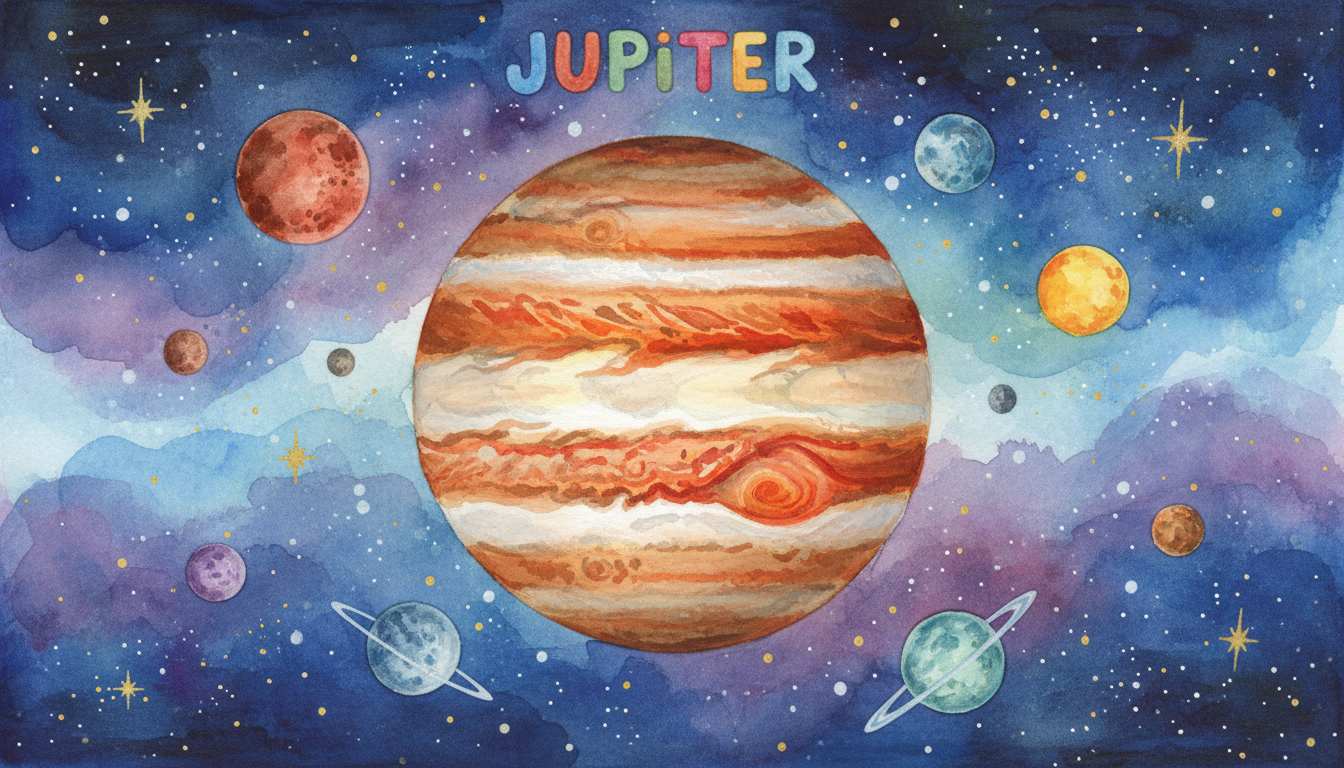
One of Jupiter's most famous features is the Great Red Spot, a gigantic storm that has been raging for over 350 years. This storm is so enormous that it could fit two or even three Earths inside it! The Great Red Spot is a testament to the dynamic and violent weather systems that can exist on gas giants.
Jupiter’s atmosphere is characterized by bands of clouds, which can be seen in images taken by spacecraft. These bands are created by the planet’s rapid rotation, which lasts about 10 hours, making a day on Jupiter much shorter than a day on Earth. However, Jupiter takes nearly 12 Earth years to complete one orbit around the Sun, resulting in a much longer year for this massive planet.
Another intriguing aspect of Jupiter is its extensive moon system. Jupiter has at least 95 known moons, with the four largest being Io, Europa, Ganymede, and Callisto, collectively known as the Galilean moons. Each of these moons has its unique features:
- **Io** is the most volcanically active body in the solar system.
- **Europa** is believed to have a subsurface ocean beneath its icy crust, making it a candidate for potential extraterrestrial life.
- **Ganymede** is the largest moon in the solar system, even larger than the planet Mercury.
- **Callisto** has a heavily cratered surface, indicating a long history of impacts.
Understanding Jupiter is essential not only for our knowledge of the solar system but also for insights into the formation and evolution of planetary systems. The study of gas giants like Jupiter helps scientists learn about the atmospheres of exoplanets and the conditions that may support life elsewhere in the universe.
In summary, Jupiter is not just a massive planet; it is a dynamic, ever-changing world with a rich set of features and mysteries. Whether you're fascinated by its storms, moons, or its role in the solar system, Jupiter remains a topic of great interest for astronomers and space enthusiasts alike.
Was this answer helpful?