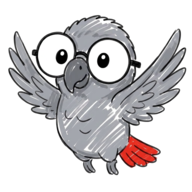
Seeing a Galaxy
Polly watches an astronomer look at a galaxy 47 million light years away and thinks about time.

Read at your pace. The full app adds translation and saved vocabulary.
Keep it on your phone →On the sixth night, Camila was looking at a distant galaxy. Its name was NGC 1068. It is one of the brightest galaxies near us.

At the centre of this galaxy is a huge black hole. The black hole is feeding on gas. The gas spirals in. It gets very hot. It glows. The black hole has the mass of ten million suns. It is 47 million light years away.

"Look," Camila said. She showed Polly a picture. There was a bright spot with two faint lobes. "The bright spot is the galaxy's centre. The lobes are jets of hot gas thrown out by the black hole."

Polly tilted her glasses.

"We are looking at this galaxy from 47 million years ago," Camila said. "The light we see now left the galaxy then. There were no humans then. Antarctica still had forests."

The telescope hummed.

"Sometimes I think," Camila said quietly, "that astronomy is mostly about feeling small and late, and then finding it comforting."

Polly tilted her head. "I do not mind being small," she said. "I mind, sometimes, being late."

Camila smiled. "You are not late. The light has been travelling for 47 million years to get here. In a way, the galaxy is happening tonight."

The Magellanic Clouds were visible. They are small galaxies near our own. The light from them is older than our species.
You just heard Polly
Want to hear what YOU sound like?
Read a line of the story out loud. Your recording stays on your device and is never uploaded.
Not bad, right? If you were in the PollyStop app, Polly would listen to exactly that and score you right now.
Coaching, saved words, spaced repetition, and a fresh story every day.
Get PollyStop freeYou just tried the loop
Now take the story with you.
PollyStop brings listening, saved vocabulary, speaking practice, and a fresh graded story together on your phone.
Learning on Android? Join the waitlistRead this story in another language.
Same story, different language. Compare the shape and rhythm without losing the plot.
Keep reading
More English stories.
The Sea Grows Quiet
Read free
The Sea Grows Quiet
Read free
The Sea Grows Quiet
Read free
The Giant
Read free
The Giant
Read free
The Giant
Read freeKeep learning in PollyStop
Listen, save words, practise