When Earth and Sky Unite
Polly helps expose a mining company's environmental fraud at Bolivia's salt flats, leading to a spontaneous community uprising that saves the ceremonial grounds through collective action and unexpected rainfall.
Read at your pace. The full app adds translation and saved vocabulary.
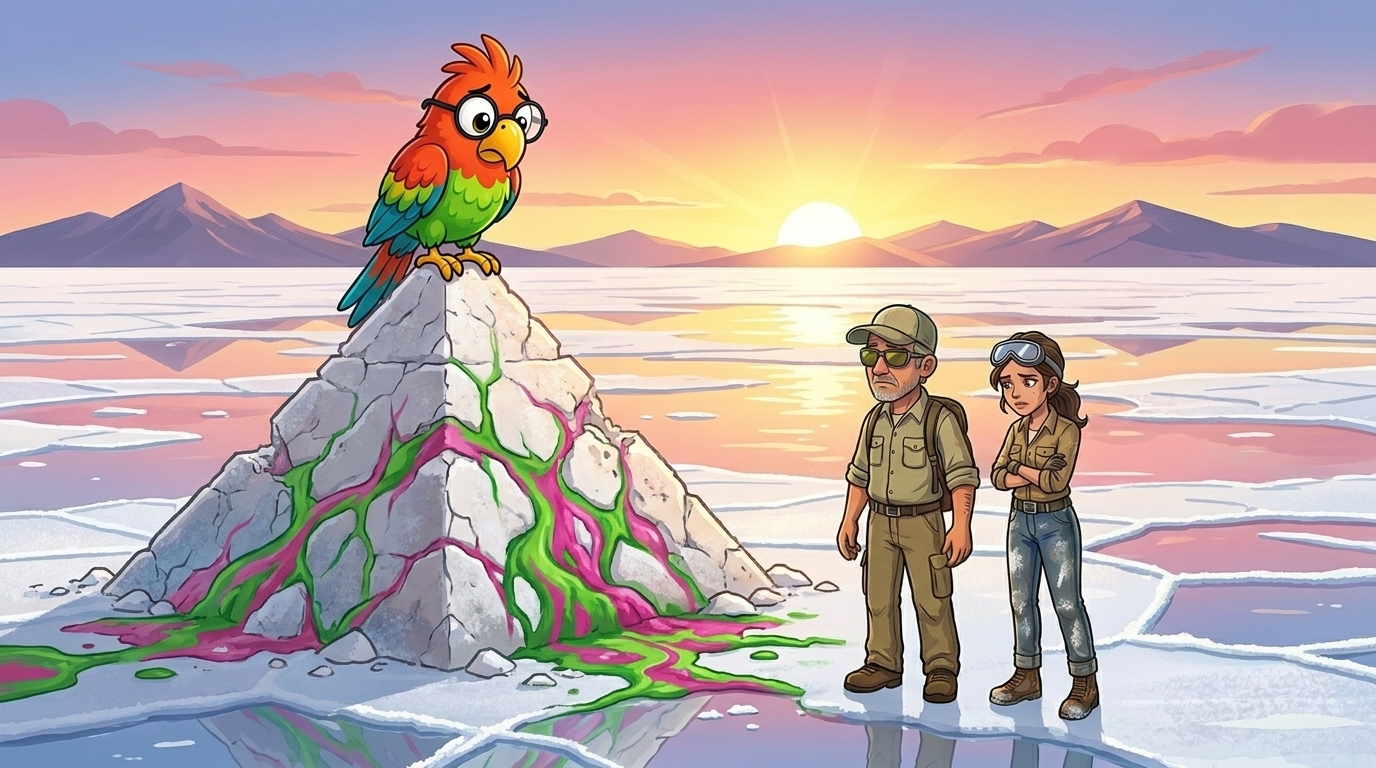
Keep it on your phone →The sun was still behind the mountains when Polly sat on the salt pyramids. The white salt now had ugly green and pink lines running through it. The contamination spread everywhere like a sickness, but the silence worried her most. Usually the morning was full of workers singing, but now only wind crossed the empty flats.
"We've lost," Joaquín said quietly as he walked up with Elena. They had been questioned for hours, but officials just shrugged and promised investigations that would go nowhere.
"Have we?" Polly asked, pointing one wing toward the distance. "Look."
Hundreds of people were walking across the salt flats from every direction. There were salt workers from other communities, activists from La Paz, and Aymara elders in traditional clothes. Even tourists had left their tours to come help.
"The livestream went viral," Elena said, checking her phone. "People are calling it the 'Salt March.' They're coming to help us."
What happened next would be remembered forever. The crowd formed human chains and passed buckets in an ancient rhythm. They separated the contaminated salt from the pure salt. Maybe it was hopeless because the damage was deep, but the act itself had power.
"You see," an elderly Aymara woman told Polly as she worked, "conquistadors thought they could steal our silver. Corporations think they can steal our lithium. But they never understood that the real treasure isn't under the salt—it's the community that harvests it."
Clouds began gathering, which was unusual for the dry season. The first raindrops fell, and Polly understood. The rain would flood the flats and dilute the contamination so nature could begin healing.
"The company will return," Elena warned.
"Let them come," Joaquín replied. "We remember who we are now."
As the rain continued, the salt flats became that famous mirror. In its reflection, Polly saw the future—one where the community's love for their land was stronger than corporate greed.
You just heard Polly
Want to hear what YOU sound like?
Read a line of the story out loud. Your recording stays on your device and is never uploaded.
Not bad, right? If you were in the PollyStop app, Polly would listen to exactly that and score you right now.
Coaching, saved words, spaced repetition, and a fresh story every day.
Get PollyStop freeYou just tried the loop
Now take the story with you.
PollyStop brings listening, saved vocabulary, speaking practice, and a fresh graded story together on your phone.
Learning on Android? Join the waitlistRead this story in another language.
Same story, different language. Compare the shape and rhythm without losing the plot.
Keep reading
More English stories.
The Sea Grows Quiet
Read free
The Sea Grows Quiet
Read free
The Sea Grows Quiet
Read free
The Giant
Read free
The Giant
Read free
The Giant
Read freeKeep learning in PollyStop
Listen, save words, practise