
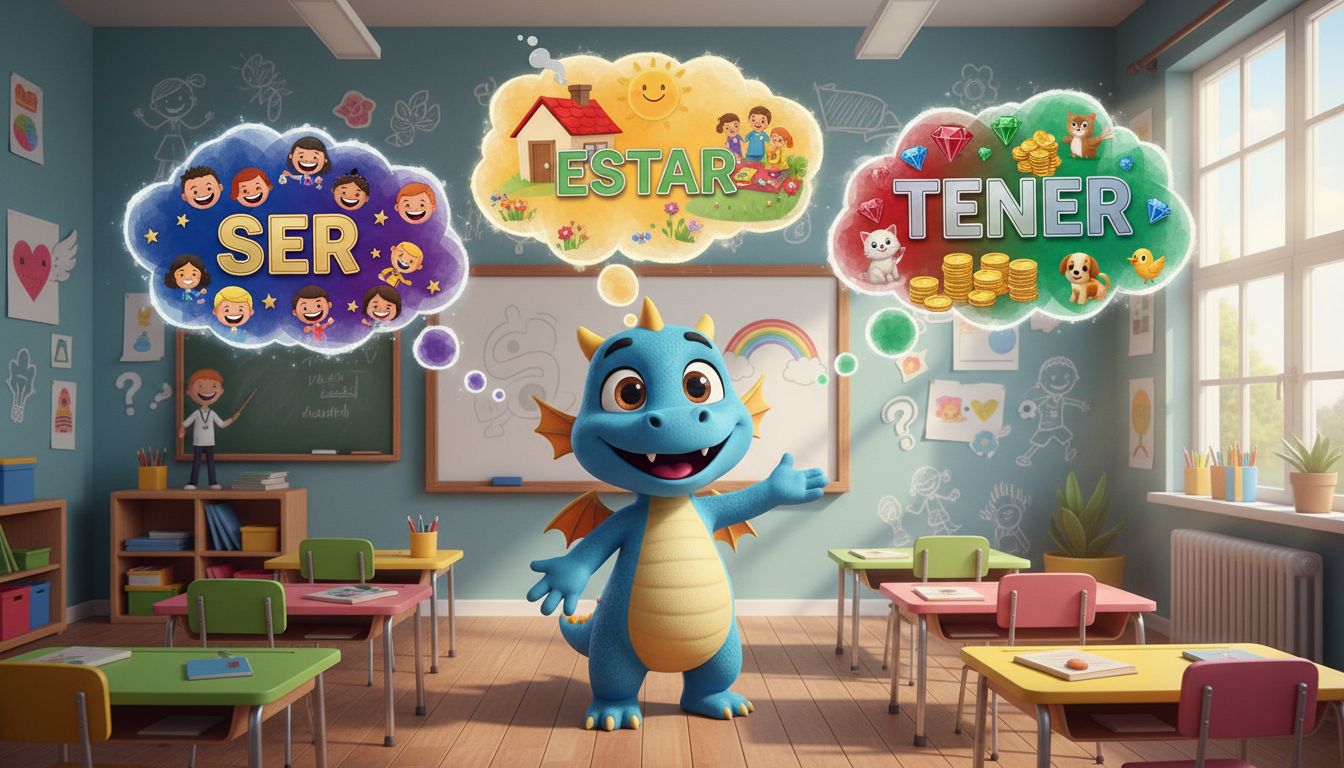
How to Use SER, ESTAR, and TENER in Spanish: A Student's Guide
Quick Answer
In Spanish, SER, ESTAR, and TENER are essential verbs that denote being and having. Use SER for identity and characteristics, ESTAR for location and temporary states, and TENER for possession and feelings.
Understanding when to use the verbs SER, ESTAR, and TENER is crucial for mastering Spanish. These verbs translate to 'to be' and 'to have' in English, but they serve different purposes in sentences, which can be confusing for learners. Let’s break down each verb and provide examples to clarify their usage.
### SER (To Be)
SER is used to describe inherent characteristics, identity, and facts. For instance, you would say, 'Ella **es** doctora' (She **is** a doctor), indicating a profession. Here are some other scenarios where SER is appropriate:
- **Descriptions**: 'El cielo **es** azul' (The sky **is** blue).
- **Origin**: 'Yo **soy** de México' (I **am** from Mexico).
- **Time**: 'Son las tres' (It **is** three o'clock).
### ESTAR (To Be)
On the other hand, ESTAR is used for temporary states, conditions, and locations. For example, you would say, 'El libro **está** en la mesa' (The book **is** on the table), which refers to the book's location. Here are more examples:
- **Emotions**: 'Estoy feliz' (I am happy).
- **Location**: 'Nosotros **estamos** en el cine' (We **are** at the cinema).
- **Present Progressive**: 'Estoy estudiando' (I am studying).
### TENER (To Have)
TENER translates to 'to have' and is used for physical possessions, age, and certain expressions. For instance, 'Tengo un perro' (I have a dog) shows possession. Here are some common uses of TENER:
- **Possession**: 'Ella **tiene** una bicicleta' (She has a bike).
- **Age**: 'Yo **tengo** veinte años' (I am twenty years old).
- **Physical States**: 'Tengo hambre' (I am hungry).
### Examples in Context
1. **SER**: 'Soy estudiante' (I am a student) indicates identity.
2. **ESTAR**: 'El coche **está** sucio' (The car **is** dirty) describes a temporary condition.
3. **TENER**: 'Tienes suerte' (You have luck) indicates possession of luck.
### Tips for Remembering
- Remember that SER is for permanent states and identities, while ESTAR is for temporary conditions and locations. TENER is about having or possessing something.
- Practice using these verbs in sentences to become more familiar with their applications.
If you practice regularly and pay attention to these distinctions, you will improve your Spanish skills significantly. Keep working on your exercises, and don't hesitate to ask for help when needed!
Was this answer helpful?