
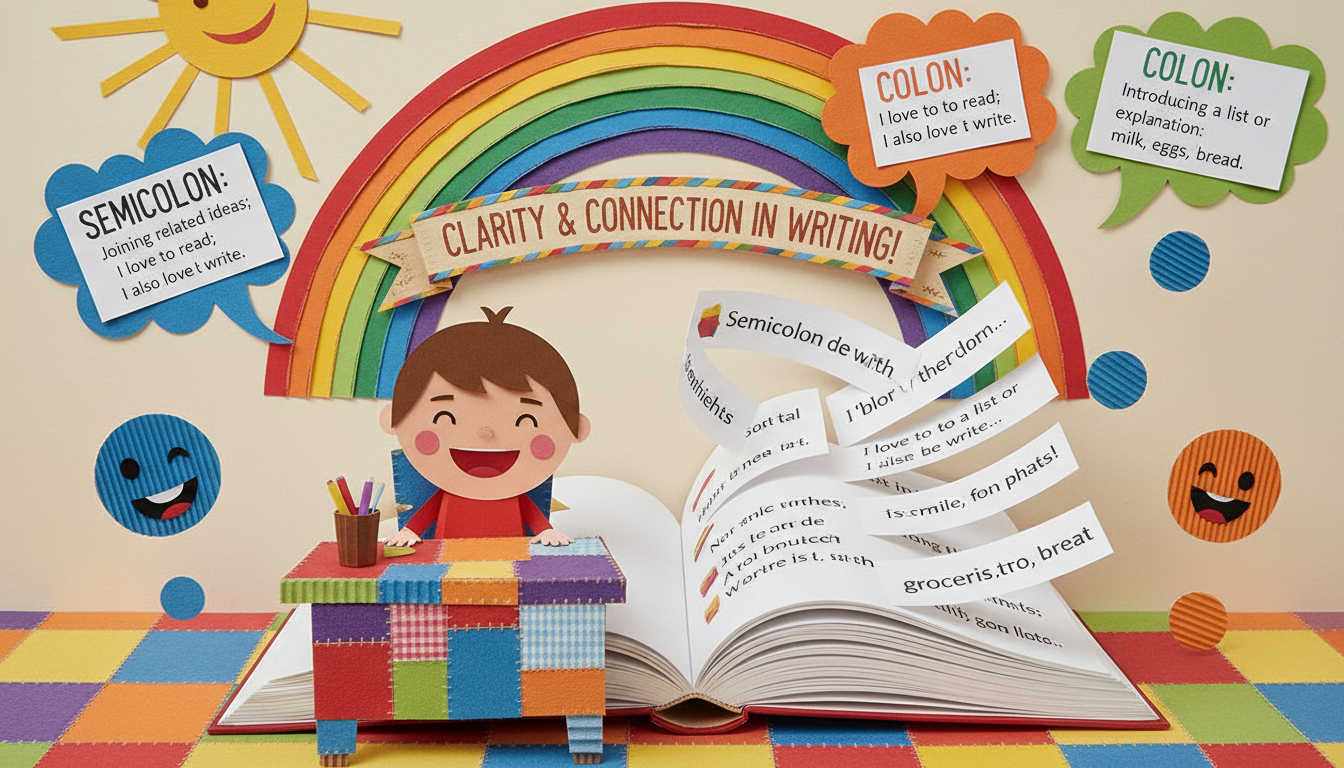
How to Use Semicolons and Colons in Writing: A Student's Guide
Quick Answer
Semicolons link closely related independent clauses, while colons introduce or clarify information. Mastering these punctuation marks can greatly improve your writing clarity and flow.
Understanding how to use semicolons and colons effectively can elevate your writing by providing clarity and enhancing the flow of your ideas. Let’s break down each punctuation mark to help you master its use.
**Semicolons (;)**
Semicolons are used to connect closely related independent clauses—think of them as a bridge between two complete thoughts. For example, in the sentence 'The cat spotted the penguins; they were waddling around, just as he had imagined,' the semicolon links the two ideas about the cat and the penguins, showing their relationship clearly. Remember that both sides of a semicolon should be able to stand alone as complete sentences.
**Common Uses of Semicolons:**
1. **Connecting Related Ideas:** Use a semicolon to join two related independent clauses. For example: 'I love reading; it transports me to another world.'
2. **Separating Items in a Complex List:** When items in a list contain commas, use semicolons to separate them for clarity. For example: 'On our trip, we visited Paris, France; Rome, Italy; and Berlin, Germany.'
**Colons (:)**
Colons serve to introduce or further clarify a concept or list. They indicate that what follows is directly related to the preceding clause. In your example 'There was one thing the cat couldn’t wait to see the penguins do: dive into the water!', the colon effectively introduces what that 'one thing' is. This usage clarifies the sentence and adds emphasis to the action that follows.
**Common Uses of Colons:**
1. **Introducing Lists:** Use a colon to introduce a list of items. For example: 'You need the following ingredients: flour, sugar, eggs, and butter.'
2. **Clarifying Statements:** Colons can also clarify a statement, as in: 'She had one goal: to win the championship.'
**Practice Makes Perfect**
To get comfortable with semicolons and colons, practice writing sentences and then revise them. Try combining short sentences with semicolons to create more complex ideas, and use colons to elaborate on points or introduce lists. Always remember to check if the clauses can stand alone for semicolons, and ensure that what follows a colon directly relates to what precedes it.
**Real-World Application**
Mastering semicolons and colons is essential not only in academic writing but also in professional communication. Whether you’re drafting emails, reports, or creative pieces, these punctuation marks can help convey your thoughts clearly and effectively. The more you practice, the more intuitive their use will become, enhancing your overall writing skills.
Was this answer helpful?