
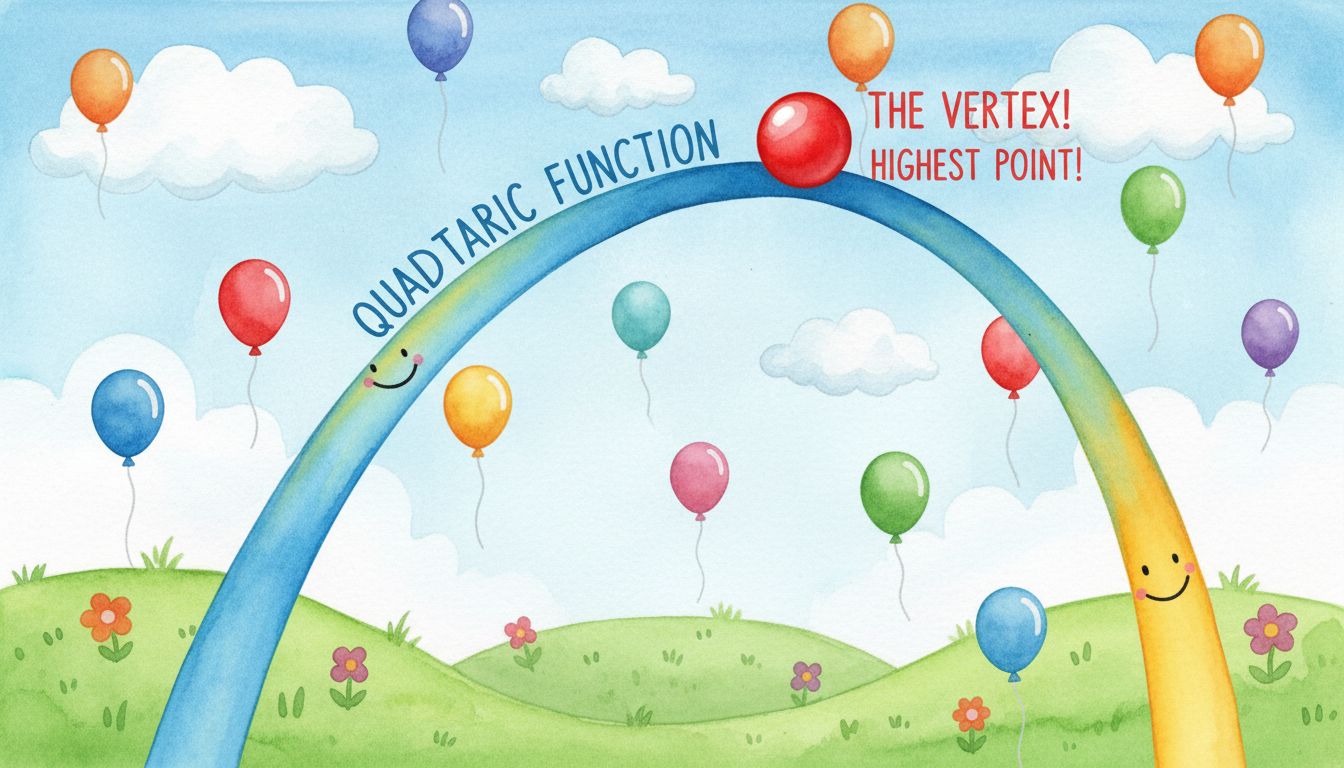
What is the Most Important Point in a Quadratic Function?
Quick Answer
The most important point in a quadratic function is the vertex. It serves as the turning point where the graph switches from decreasing to increasing (or vice versa).
In the study of quadratic functions, understanding the behavior of their graphs is crucial. Quadratic functions are represented by a parabolic shape, which can either open upwards or downwards depending on the coefficients in the equation. The vertex of the parabola plays a pivotal role in determining the intervals of increase and decrease of the function.
The vertex is the point where the graph of the quadratic function reaches its maximum or minimum value. If the parabola opens upwards, the vertex represents the lowest point (minimum), while if it opens downwards, it indicates the highest point (maximum). This makes the vertex the most significant point when analyzing the function's behavior.
To illustrate this, consider the quadratic function given by the equation y = ax² + bx + c, where a, b, and c are constants. The vertex can be found using the formula:
\[ x = -\frac{b}{2a} \]
Once you find the x-coordinate of the vertex, you can substitute it back into the equation to find the corresponding y-coordinate. For example, for the function y = 2x² - 8x + 6, we first calculate the x-coordinate:
\[ x = -\frac{-8}{2 \cdot 2} = 2 \]
Next, we substitute x back into the function to find y:
\[ y = 2(2)^2 - 8(2) + 6 = -2 \]
Thus, the vertex of this function is (2, -2).
Now, regarding intervals of increasing and decreasing:
- For the function to the left of the vertex (x < 2 in this case), the graph decreases.
- To the right of the vertex (x > 2), the graph increases.
Therefore, when asked about intervals of increase and decrease, the vertex is the key point that indicates where the function changes its behavior. Understanding this allows you to effectively analyze any quadratic function.
Additionally, it’s important to note that the axis of symmetry, which is a vertical line that passes through the vertex, also helps in understanding the function's symmetry but does not provide the critical point of change in direction. Thus, in multiple-choice scenarios related to this topic, always remember that the vertex is the focal point of interest.
Was this answer helpful?