
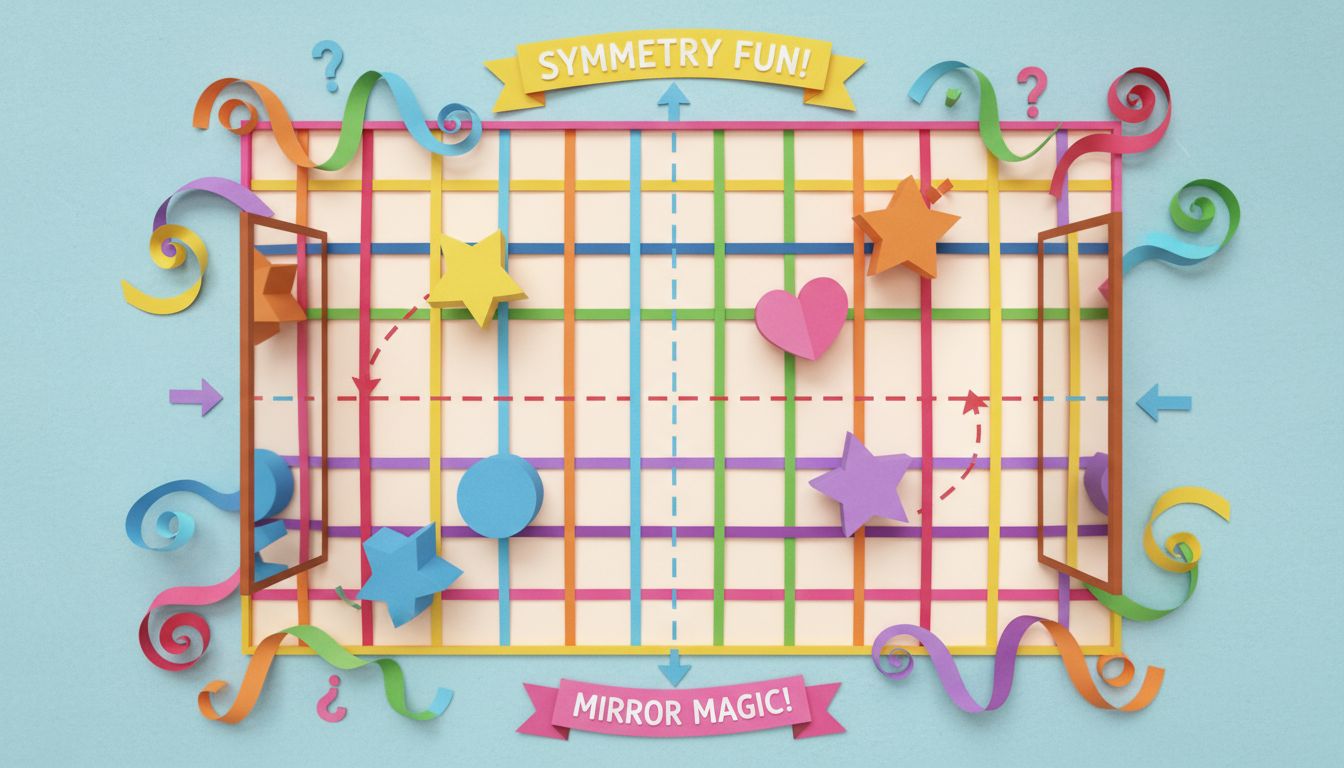
Understanding Reflections in Mathematics: X-Axis and Y-Axis
Quick Answer
When reflecting a point over the x-axis, the x-coordinate remains the same while the y-coordinate changes sign. For example, the point (2, 25) reflects to (2, -25). Reflecting over the y-axis changes the sign of the x-coordinate instead.
Reflections in mathematics are transformations that flip a point, line, or shape over a specified axis. Understanding how these reflections work is essential for graphing functions and analyzing their behaviors.
When we talk about reflecting a point over the **x-axis**, we need to remember a simple rule: the x-coordinate stays the same, while the y-coordinate changes its sign. For instance, if we start with the point
\[(2, 25)\], it reflects across the x-axis to become
\[(2, -25)\]. This means that if a point is located above the x-axis, its reflection will be found below it, maintaining the same distance from the axis.
Here's a breakdown of the reflection process:
- Starting Point:
- The point is
\[(2, 25)\].
- Applying the Reflection Rule:
- Keep the x-value: 2
- Change the y-value: 25 becomes -25
- Resulting Point:
- Therefore, the reflected point is
\[(2, -25)\].
Now, let’s consider what happens when we reflect over the **y-axis**. In this case, the y-coordinate remains unchanged, and we switch the sign of the x-coordinate. For example, reflecting the point
\[(2, 25)\] over the y-axis results in the point
\[(-2, 25)\]. The reflection moves the point horizontally, while its vertical position remains the same.
To visualize this, think about how reflections behave in real life. For instance, when you stand in front of a mirror, your left becomes right and vice versa, similar to how points transform during reflections in mathematics. This concept is not just limited to points; entire shapes and functions can be reflected, allowing us to explore symmetry and transformations.
In mathematics, these transformations are crucial for graphing functions, understanding symmetry, and solving real-world problems. For example, if you were to graph the function
\[f(x) = (x + 3)^2\], reflecting it over the x-axis would change the shape of the parabola, providing insight into its characteristics at different points.
In summary, reflections over the x-axis and y-axis are fundamental concepts in geometry and algebra, helping students visualize and manipulate functions and shapes. Understanding these transformations is key to mastering more complex mathematical ideas. If you have further questions or would like to explore more examples, feel free to ask!
Was this answer helpful?