
The Midnight Sun Marathon
Polly arrives in Tromsø, Norway during the midnight sun and meets Astrid, a 67-year-old marathoner attempting to qualify for Boston in her last year of her current age group.
Read at your pace. The full app adds translation and saved vocabulary.
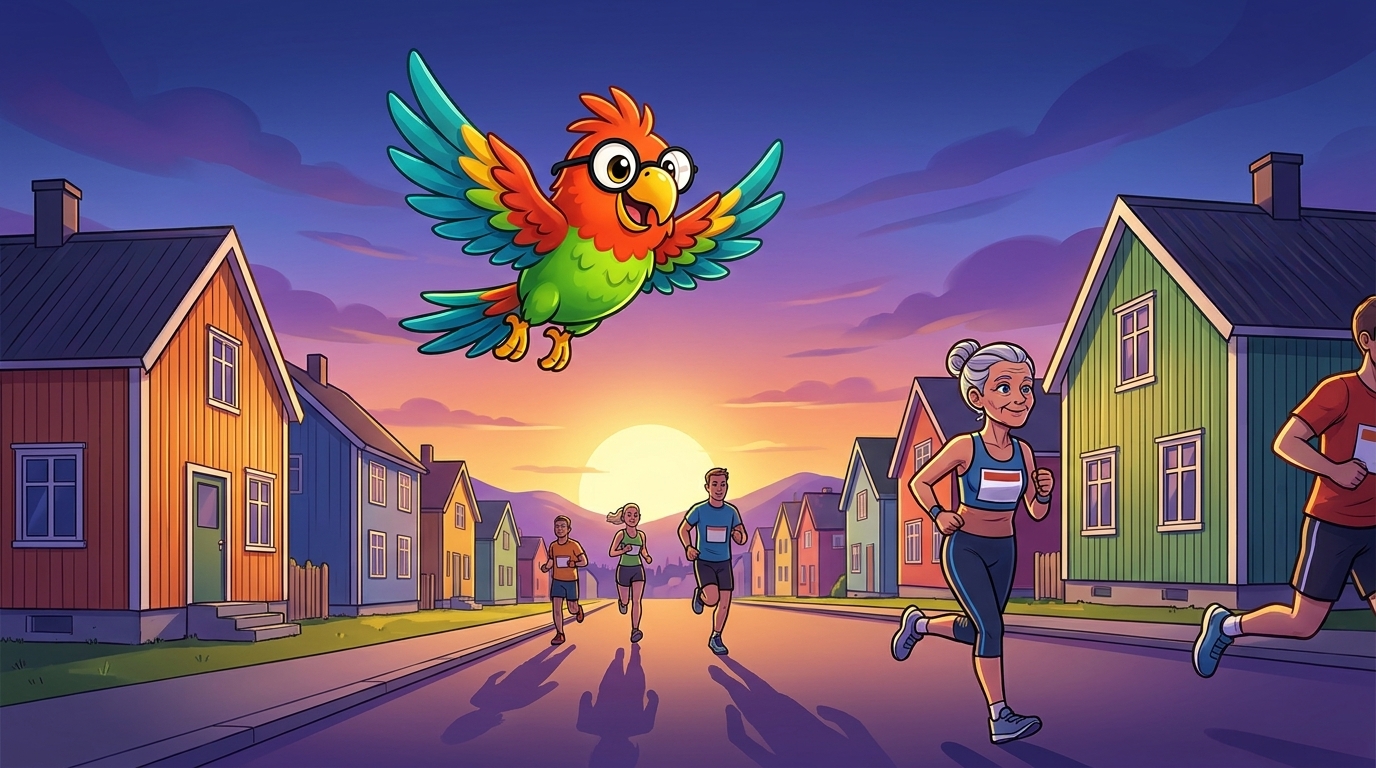
Keep it on your phone →The perpetual twilight of Tromsø in June had always fascinated Polly, but experiencing it firsthand was something else entirely. As she glided over the Arctic city's colorful wooden houses, the midnight sun hung stubbornly above the horizon, casting long shadows that seemed to stretch endlessly across the fjord. It was two in the morning, yet the streets buzzed with an energy that defied conventional notions of time.
"Would you look at that," Polly squawked to herself, perching on a lamppost near the harbor. "Broad daylight at this ungodly hour!"
The Arctic Cathedral's distinctive triangular silhouette dominated the skyline, its glass mosaic catching the golden light. But what truly caught Polly's attention was the unusual commotion near the city center. Hundreds of people were gathering, many wearing running gear despite the late—or was it early?—hour.
Intrigued, Polly swooped down to investigate, landing on a registration table where volunteers were distributing race numbers. A woman with silver-streaked hair pulled back in a tight bun was arguing heatedly with one of the organizers, her hands gesticulating wildly.
"What do you mean my pacing strategy won't work?" she demanded, her Norwegian accent coloring her English. "I've run seventeen marathons, young man. I think I know what I'm doing."
The volunteer, barely out of his teens, looked thoroughly intimidated. "Ma'am, I'm just saying that the midnight sun affects people differently. The constant light can mess with your circadian rhythms, and—"
"Circadian rhythms," she scoffed. "When I was training for the Boston Marathon in '92, nobody talked about circadian rhythms. We just ran."
Polly couldn't help but chuckle at the exchange. The woman—her race bib identified her as Astrid Lindberg, age 67—reminded her of a particularly stubborn seagull she'd once met in Bergen.
"Excuse me," Polly interjected, causing both humans to jump. "I couldn't help but overhear. You're running the Midnight Sun Marathon?"
Astrid's eyes widened momentarily before narrowing with suspicion. "A talking parrot. Of course. Why shouldn't there be a talking parrot at quarter past two in the morning?" She shook her head as if clearing it. "Yes, I'm running. Have been training all winter for this."
"Your first time running under the midnight sun?" Polly asked, genuinely curious.
Astrid's defensive posture softened slightly. "First time running it, yes. Though I've lived in Tromsø for forty years." She glanced at the sun, which hadn't moved perceptibly in the sky. "It's different when you're trying to pace yourself for 42 kilometers. The light plays tricks on you."
The young volunteer seized his chance to escape, muttering something about needing to help at the starting line. Astrid watched him go with a mixture of annoyance and amusement.
"Kids these days," she muttered. "They read one article about sports science and think they know everything."
Polly hopped closer, studying the woman's weathered face. There was something beneath the bravado—a flicker of uncertainty, perhaps even fear.
"You seem worried about something," Polly observed.
Astrid's jaw tightened. "Worried? I don't get worried. I get prepared." But her fingers betrayed her, drumming nervously against her thigh. After a moment, she sighed. "It's just... this is my last chance."
"Last chance?"
"To qualify for Boston again. Age group standards, you know. Next year I move up to the 70-74 category, and while the qualifying time gets easier..." She trailed off, staring at the midnight sun. "I want to do it while I'm still in my sixties. Prove I've still got it."
The weight of her words hung in the arctic air. Around them, more runners were arriving, their excited chatter filling the night that wasn't quite night. The paradox of Tromsø in summer—where time seemed both suspended and urgently pressing forward—had never been more apparent to Polly.
"Well then," Polly said, spreading her wings. "Sounds like you could use a pacing partner who understands that sometimes the old ways are the best ways."
Astrid raised an eyebrow. "You? You're a parrot."
"A parrot who's flown through monsoons in Mumbai and sandstorms in the Sahara," Polly replied with a wink. "I think I can handle a little midnight sunshine."
For the first time since Polly had encountered her, Astrid smiled—a real smile that crinkled the corners of her eyes. "You know what? Why not? It's already the strangest marathon I've ever run, might as well add a talking parrot to the mix."
As if on cue, an announcement echoed across the gathering crowd: "Runners, please make your way to the starting line. The Midnight Sun Marathon begins in thirty minutes!"
The adventure, it seemed, was about to begin.
You just heard Polly
Want to hear what YOU sound like?
Read a line of the story out loud. Your recording stays on your device and is never uploaded.
Not bad, right? If you were in the PollyStop app, Polly would listen to exactly that and score you right now.
Coaching, saved words, spaced repetition, and a fresh story every day.
Get PollyStop freeYou just tried the loop
Now take the story with you.
PollyStop brings listening, saved vocabulary, speaking practice, and a fresh graded story together on your phone.
Learning on Android? Join the waitlistRead this story in another language.
Same story, different language. Compare the shape and rhythm without losing the plot.
Keep reading
More English stories.
The Sea Grows Quiet
Read free
The Sea Grows Quiet
Read free
The Sea Grows Quiet
Read free
The Giant
Read free
The Giant
Read free
The Giant
Read freeKeep learning in PollyStop
Listen, save words, practise