
What Are the Different Verb Moods? A Student's Guide
Quick Answer
Verb moods indicate the attitude of the speaker toward the action. The main moods include imperative (commands), interrogative (questions), conditional (hypothetical situations), and subjunctive (wishes or doubts).
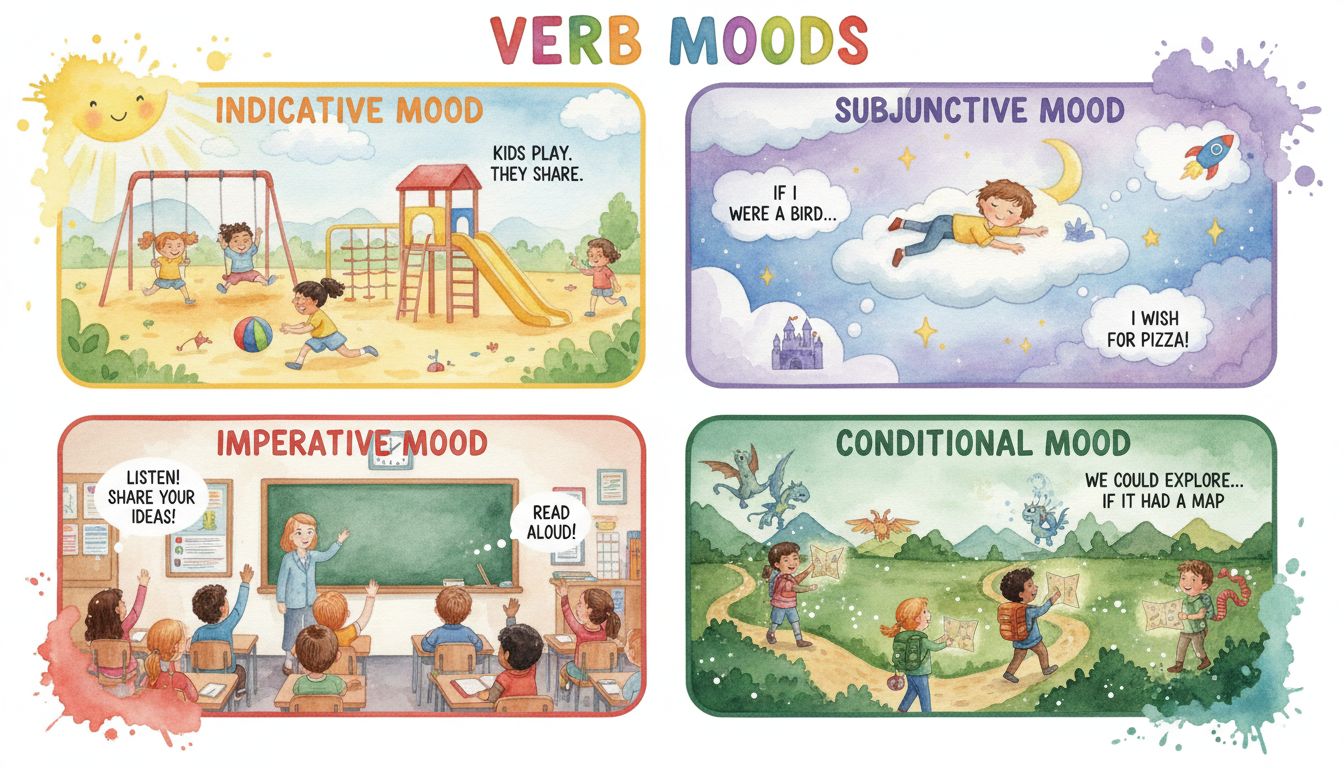
Understanding verb moods is essential for mastering the nuances of English. Verb moods express the speaker's attitude toward the action of the verb, and they can significantly alter the meaning of a sentence. Here’s a breakdown of the four primary verb moods:
1. **Imperative Mood**: This mood is used to give commands or requests. It often comes without a subject because the subject 'you' is implied. For example, in the sentence, "Please close the door," the speaker is directly instructing someone to carry out that action. Other examples include "Turn in your homework" and "Help me with this task." These sentences are straightforward commands aimed at getting someone to take action.
2. **Interrogative Mood**: The interrogative mood is used to ask questions. Sentences in this mood typically begin with a question word (like who, what, where, when, why) or a helping verb (like is, are, do, will). For instance, "Where is the lantern?" or "Can you pass the salt?" These examples demonstrate how the interrogative mood seeks information, requiring a response from the listener.
3. **Conditional Mood**: This mood expresses actions that depend on certain conditions. It often uses the word 'if' and indicates a scenario that may or may not happen. For instance, "If it rains, we will stay indoors" shows that the action of staying indoors depends on the condition of it raining. Other examples include, "If I had a million dollars, I would travel the world." This mood is great for discussing possibilities and hypothetical situations.
4. **Subjunctive Mood**: The subjunctive mood is used to express wishes, doubts, or hypothetical situations. It’s less common in everyday speech but can be seen in sentences like, "I wish you were here" or "If I were a bird, I would fly high." The subjunctive mood often involves the use of the word 'were' instead of 'was' in certain contexts, adding to its unique structure.
By understanding these moods, students can enhance their writing and speaking skills, allowing them to convey their thoughts more precisely. Practicing these moods in different sentences can also help in recognizing them in literature and everyday conversations. Remember, the mood of a verb can change the entire tone of a sentence, making it crucial for effective communication. Keep practicing, and soon identifying these moods will come naturally to you!
Was this answer helpful?