
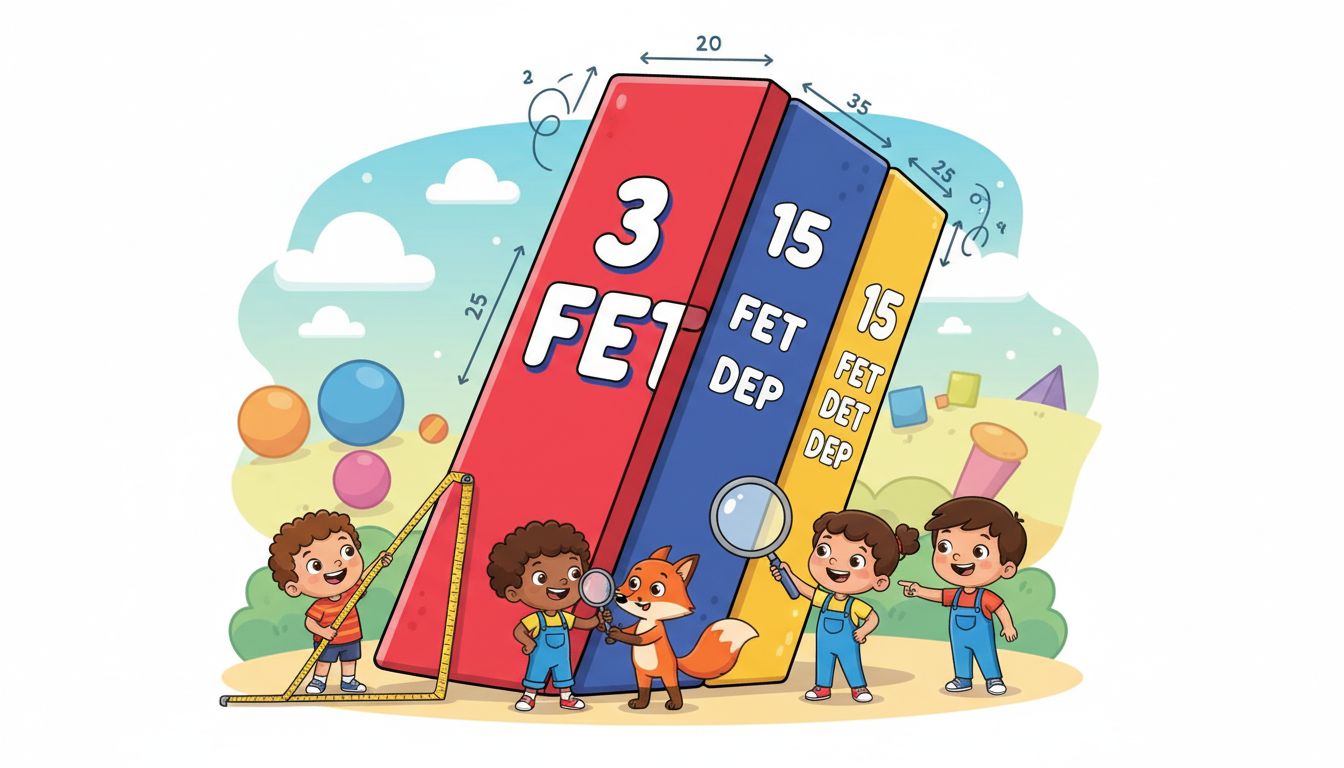
How Can an Object Be 3 Ft Tall but 15 Ft Deep?
Quick Answer
An object can be 3 ft tall and 15 ft deep because these measurements refer to different dimensions. Height describes how tall something is vertically, while depth measures how far it extends from front to back.
Understanding dimensions is crucial in both mathematics and everyday life. When we say an object is '3 ft tall but 15 ft deep,' we are referring to its height and depth, which represent two distinct measurements in three-dimensional space.
The term 'tall' typically refers to the vertical aspect of an object. For example, think about a bookshelf. If a bookshelf is 3 ft tall, it stands three feet from the ground to the top. On the other hand, 'deep' refers to how far the object extends back from the front to the back. A depth of 15 ft indicates that the object stretches back 15 feet.
To illustrate this concept further, let’s consider a few examples:
1. **A Large Rectangular Table**: Imagine a table designed for outdoor gatherings. It might stand only 3 ft tall, making it easy to reach for people seated around it. However, if this table is customized to be 15 ft deep, it can accommodate multiple dishes, decorations, or even serve as a buffet table, providing ample space for food and drinks.
2. **Theater Stage Platform**: A theater stage could be constructed to be 3 ft tall, allowing performers to be elevated above the audience for better visibility. Meanwhile, the stage might extend 15 ft deep to give actors plenty of room to move around, create scenes, and engage with the audience. This depth is essential for stage design, as it enhances performance dynamics.
3. **Aquarium Design**: Consider an aquarium that is 3 ft tall but 15 ft deep. The height allows for a diverse display of aquatic life, while the depth provides a larger habitat for fish and plants, creating a more vibrant underwater ecosystem.
In each of these examples, we see how the relationship between height and depth varies significantly depending on the object’s purpose. An object can be relatively short in one dimension while being significantly longer in another dimension. This is common in design and architecture, where functionality often dictates the dimensions of the objects we create.
Understanding how to interpret dimensions correctly helps in various fields, from construction to graphic design, where spatial awareness is essential. It’s also a fundamental concept in geometry, which deals with the properties and relations of shapes and spaces.
In summary, when you encounter measurements like 3 ft tall and 15 ft deep, remember that these values describe different aspects of an object’s size and shape. Recognizing this distinction can enhance your comprehension of geometry and its applications in real-life scenarios.
Was this answer helpful?