
What is the Conversion Factor from Square Yards to Square Miles?
Quick Answer
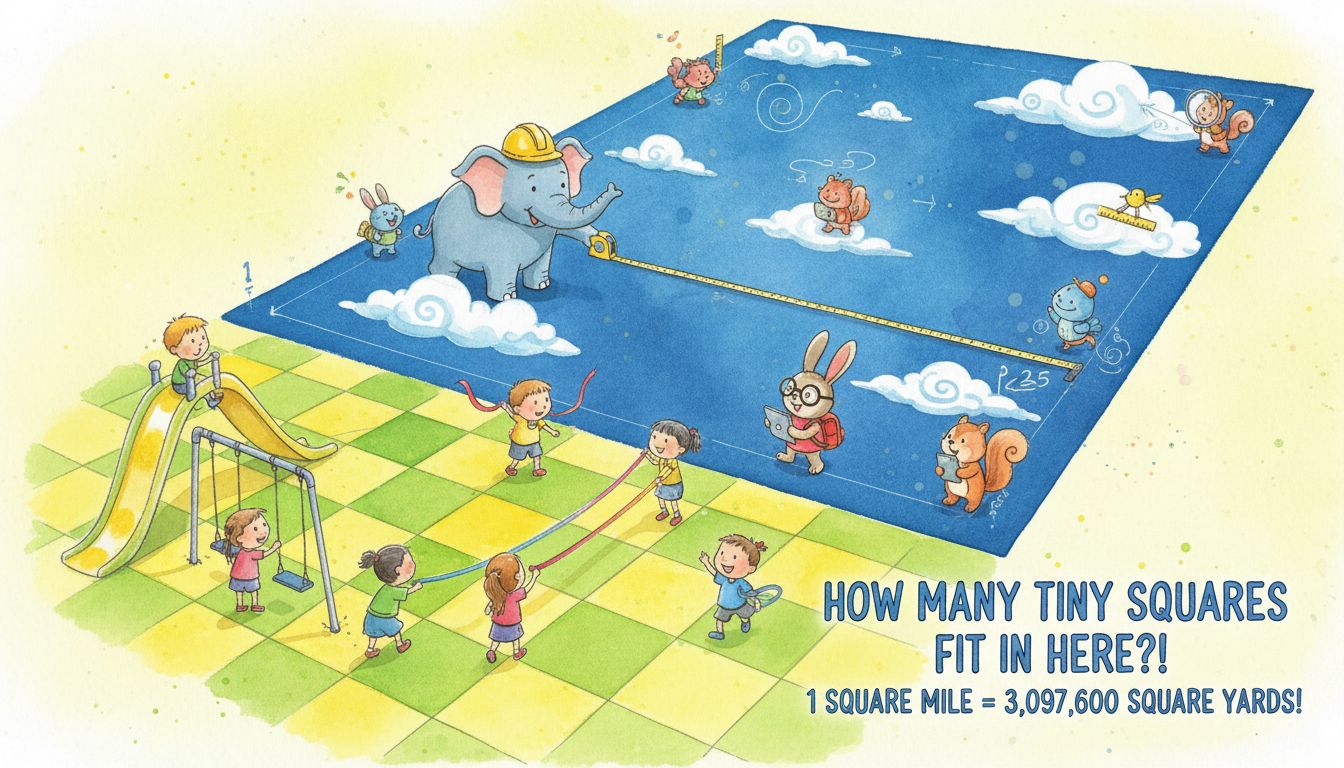
To convert square yards to square miles, remember that 1 square mile equals 3,097,600 square yards. This comes from multiplying 1 mile (1,760 yards) by itself.
Understanding how to convert between different units of area, such as square yards to square miles, is crucial in various fields, including construction, landscaping, and land use planning. Let's break down the conversion process step by step.
First, recall that 1 mile equals 1,760 yards. This is a fundamental conversion factor used in many calculations. When we talk about square miles, we are referring to an area that is 1 mile long and 1 mile wide. Thus, a square mile can be visualized as a square with each side measuring 1 mile.
To find the area in square yards, we need to convert each side of the square mile from miles to yards. Since each side is 1 mile long, we convert it as follows:
- 1 mile = 1,760 yards
Therefore, a square mile is:
- 1 square mile = 1,760 yards × 1,760 yards.
Now, let’s multiply these values to find the total area in square yards:
- 1,760 × 1,760 = 3,097,600 square yards.
This means that 1 square mile contains 3,097,600 square yards. This conversion factor is crucial for various applications. For instance, if you're planning a garden that occupies 0.5 square miles, you would need to know how many square yards that translates to for proper landscaping and planning. Simply multiply:
- 0.5 square miles × 3,097,600 square yards/square mile = 1,548,800 square yards.
In summary, understanding the conversion factor from square yards to square miles (and vice versa) helps in practical scenarios such as real estate measurements, landscaping, and even when calculating areas for sports fields. By mastering these conversions, you can confidently tackle a variety of mathematical problems and real-world applications.
Remember, always check your calculations and understand the units you are working with to avoid confusion. This knowledge not only enhances your mathematical skills but also prepares you for more advanced concepts in geometry and spatial reasoning.
Was this answer helpful?