
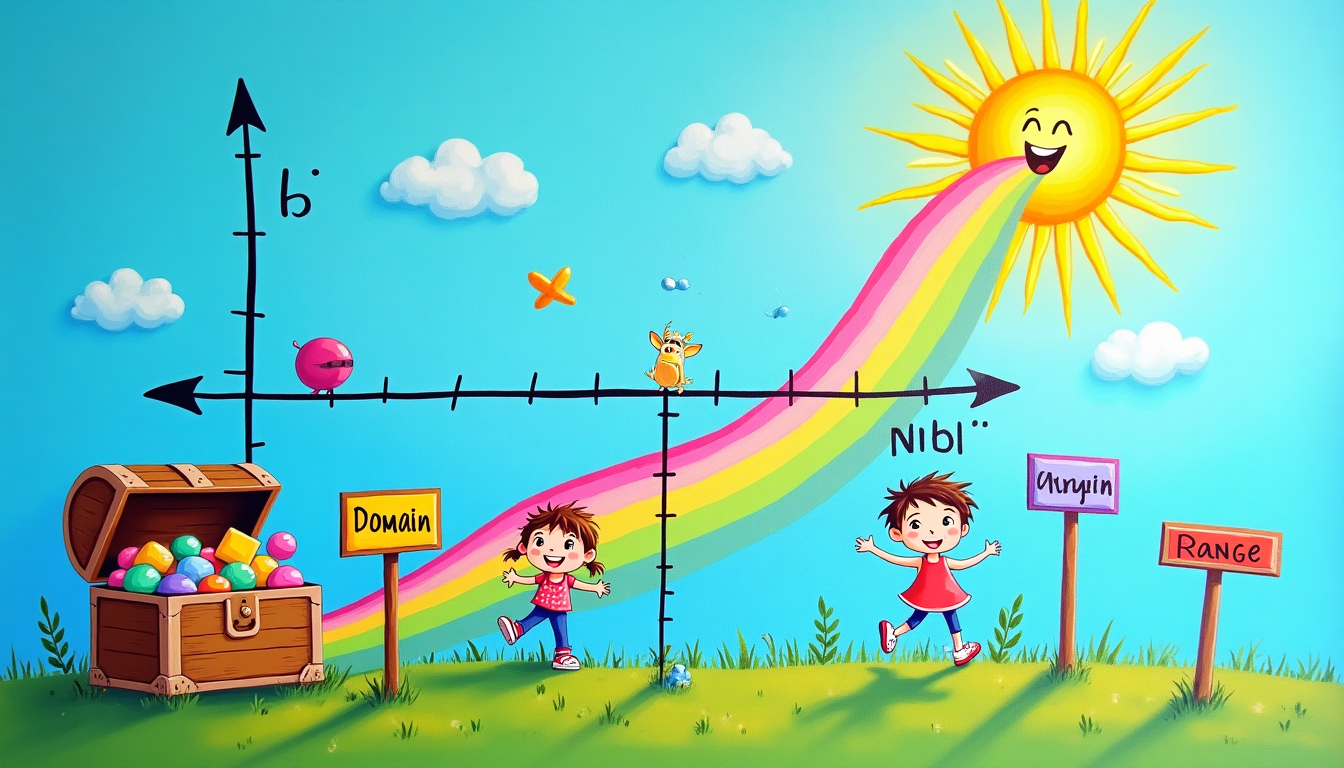
Understanding Domain and Range in Graphs: A Student's Guide
Quick Answer
Domain refers to the set of all possible x-values in a function, while range refers to the possible y-values. Understanding these concepts is crucial for mastering graph interpretation.
Understanding domain and range is fundamental in mathematics, especially when working with functions and graphs. These concepts help define the limits of the function's input and output values.
### What is DOMAIN?
The domain of a function is the complete set of possible values of the independent variable, usually represented as x. To visualize this, think of a graph where the x-axis represents different input values. For example, if you have a graph of a quadratic function like y = x², you can input any real number for x. Therefore, the domain of this function is all real numbers.
In the context of your exponential graph, the domain is also all real numbers. If you slide along the x-axis from left to right, you will always find a corresponding y-value from the graph above the x-axis, indicating that there are no gaps. This can be written in interval notation as (-∞, ∞).
### What is RANGE?
The range, on the other hand, refers to the set of possible output values (y-values) that a function can produce. In the case of the exponential graph you described, the curve starts just above the x-axis and rises infinitely high as x increases. This means that while the function can approach zero (but never actually touches it), it can take on any positive value. Thus, the range of this function is expressed as (0, ∞).
### Real-World Applications
Understanding domain and range is not just an academic exercise; it has practical applications in various fields. For instance, in economics, these concepts can be used to model supply and demand curves, where the domain might represent different price levels, while the range represents the quantity sold at those prices.
In science, domain and range can also apply to measurements. For example, if you were measuring the height of a growing plant, the domain could represent time (in days), while the range would be the corresponding heights of the plant.
### Tips for Mastering Domain and Range
1. **Visualize with Graphs**: Always try to look at the graph of the function. It can help you see the domain and range more clearly.
2. **Use Interval Notation**: Get comfortable using interval notation to express domain and range. It’s a concise way to represent sets of numbers.
3. **Practice with Different Functions**: Different types of functions (linear, quadratic, exponential) have different domains and ranges. Practicing with various functions helps solidify your understanding.
4. **Ask Questions**: If you're unsure, don’t hesitate to ask for help. Sometimes a simple explanation can clear up confusion.
In summary, mastering domain and range makes navigating through various mathematical concepts easier and more intuitive. By visualizing these concepts through graphs and practicing with different functions, you can develop a deeper understanding that will benefit you greatly in your mathematical studies.
Was this answer helpful?