
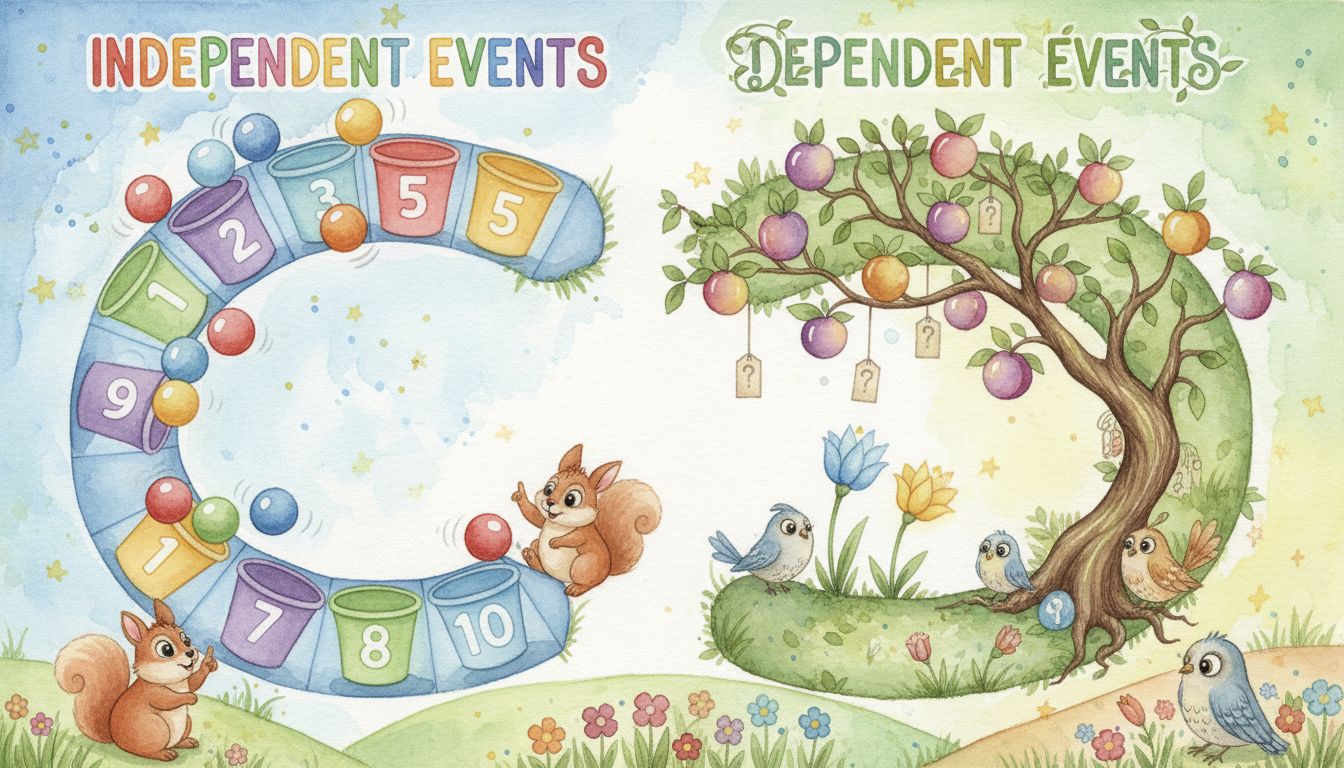
Understanding Probability: Independent and Dependent Events Explained
Quick Answer
In probability, events are independent when the outcome of one does not affect the other. When drawing cards from a deck, if the first card is replaced, the events are independent; if not, they are dependent.
Probability is a fundamental concept in mathematics that helps us understand how likely an event is to occur. When dealing with multiple events, it's crucial to determine whether these events are independent or dependent, as this affects how we calculate their probabilities.
**Independent vs. Dependent Events**
- **Independent Events**: Two events are considered independent if the occurrence of one event does not influence the occurrence of the other. A classic example is drawing cards from a deck with replacement. If you draw a card and put it back before drawing again, the probability of drawing any card remains the same throughout.
- **Dependent Events**: Conversely, events are dependent if the outcome of one event affects the outcome of another. For instance, if you draw a card from a deck and do not replace it, the total number of cards in the deck decreases, and thus the probabilities change for the subsequent draws.
**Example Scenario**
Let’s clarify this with a practical example involving a standard deck of 52 playing cards. Assume you want to find the probability of drawing a diamond first and then a spade.
1. **Without Replacement (Dependent Events)**: After drawing a diamond, you do not return it to the deck. The probability for the first draw of a diamond is:
- P(Diamond first) = 13 diamonds / 52 total cards = 0.25.
- After drawing a diamond, there are now only 51 cards left in the deck, with still 13 spades. The probability of then drawing a spade is:
- P(Spade second | Diamond first) = 13 spades / 51 remaining cards.
- The combined probability of these two dependent events occurring is:
- P(Diamond first and Spade second) = P(Diamond first) × P(Spade second | Diamond first) = 0.25 × (13/51) = approximately 0.0638.
- This shows how the first event (drawing a diamond) directly affects the second event's probability.
2. **With Replacement (Independent Events)**: Now, if you replace the first card back into the deck before drawing the second card, the events are independent. The calculations are as follows:
- The probability of drawing a diamond first remains:
- P(Diamond first) = 13/52 = 0.25.
- After replacing the diamond, the total number of cards and the number of spades remain unchanged. Therefore, the probability of drawing a spade on the second draw is also:
- P(Spade second) = 13/52 = 0.25.
- The combined probability in this case is:
- P(Diamond first and Spade second) = P(Diamond first) × P(Spade second) = 0.25 × 0.25 = 0.0625.
**Real-World Applications**
Understanding the difference between independent and dependent events is crucial in various fields such as statistics, finance, and even game theory. For example, in risk assessment, determining whether events are dependent can significantly influence decision-making processes. Whether you're playing a card game, analyzing data, or predicting outcomes, grasping these concepts will enhance your analytical skills.
By mastering the concepts of independent and dependent events, you'll be better equipped to tackle probability problems effectively. Keep practicing with various scenarios to strengthen your understanding!
Was this answer helpful?