
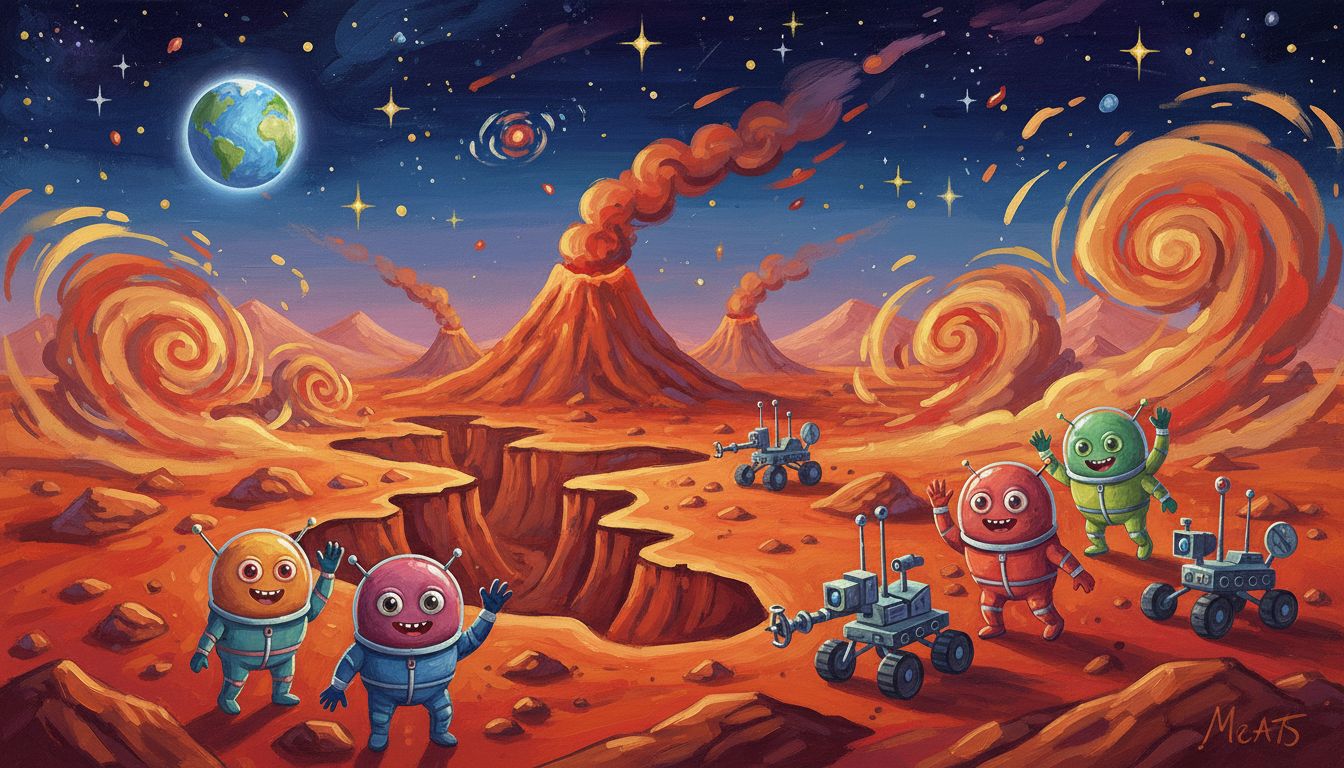
What Are Some Fascinating Facts About Mars?
Quick Answer
Mars, known as the 'Red Planet,' is the fourth planet from the Sun and has two moons, Phobos and Deimos. It's famous for its massive volcanoes and canyons, and scientists are exploring it for signs of past water and potential life.
Mars, often referred to as the 'Red Planet', is the fourth planet in our solar system, orbiting the Sun at an average distance of about 227.9 million kilometers (141.6 million miles). Its striking reddish appearance is due to iron oxide, commonly known as rust, which covers its surface. This unique color has made Mars a subject of fascination for astronomers and space enthusiasts alike.
One of the most intriguing features of Mars is its two small moons, Phobos and Deimos. These moons are irregularly shaped and are thought to be captured asteroids from the asteroid belt. Phobos, the larger of the two, is slowly spiraling inward towards Mars and may eventually crash into the planet or break apart, creating a ring.
A day on Mars, known as a 'sol,' is approximately 24.6 hours, slightly longer than an Earth day. However, a year on Mars takes about 687 Earth days to complete one full orbit around the Sun. This means that Martian seasons are almost twice as long as those on Earth!
Mars is home to the tallest volcano in the solar system, Olympus Mons, which stands at a staggering height of about 22 kilometers (13.6 miles). This volcano is about two and a half times the height of Mount Everest. Additionally, Mars boasts the largest canyon, Valles Marineris, which stretches over 4,000 kilometers (about 2,500 miles) and is up to 7 kilometers (4.3 miles) deep. These features are a testament to the planet's dynamic geological history.
Scientists are particularly interested in Mars because there is substantial evidence suggesting that liquid water once flowed on its surface. Features resembling dry riverbeds and minerals that form in water have been discovered, leading to ongoing research about the planet's past climate. The exploration of Mars has intensified with missions like NASA's Perseverance rover and the Ingenuity helicopter, which are searching for signs of past or present life.
In addition to its physical characteristics, Mars experiences extreme weather conditions, including dust storms that can envelop the entire planet. These storms can last for weeks and significantly affect its atmosphere and surface.
In summary, Mars is not only a planet of scientific interest but also a symbol of human curiosity and exploration. The ongoing missions to Mars aim to answer fundamental questions about the possibility of life beyond Earth and the history of our solar system. If you want to learn more about Mars' weather, geography, or past missions, feel free to ask!
Was this answer helpful?