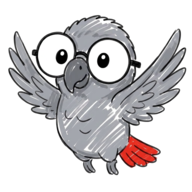
The Birds That Live Here
Polly explores the small fauna of the Atacama: the fog beetle that drinks from condensation, the gecko that absorbs water through its skin, the leaf-eared mouse. She thinks about why humans built an observatory in a place this hostile.

Read at your pace. The full app adds translation and saved vocabulary.
Keep it on your phone →On the fifth morning, before going to bed for the day, Polly went looking for animals.

The Atacama, against expectation, was not lifeless. It was lightly lifed. Almost everything that lived here was at the absolute edge of what is biologically possible. The cycle of survival ran on very small budgets, and almost no waste.

The first creature Polly found was a small black beetle on a stone near the residencia entrance. Its species was Onymacris bicolor, the fog beetle. The fog beetle lives by climbing up onto rocks during the rare predawn coastal fog and tilting its body forward so that condensation collects on its back and runs into its mouth. It does not need to drink any other water for its whole life. Polly watched it for a long minute. It was doing nothing at the moment. The fog had been three weeks ago.

A little further on, behind a low rock, a small gecko. Phyllodactylus gerrhopygus. The desert gecko. It hunted at night, slept under rocks during the day. It absorbed water from air through its skin. Its kidneys were so efficient that its urine was almost crystalline. It could go six months without drinking.

A small mouse-like rodent, the leaf-eared mouse, lived in colonies in burrows under salar margins. It survived on grass seeds, condensation, and the metabolic water released by digesting fats.

No flies. No grass. No flowering plants in this stretch. The few flowering plants of the Atacama lived further down on the coast where the camanchaca fog reached, or in deep valleys where rare rainstorms had filled aquifers below.

Polly thought about Polly. She drank water freely whenever she felt like it. She ate fruits and seeds and the occasional sliver of fish given by amused humans. She was the visitor, and a strangely well-resourced one. The fog beetle, in contrast, had been at this for fifty million years. Its great-great-many-grandparents had been the same insect doing the same thing in this same desert before mammals were a serious idea.

A black vulture passed overhead, very high. They cleared the carrion of the Atacama coast. They flew between this desert and the coastal mountains, surveying. There were not many of them. There did not need to be.

Polly walked back toward the residencia in the rising heat. A second engineer was at the entrance, talking to a delivery driver. The driver had brought groceries from Antofagasta. A box of oranges. A box of apples. Three large plastic containers of bottled water. A small bag of fresh bread.

None of these things grew here. Everything in the residencia kitchen had been driven up from the coast. Even the water for the showers was trucked in. The closest natural surface freshwater to Paranal was over a hundred kilometres away.

Polly thought about the fog beetle again, and then about the bottled water, and then about the fact that humans had decided, despite all of this, that it was worth it. Worth driving a hundred and fifty thousand litres of water a week up a mountain so that other humans could spend their nights looking at light from exoplanets sixty-three light years away. There was an argument for it that Polly would not have been able to make. But she felt the shape of it.

She went inside to sleep.
You just heard Polly
Want to hear what YOU sound like?
Read a line of the story out loud. Your recording stays on your device and is never uploaded.
Not bad, right? If you were in the PollyStop app, Polly would listen to exactly that and score you right now.
Coaching, saved words, spaced repetition, and a fresh story every day.
Get PollyStop freeYou just tried the loop
Now take the story with you.
PollyStop brings listening, saved vocabulary, speaking practice, and a fresh graded story together on your phone.
Learning on Android? Join the waitlistKeep reading
More English stories.
The Sea Grows Quiet
Read free
The Sea Grows Quiet
Read free
The Sea Grows Quiet
Read free
The Giant
Read free
The Giant
Read free
The Giant
Read freeKeep learning in PollyStop
Listen, save words, practise