
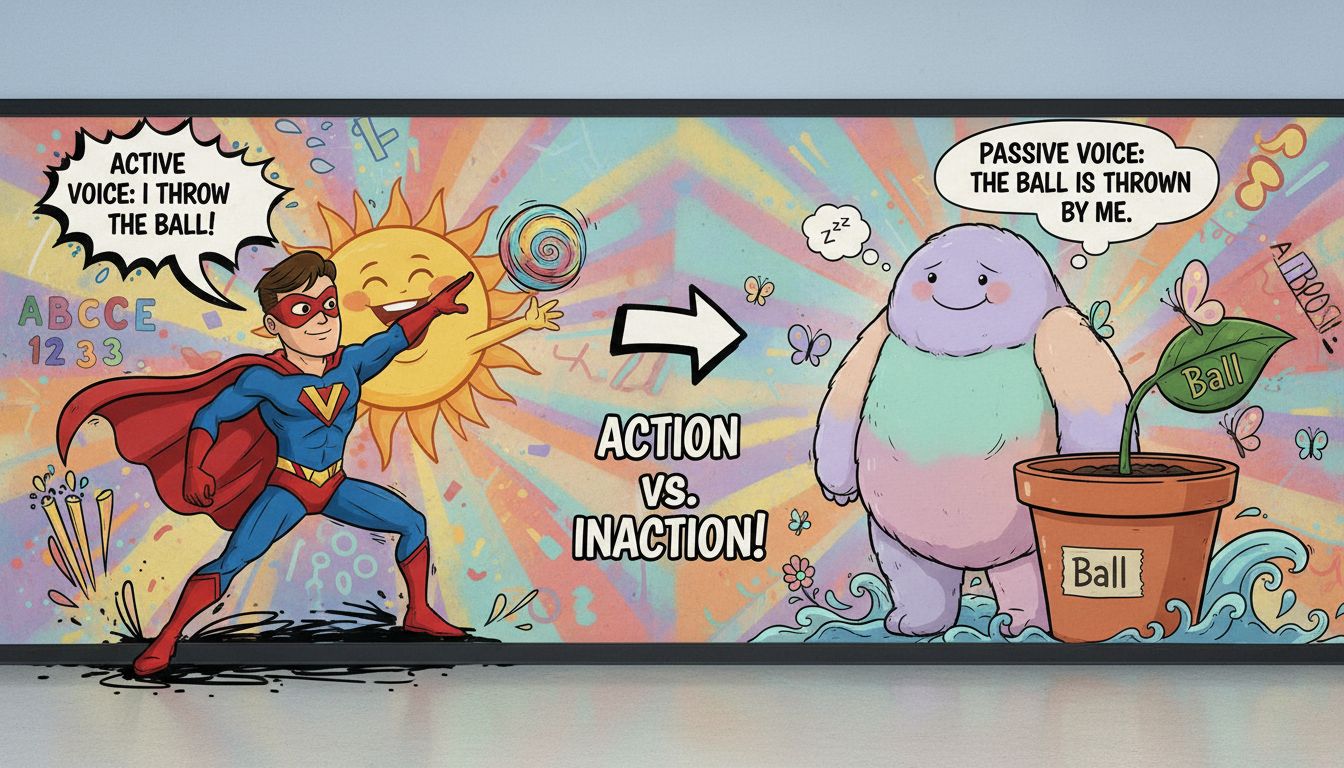
Passive vs Active Voice Explained: Simple Guide for Students
Quick Answer
Active voice emphasizes the doer of the action, while passive voice focuses on the receiver. For example, 'The cat chased the mouse' (active) vs. 'The mouse was chased by the cat' (passive).
Understanding the difference between passive and active voice is crucial for effective writing. Let’s break it down step by step.
**Active Voice**: In active voice, the subject performs the action. The structure is straightforward: **Subject + Verb + Object**. For instance, in the sentence 'The dog barks at the mailman,' 'the dog' is the subject actively doing the barking. This voice is often preferred in writing because it is direct and vigorous.
**Passive Voice**: In contrast, passive voice shifts the focus to the subject receiving the action. The structure follows: **Subject + form of 'to be' + past participle + (by agent)**. For example, 'The mailman is barked at by the dog.' Here, 'the mailman' is the subject, but he is not acting; instead, he is receiving the barking. This voice can sometimes create a more formal tone or emphasize the action rather than the actor.
**Identifying the Voices**: To determine whether a sentence is in active or passive voice, ask yourself, '**Who is doing the action?**' If the doer of the action is clearly stated at the beginning of the sentence, it’s likely in active voice. Conversely, if the sentence centers on the receiver of the action, often requiring the word 'by' to clarify the doer, it’s in passive voice.
**Examples for Clarity**:
- **Active Voice**: 'The chef cooked a delicious meal.' - The chef (subject) is performing the action of cooking.
- **Passive Voice**: 'A delicious meal was cooked by the chef.' - The meal (new subject) is receiving the action of being cooked.
While both voices are grammatically correct, the active voice is generally preferred for its clarity and energy in writing. However, passive voice can be useful in certain contexts, such as when the doer is unknown or less important than the action itself.
**Real-World Application**: Understanding these differences can enhance your writing skills, making your work more engaging and effective. In essays, reports, and even creative writing, choosing the right voice can impact how your message is perceived by the audience. Active voice brings a sense of immediacy and engagement, while passive voice can lend a more formal or detached tone when necessary.
In summary, mastering active and passive voice will not only improve your writing clarity but also enable you to express your thoughts more effectively. Practice recognizing and using both forms to become a more versatile writer.
Was this answer helpful?