
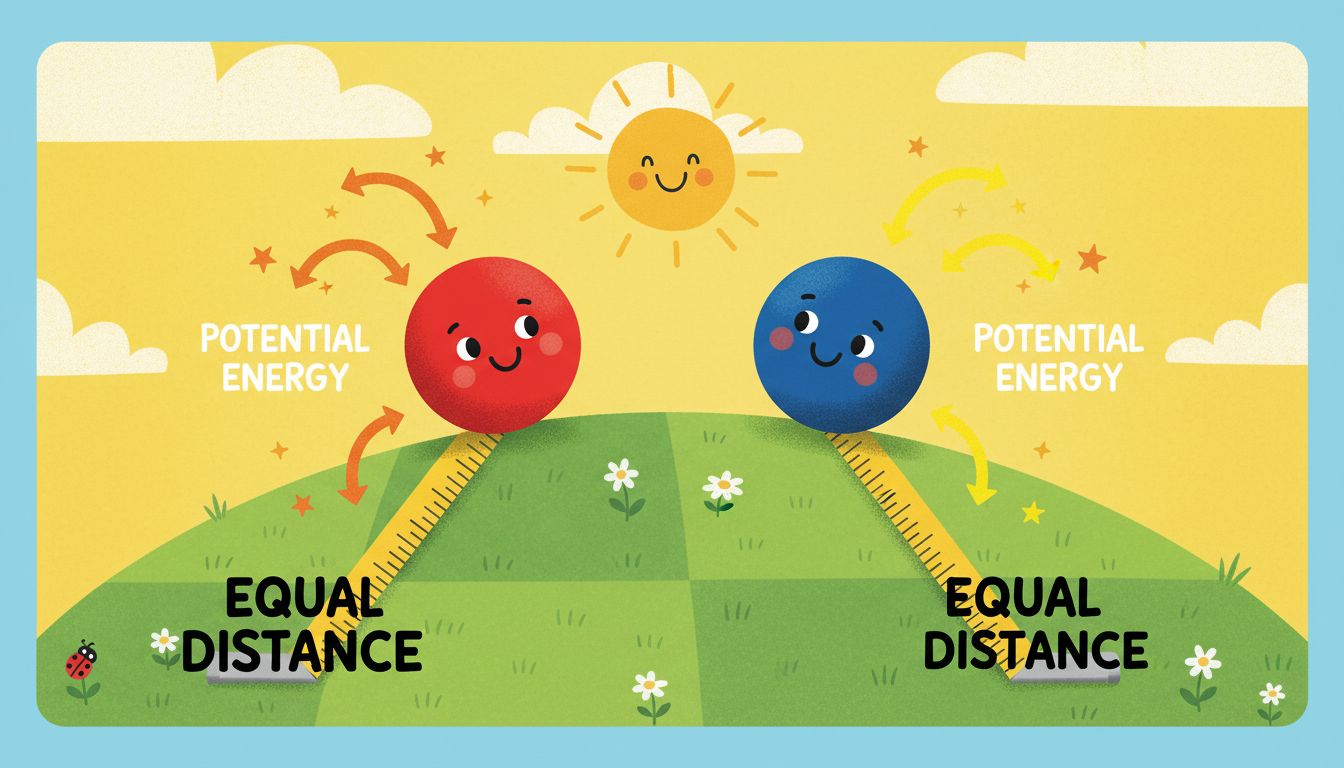
Do Both Balls Have Equal Potential Energy at the Top of a Hill?
Quick Answer
Yes, both balls have equal potential energy because they are at the same height and have the same mass. The path taken to reach that height does not affect their gravitational potential energy.
When discussing gravitational potential energy, it's essential to understand the factors that influence it. Gravitational potential energy (PE) is defined by the formula:
PE = mgh
where 'm' is the mass of the object, 'g' is the acceleration due to gravity, and 'h' is the height above a reference point (usually the ground). This equation indicates that potential energy depends chiefly on two variables: mass and height.
In the scenario involving two balls carried to the top of a hill, both Ball A and Ball B are brought to the same height. According to the principles of physics, the path taken to reach that height, whether it is a straight line or a zigzag, does not impact the amount of gravitational potential energy each ball possesses.
To elaborate, let’s break down the reasoning:
1. **Mass**: If both balls are of the same type and composition, we can assume they have equal mass. This is crucial because the mass directly influences the potential energy.
2. **Height**: Both balls are elevated to the same height (the top of the hill), which is another key factor in determining their potential energy. Since both are at rest at this height, we are not considering kinetic energy (which would involve speed).
3. **Path Independence**: The energy required to lift the balls is determined solely by their mass and the height to which they are raised. Thus, whether you carry a ball directly up or take a longer, winding path, the gravitational potential energy remains unchanged as long as the height and mass are constant.
### Real-World Applications
Understanding potential energy is not just an academic exercise; it has practical implications in various fields. For example, in engineering, the design of roller coasters relies on the principles of potential and kinetic energy. As a coaster climbs to a peak, it gains potential energy, which is then converted to kinetic energy as it descends. Similarly, in everyday life, when you lift an object, you are doing work against gravity, increasing its potential energy.
In conclusion, when both balls are at the top of the hill, they possess equal gravitational potential energy due to having the same mass and being at the same height, regardless of the paths taken to reach there. This concept is fundamental in physics and can be applied in various practical scenarios to better understand energy dynamics.
Was this answer helpful?