
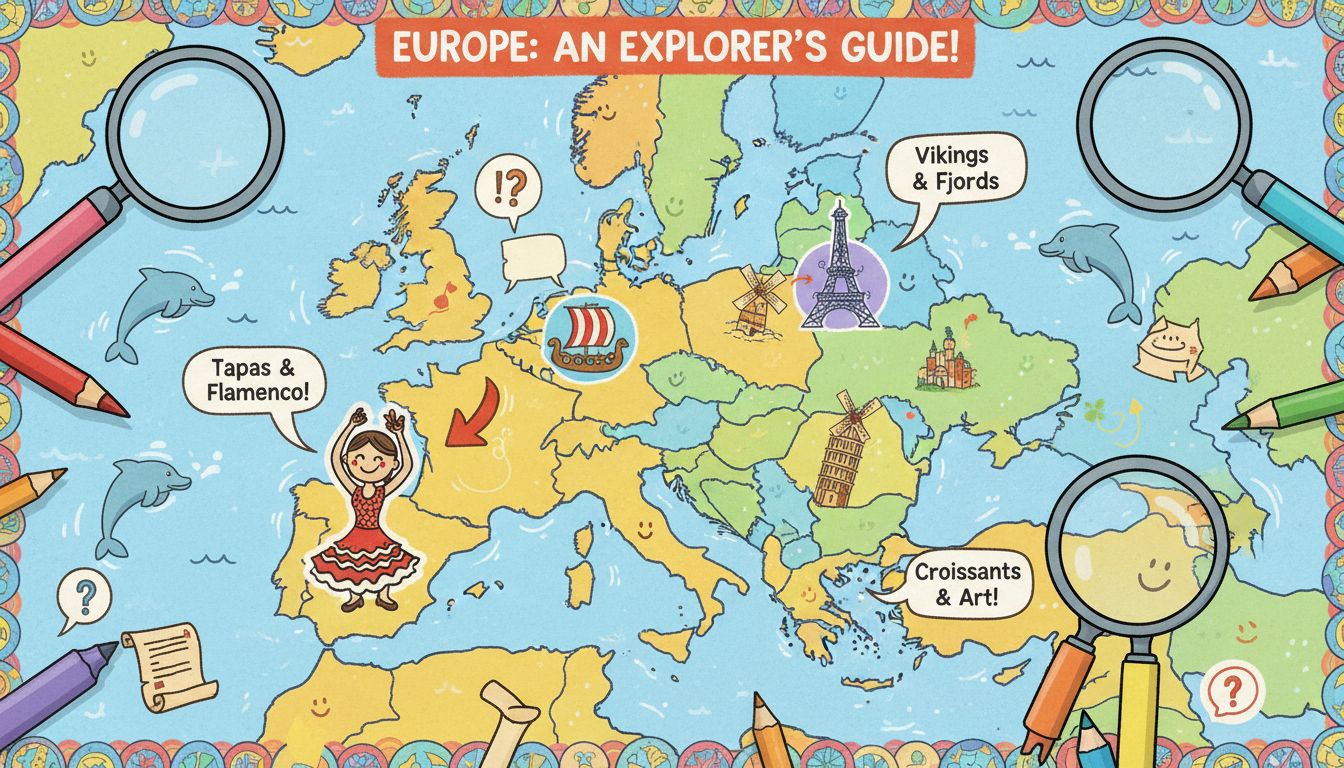
How to Annotate a Map of Europe’s Cultural Landscape
Quick Answer
Annotating a map means adding notes and labels to explain what you see. For Europe's Cultural Landscape map, identify language groups and highlight key patterns to enhance your understanding.
Annotating a map is an essential skill in geography that helps you visually interpret and understand complex information. When you look at a map titled **'Europe’s Cultural Landscape'**, which showcases various **Indo-European language groups**, it invites you to deepen your comprehension of cultural and linguistic diversity across the continent.
**Step 1: Understanding Annotation**
Annotation involves adding notes, labels, or comments directly onto the map. This can help clarify information and highlight significant patterns. For example, if you see that certain regions are colored similarly, it often indicates that they share linguistic characteristics.
**Step 2: Identifying Language Groups**
On your map, you might find different colors representing various language groups. For instance:
- **Green for Romance languages**: This includes countries like Spain, France, and Italy.
- **Orange for Slavic languages**: Countries like Russia and Poland fall into this category.
- **Blue for Germanic languages**: This group includes nations such as Germany and the Netherlands.
As you annotate, consider labeling these color-coded areas with brief descriptions. For example, you could write:
- 'Green = Romance languages (Spanish, French, Italian)'
- 'Orange = Slavic languages (Russian, Polish)'
- 'Blue = Germanic languages (German, Dutch)'
**Step 3: Making Observations**
Beyond just labeling, think about what the map tells you. Are there noticeable patterns? For example, you might note that most of Western Europe predominantly speaks Germanic or Romance languages, while Eastern Europe is largely composed of Slavic languages. This can reveal historical migration patterns or cultural influences.
You can also highlight specific regions with arrows. For instance, you might draw an arrow to the **Island of Ireland** and note, 'Mostly Celtic languages here,' emphasizing the uniqueness of this region compared to its neighbors.
**Step 4: Real-World Applications**
Understanding these language groups has real-world implications. It can help you appreciate the cultural diversity of Europe, understand historical contexts, and even prepare for travel or studies in European countries. The more you explore and annotate, the more connections you’ll make between language, culture, and geography.
By annotating the map, you not only fulfill the assignment's requirements but also enhance your geographical literacy. This skill will serve you well in future studies, whether in history, social studies, or even when learning new languages. Remember, maps are powerful tools that tell stories about the world around us; your annotations will help uncover those stories!
Was this answer helpful?