
What Were the Issues with the Virginia Plan and Its Compromise?
Quick Answer
The Virginia Plan proposed representation based on population, favoring larger states and causing concern among smaller states. This led to the Great Compromise, balancing representation through a bicameral legislature.
Understanding the Virginia Plan is crucial for grasping the early debates that shaped the United States government. Proposed at the 1787 Constitutional Convention, this plan was primarily drafted by James Madison and introduced by Edmund Randolph, aiming to establish a stronger federal government than the one under the Articles of Confederation.
**Key Features of the Virginia Plan:**
The Virginia Plan included a strong central government divided into three branches: legislative, executive, and judicial. Specifically, it called for a bicameral legislature, meaning it would have two houses: the House of Representatives and the Senate. The most controversial aspect was that representation in both houses would be based on each state’s population or their financial contributions to the national government.
**The Main Issue:**
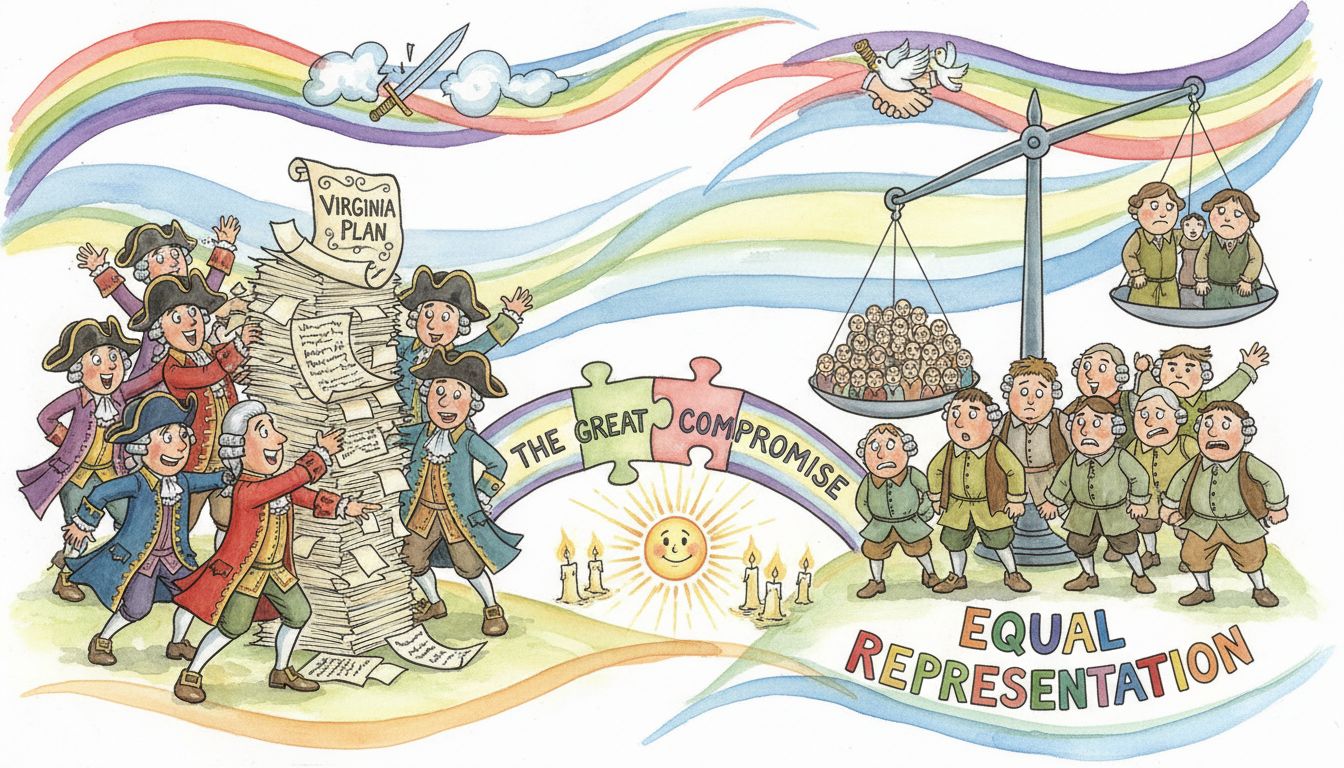
The plan faced significant opposition, particularly from smaller states. Their primary concern was that a population-based representation system would give larger states disproportionate power. For instance, if a state like Virginia, with a larger population, had more representatives compared to a smaller state like Delaware, this could lead to scenarios where the interests of small states were consistently overshadowed. They feared that in critical votes, their voices would be drowned out, leading to a lack of balance in the new government.
**Who Supported and Disliked the Virginia Plan?**
Supporters of the Virginia Plan included larger states that would benefit from a population-based representation system. They argued that it would create a more democratic and equitable government structure. Conversely, smaller states, such as New Jersey, strongly opposed it, advocating instead for equal representation regardless of size—leading to their proposal called the New Jersey Plan.
**The Compromise:**
To resolve this conflict, the delegates reached what is now known as the Great Compromise, or the Connecticut Compromise. This agreement established a bicameral legislature where the House of Representatives would have representation based on population, while the Senate would provide equal representation, with two senators from each state. This compromise effectively balanced the interests of both large and small states, allowing for a more unified approach to governance.
By understanding the Virginia Plan and its challenges, students can appreciate the complexities of forming a government that considers diverse state interests. The Great Compromise is a great example of how negotiation and collaboration are essential in political processes, lessons that are still relevant today as we navigate various forms of governance around the world.
Was this answer helpful?