
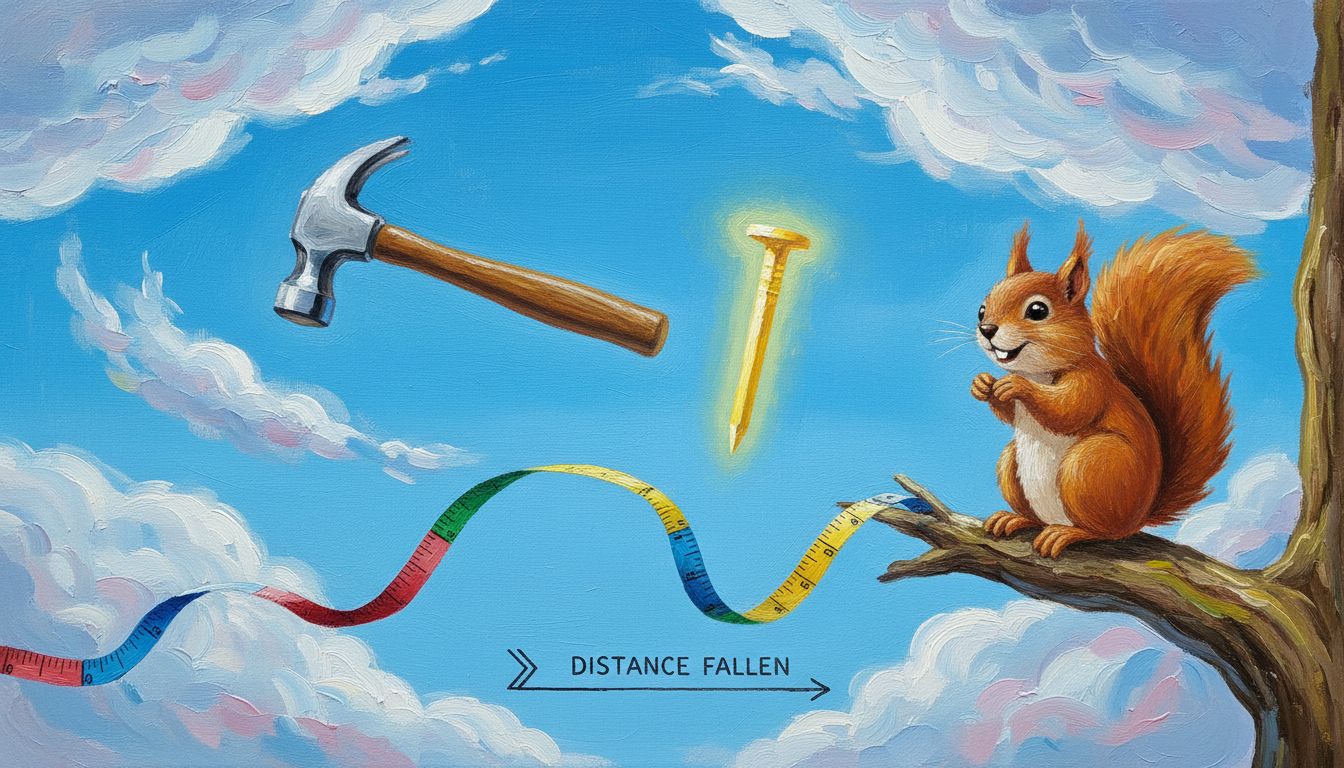
Why Do a Hammer and Nail Fall at the Same Time? Explained
Quick Answer
A hammer and a nail fall at the same rate due to Earth's gravity, which accelerates all objects equally (approximately 9.8 m/s²) near its surface, regardless of their mass.
When you drop a hammer and a nail from the same height, they hit the ground at the same time. This may seem surprising, especially since a hammer is heavier than a nail. However, the reason lies in the principles of physics, particularly the effects of gravity.
1. **Understanding Gravity**: Gravity is a force that pulls objects toward the center of the Earth. Near the Earth's surface, gravity accelerates all objects at approximately 9.8 meters per second squared (m/s²). This means that regardless of an object's mass, they will fall with the same acceleration in the absence of air resistance.
2. **Mass and Acceleration**: It's important to realize that while heavier objects experience a greater gravitational force, they also have more mass, which means they resist changes to their motion to a greater extent. These two factors—gravitational force and mass—balance each other out. Therefore, mass does not affect the acceleration due to gravity, and both the hammer and the nail will fall at the same rate.
3. **Ignoring Air Resistance**: In many physics problems, we simplify the scenario by ignoring air resistance. In reality, air resistance can slow down lighter objects more than heavier ones. However, if we drop a hammer and a nail in a vacuum (where there is no air), they will still fall simultaneously because there is no air resistance acting on either object.
4. **Real-World Application**: This principle of gravity is not just a theoretical concept; it has real-world applications. For instance, understanding how different objects fall can help engineers design safer buildings and structures. It’s also crucial in fields like aerospace, where understanding the forces acting on objects is vital for safe travel in space.
5. **Examples**: To visualize this, think of astronauts in space. When they are in a spacecraft, they experience microgravity, meaning they float. If they were to drop a hammer and a feather in this environment, both would fall at the same rate and hit the ground at the same time, demonstrating that without air resistance, mass is irrelevant in the context of free fall.
In summary, when you drop a hammer and a nail, they fall at the same rate due to the uniform acceleration of gravity near the Earth's surface, ignoring air resistance. This fundamental principle of physics helps explain a wide range of phenomena in our everyday lives.
Was this answer helpful?