
Do Protons and Neutrons Have the Greatest Mass in Atoms?
Quick Answer
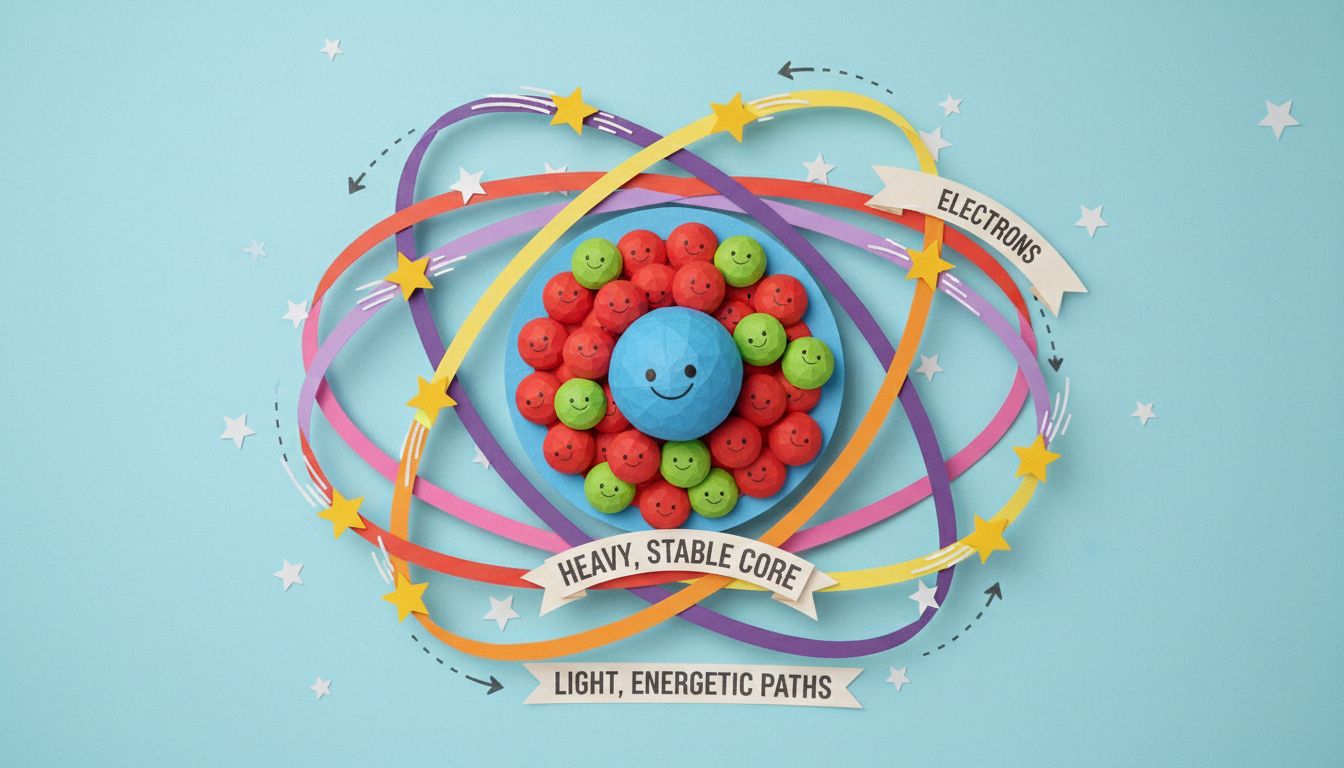
Yes, protons and neutrons have the greatest mass in an atom. They are found in the nucleus, while electrons are much lighter, contributing negligible mass compared to protons and neutrons.
Understanding the components of an atom is crucial to grasping the fundamentals of chemistry and physics. Atoms, the building blocks of matter, are made up of three primary particles: protons, neutrons, and electrons.
1. **Parts of an Atom**:
- **Protons**: These particles carry a positive charge and are found in the nucleus at the center of the atom.
- **Neutrons**: Neutrons are neutral particles, meaning they have no charge, and they also reside in the nucleus alongside protons.
- **Electrons**: Electrons are negatively charged particles that orbit the nucleus in various energy levels or shells.
2. **Mass Comparison**:
When comparing the masses of these particles, protons and neutrons are significantly heavier than electrons. In fact, a proton and a neutron have nearly the same mass, and both are about 1836 times heavier than an electron. To visualize this, if you have one proton, you would need approximately 1836 electrons to equal its mass.
3. **Where is the Mass?**:
Almost all of an atom’s mass is concentrated in its nucleus, where protons and neutrons reside. This is why the atomic mass of an element is primarily determined by the number of protons and neutrons it contains. For example, a carbon atom, which has six protons and six neutrons, has an atomic mass of about 12 atomic mass units (amu).
4. **Real-World Applications**:
Understanding the mass of protons and neutrons is not just a theoretical concept; it has practical applications in fields like chemistry and nuclear physics. For instance, nuclear reactions, such as those that occur in stars or nuclear power plants, involve changes in the nucleus of atoms. These reactions can release or absorb large amounts of energy, primarily because of the mass-energy equivalence principle described by Einstein’s famous equation, E=mc².
In summary, protons and neutrons do indeed have the greatest mass within atoms, and grasping this concept is foundational for further studies in science. It highlights the significance of the nucleus in determining the properties and behavior of elements in the universe.
Was this answer helpful?