
How Does Temperature Relate to Kinetic Energy of Particles?
Quick Answer
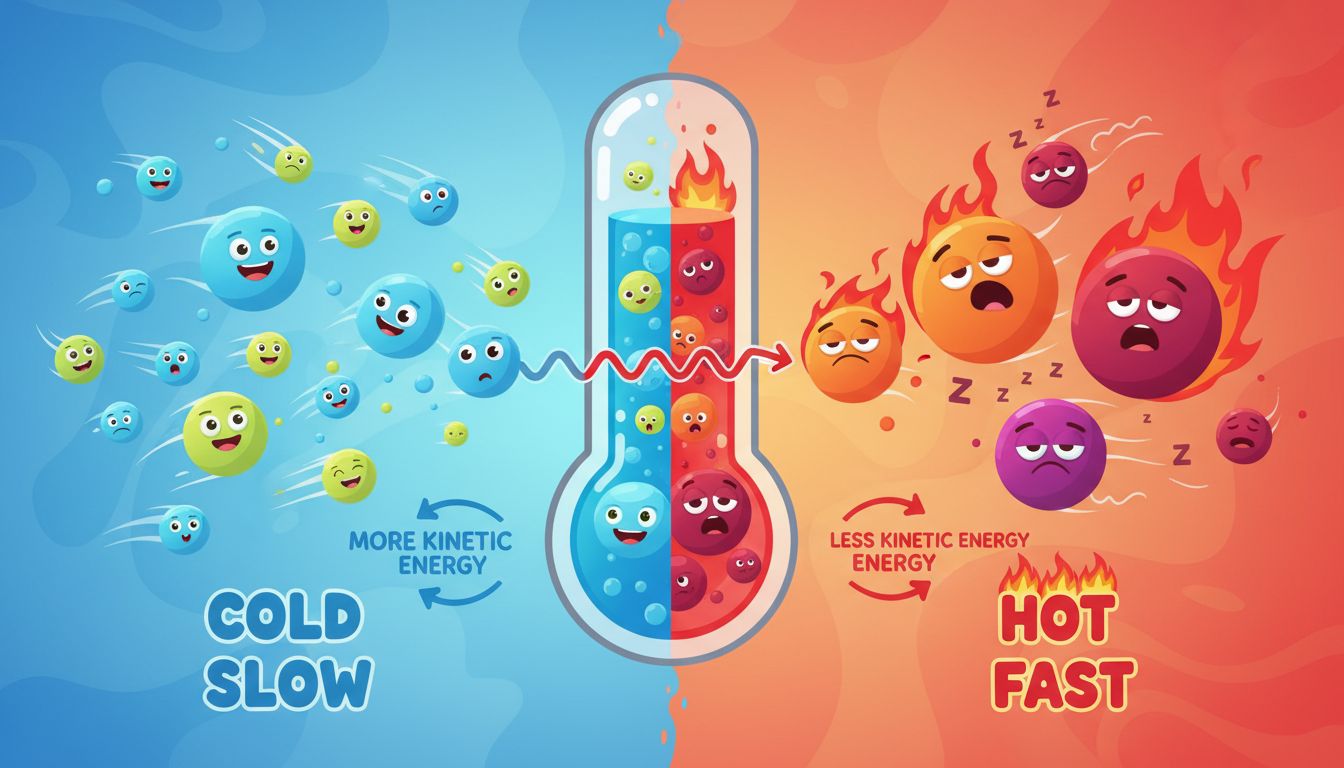
When thermal energy is removed from particles, their kinetic energy decreases, causing them to move slower. This results in a drop in temperature, as temperature measures the average kinetic energy of particles.
Understanding the relationship between temperature and kinetic energy is crucial in the study of physics and chemistry. Kinetic energy is the energy that an object possesses due to its motion. In the context of particles, especially in gases and liquids, the kinetic energy of these tiny particles is directly linked to the temperature of the substance.
When thermal energy, or heat, is removed from particles, they lose energy and their kinetic energy decreases. This decrease means that the particles move more slowly. For instance, when water is cooled, the water molecules lose energy and move less vigorously, resulting in lower temperatures. Conversely, when heat is added, the particles gain kinetic energy and move faster, which raises the temperature.
Temperature itself is a measure of the average kinetic energy of the particles in a substance. Therefore, when the kinetic energy of the particles decreases, the average temperature of the substance also drops. This principle can be observed in everyday life; for example, when ice melts, the temperature of the water remains at 0 degrees Celsius until all the ice has melted. This phenomenon occurs because the energy being added is used to break the bonds between ice molecules rather than increasing their kinetic energy.
It's important to remember that energy cannot be created or destroyed; it can only be transformed or transferred. When energy is removed from a system, as in the case of cooling a gas, the particles can’t move faster, which reinforces the relationship between kinetic energy and temperature.
In the realm of science, this concept has significant implications. For instance, understanding how temperature affects kinetic energy is essential in fields like thermodynamics, meteorology, and even biology. In thermodynamics, the laws governing energy transfer and conversion are fundamentally based on these principles. In meteorology, temperature changes in the atmosphere influence weather patterns, while in biology, the kinetic energy of molecules can affect metabolic rates within living organisms.
In summary, recognizing how kinetic energy and temperature are interrelated helps us make sense of various physical and chemical processes. For a deeper understanding, students can explore formulas that relate kinetic energy and temperature, such as the equation KE = 1/2 mv², where KE is kinetic energy, m is mass, and v is velocity. This formula illustrates how changes in speed (velocity) impact kinetic energy, thereby influencing temperature in the context of particle motion. Remember to keep these concepts in mind as you explore the fascinating world of science!
Was this answer helpful?