
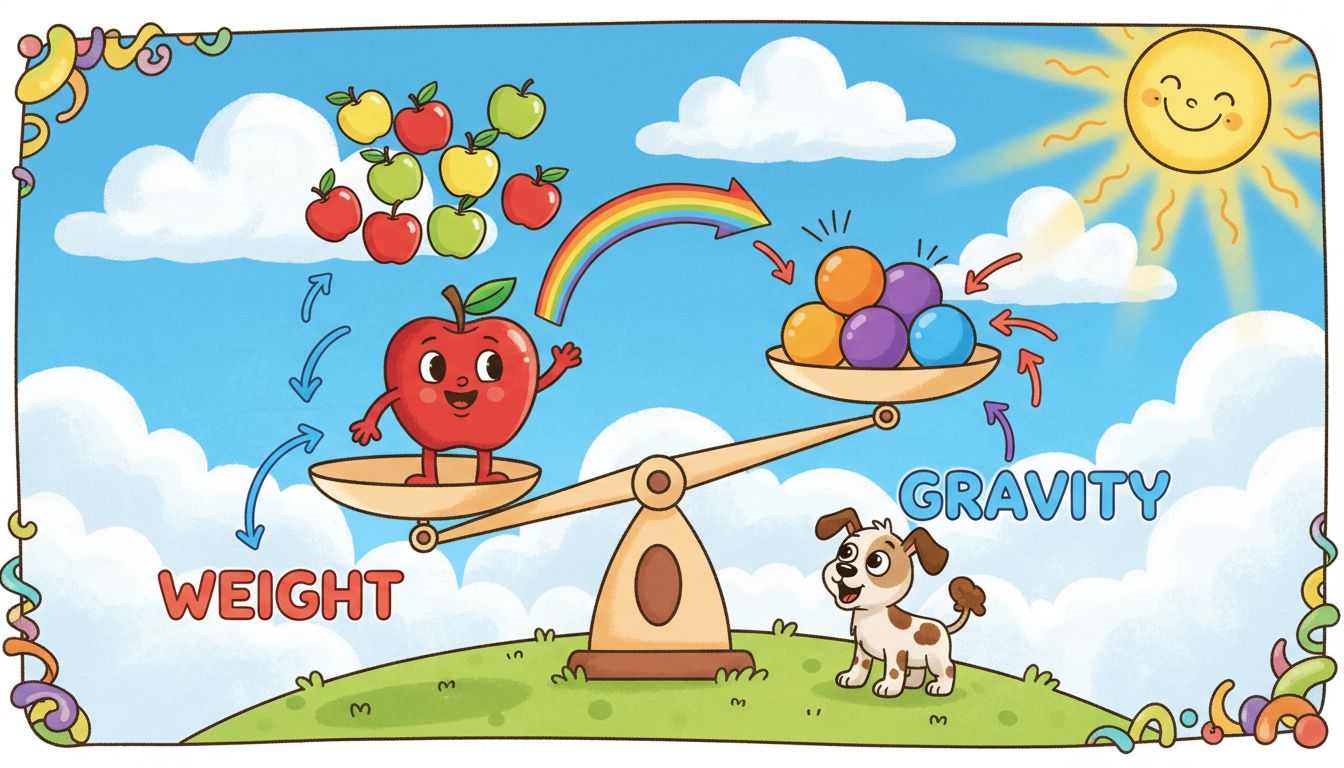
Understanding Gravity and Weight: Common Questions Answered
Quick Answer
The force of gravity depends on the mass of objects and the distance between them. The SI unit for weight is the newton, and all objects with mass attract each other through gravity.
Gravity is a fundamental force that plays a crucial role in our universe. It is the force of attraction between two objects with mass, and it depends on two main factors: the mass of the objects and the distance between them. Understanding these concepts can help clarify many misconceptions about gravity and weight.
1. **Factors Affecting Gravity**: The gravitational force between two objects increases as the mass of either object increases. For instance, the Earth has a large mass, which is why it exerts a strong gravitational pull on us. Conversely, if two objects are very far apart, the gravitational force between them decreases significantly. This relationship is described by Newton's law of universal gravitation, which can be summarized with the formula:
**F = G * (m1 * m2) / r²**,
where F is the force of gravity, G is the gravitational constant, m1 and m2 are the masses of the two objects, and r is the distance between their centers.
2. **Weight vs. Mass**: It’s essential to distinguish between weight and mass. Mass is a measure of the amount of matter in an object and remains constant regardless of location. On the other hand, weight is the force exerted by gravity on that mass. Thus, weight varies based on the gravitational pull of the planet or celestial body where the object is located. The SI unit for weight is the newton (N), where 1 newton is equal to the force needed to accelerate a mass of 1 kilogram at a rate of 1 meter per second squared.
3. **The Attraction of Objects**: It is a common misconception that gravity only acts on large objects like planets or stars. In reality, gravity acts on all objects with mass, regardless of their size. For example, even a small pebble exerts a gravitational force on another pebble, though this force is negligible compared to larger masses. This principle is crucial for understanding various phenomena, from why objects fall to the ground to how planets orbit stars.
4. **Real-World Applications**: Understanding gravity is vital in many fields, including engineering, astronomy, and physics. For instance, engineers must consider gravitational forces when designing structures to ensure stability. Astronomers study gravitational interactions between celestial bodies to understand the universe's structure and behavior.
In summary, grasping the concepts of gravity and weight can significantly enhance your understanding of the physical world. Recognizing how mass and distance influence gravitational forces allows us to appreciate the complexities of our universe. For deeper insights, always refer to reliable educational resources or seek guidance from knowledgeable instructors.
Was this answer helpful?