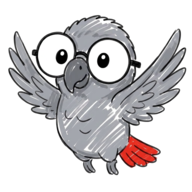
The Sequoia
Polly visits Mariposa Grove and perches on the Grizzly Giant, a giant sequoia nearly 3,000 years old, learning how its fireproof bark and fire-dependent seeds keep the species alive.

Read at your pace. The full app adds translation and saved vocabulary.
Keep it on your phone →Mariposa Grove was an hour's drive south of the valley. Ranger Tomas had dropped Polly at the trailhead and gone off-duty. "Go see the old ones," he said.

The old ones were giant sequoias. They are the biggest trees in the world by volume.

The first thing Polly noticed was the colour. Sequoia bark is not brown. It is a deep rust-orange and looks spongy. She landed on a low branch and pecked the bark with her beak. The bark gave a little. It was nearly half a metre thick, soft to the touch. This thick bark is the tree's main defence against fire.

A family walked past. A little girl said, "Look, a parrot!" Her father said, "It's a stuffed toy someone forgot." Polly did not move.

She flew up the side of the tree, level by level. At thirty metres up, the branches began. They were as thick as her own body. She perched on one and looked up. The crown was another forty metres higher.

The trail ended at one tree: the Grizzly Giant. It was about 2,995 years old. Its trunk was wider than a city bus.

Polly perched on a low spot in the bark. She looked up.

Three thousand years. The tree had been here when Egyptian pharaohs were building the Valley of the Kings. It had been here when Rome was a small farming village. It had grown about one centimetre wider each year, in steady silence.

She stayed a long time. A small fire scar on the trunk was older than most countries. The tree had survived dozens of fires.

A seed about the size of an oat flake fell past her. Sequoia seeds need fire to grow. The cones only open in the heat. Every new sequoia is the result of an old burn.
You just heard Polly
Want to hear what YOU sound like?
Read a line of the story out loud. Your recording stays on your device and is never uploaded.
Not bad, right? If you were in the PollyStop app, Polly would listen to exactly that and score you right now.
Coaching, saved words, spaced repetition, and a fresh story every day.
Get PollyStop freeYou just tried the loop
Now take the story with you.
PollyStop brings listening, saved vocabulary, speaking practice, and a fresh graded story together on your phone.
Learning on Android? Join the waitlistRead this story in another language.
Same story, different language. Compare the shape and rhythm without losing the plot.
Keep reading
More English stories.
The Sea Grows Quiet
Read free
The Sea Grows Quiet
Read free
The Sea Grows Quiet
Read free
The Giant
Read free
The Giant
Read free
The Giant
Read freeKeep learning in PollyStop
Listen, save words, practise