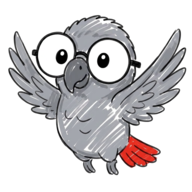
The Milky Way Over Glacier Point
Polly watches sunset from Glacier Point and stays for the Milky Way, looking through a park astronomer's telescope at the centre of our galaxy.

Read at your pace. The full app adds translation and saved vocabulary.
Keep it on your phone →Yosemite has the darkest sky most American visitors ever see. Polly had heard this from Tomas. She wanted to see for herself.

She waited out the afternoon at Glacier Point, an overlook 970 metres above the valley floor. A small crowd was there for the sunset. Polly perched on the railing.

The sun went down behind the Sierra ridge. Half Dome, across the valley, caught the last red light on its face and held it for twenty seconds. Then the red was gone. The crowd clapped softly.

A park astronomer in a brown vest set up a small telescope. He gave a talk while the sky grew darker. He explained that most American cities have lost the Milky Way to streetlights. But in Yosemite, on a clear night, you can still see what humans have seen here for thousands of years.

The first stars came out one at a time. By full dark, the Milky Way was a band of pale light running across the sky. It was broken by dark patches where dust clouds blocked the stars behind them. The biggest dark patch was called the Great Rift. Polly could see it clearly.

The astronomer pointed the telescope at a small smudge near Sagittarius. "This is the centre of our galaxy," he said. "The supermassive black hole at its heart is twenty-six thousand light years away."

A visitor looked through the eyepiece, then stepped back. The astronomer tilted the telescope so Polly could see in too. Through the eyepiece was a dense cluster of stars and dust.

Twenty-six thousand years ago, the light leaving that cluster had started its trip to this telescope. Polly looked for a long time.
You just heard Polly
Want to hear what YOU sound like?
Read a line of the story out loud. Your recording stays on your device and is never uploaded.
Not bad, right? If you were in the PollyStop app, Polly would listen to exactly that and score you right now.
Coaching, saved words, spaced repetition, and a fresh story every day.
Get PollyStop freeYou just tried the loop
Now take the story with you.
PollyStop brings listening, saved vocabulary, speaking practice, and a fresh graded story together on your phone.
Learning on Android? Join the waitlistRead this story in another language.
Same story, different language. Compare the shape and rhythm without losing the plot.
Keep reading
More English stories.
The Sea Grows Quiet
Read free
The Sea Grows Quiet
Read free
The Sea Grows Quiet
Read free
The Giant
Read free
The Giant
Read free
The Giant
Read freeKeep learning in PollyStop
Listen, save words, practise