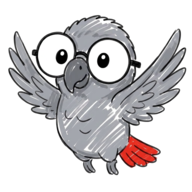
The Jar
Polly watches a giant Pacific octopus named Pasta open a screw-top jar to retrieve a live crab. She learns about octopus suckers that taste, the absence of step-by-step thinking, and how short an octopus's life is.

Read at your pace. The full app adds translation and saved vocabulary.
Keep it on your phone →On the second morning, Chiara brought a glass jar to Pasta's tank. The jar had a screw lid. Inside the jar was a single live crab.

Chiara held the jar above the water for a moment. Pasta watched. The octopus had been sitting in the same corner for forty minutes. Now her eye sharpened. One arm uncurled from the coil and stretched along the side of the tank.

Chiara dropped the jar into the water. It sank slowly. Pasta did not lunge. Octopuses, Chiara had told Polly, are not generally lungers. They are observers first.

Polly perched on the tank rim with her glasses tilted at the water. She could see the crab inside the jar, scuttling against the glass. Pasta moved one arm out and touched the jar. Her skin was suckered all the way to the tip of that arm. The suckers had perhaps two hundred sensory cells each. "More than your tongue," Chiara said quietly. "An octopus arm tastes everything it touches."

Pasta gathered the jar with a second arm. The two arms turned it, slowly. Polly could see the third arm coming around the back of the jar now, exploring the lid.

This is a well-documented behaviour. Octopuses have been opening screw-top jars in research labs since the 1950s. Some can do it in less than a minute. The first time a new octopus encounters a jar, it usually takes ten or fifteen minutes of exploration. They are not solving the problem the way a human would. They are not thinking in steps. They are letting the suckers feel the threads and then turning the lid the way the threads pull.

Pasta turned the lid one half-rotation. Then another. The lid popped free. The crab inside, sensing the change in water pressure, scrambled out of the jar and into the open water.

It did not get far. Pasta's fourth arm was already curled at the jar's mouth. The crab vanished into a soft white opening that Polly realised, after a moment, was the octopus's beak. The crab made a small click. Then nothing.

The jar sank empty to the bottom of the tank.

Chiara wrote something on a clipboard. "Three minutes forty-two seconds," she said. "She is getting fast. The first time we gave her a jar, it took her eleven minutes."

Polly tilted her red head at Pasta. The octopus was already returning to the coil of pipe. Her arms wrapped themselves around herself. Her eye, for one long moment, met Polly's. Then it closed slowly.

It is hard to overstate how strange an octopus is, Chiara said, gathering her things. They are mollusks. They are more closely related to a snail than to anything with a backbone. They have three hearts. Their blood is blue, because it carries oxygen using copper instead of iron. They live, in the wild, only about three to five years. Pasta was already two. She had perhaps two years of life left, no matter how good she got at the jar.

In that time, Chiara had said, she would learn everything she would ever know.
Listen and follow
Hear the whole story.
Press play, then let your eyes move with the language.
You just heard Polly
Want to hear what YOU sound like?
Read a line of the story out loud. Your recording stays on your device and is never uploaded.
Not bad, right? If you were in the PollyStop app, Polly would listen to exactly that and score you right now.
Coaching, saved words, spaced repetition, and a fresh story every day.
Get PollyStop freeYou just tried the loop
Now take the story with you.
PollyStop brings listening, saved vocabulary, speaking practice, and a fresh graded story together on your phone.
Learning on Android? Join the waitlistRead this story in another language.
Same story, different language. Compare the shape and rhythm without losing the plot.
Keep reading
More English stories.
The Sea Grows Quiet
Read free
The Sea Grows Quiet
Read free
The Sea Grows Quiet
Read free
The Giant
Read free
The Giant
Read free
The Giant
Read freeKeep learning in PollyStop
Listen, save words, practise