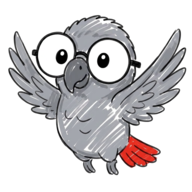
The Diving Falcon
Polly tries to copy a peregrine falcon's dive after seeing one launch from El Capitan, learning about the third eyelid and nostril cones that let peregrines hit 380 km/h without injury.

Read at your pace. The full app adds translation and saved vocabulary.
Keep it on your phone →She thought about the peregrine for two days. The way it had folded its wings. The instant from perch to gone. She wanted to know the shape of it, not in her head but in her body. So on the third morning, before the visitor lots had started to fill, Polly went looking for the bird.

She found a peregrine near El Capitan, on a ledge perhaps four hundred metres up. It was a male, smaller than the female she had seen with Tomas, slate-grey on the back, barred white on the chest. It was eating something. She did not look closely at the something.

She perched on a manzanita branch about fifty metres away and waited.

The peregrine finished its meal, wiped its beak on the rock, and looked at her. It tilted its head. Then it stepped off the ledge.

It did not flap. It folded its wings against its body, like a leaf pulled into a stem, and dropped. Polly watched it accelerate. The bird went past the half-mark of the cliff face in maybe two seconds. Then it pulled its wings out, banked, climbed away, and was gone behind a buttress of rock.

A peregrine falcon in a dive can reach 380 kilometres an hour. That is the fastest movement of any animal on Earth. To dive at that speed and not be knocked unconscious by the air, peregrines have a third eyelid that closes over the eye to keep the wind out, and small cones in their nostrils that act like the cone in front of a jet engine, slowing the air entering their lungs. They are built for the drop.

Polly was not built for the drop. She was built for short bursts and accurate landings. She knew this. But the curiosity was bigger than the knowing.

She flew up the cliff to the ledge the peregrine had used. She stood on it. The drop opened below her, almost vertical, dizzying. The valley floor was a long way down. Air rose past her in cool waves.

She folded her blue-teal wings against her green body. She tilted forward. She fell.

It was not a peregrine dive. It was a parrot in too much hurry. She wobbled. The wind got under one wing and tried to tip her. She corrected, lost the line, corrected again. Twenty metres in, she opened her wings and pulled out of it in a loose, embarrassed arc.

She landed on a pine branch a hundred metres below the ledge. She breathed for a minute. Then she did it again, smaller this time, from a lower perch. Then she did it a third time, lower still.

By the time the sun was overhead, she had made eight short dives and one decent one. None of them were a peregrine dive. All of them were a little better than the last.

From somewhere higher on the cliff, she thought she heard the peregrine call. She told herself it was probably not laughing at her. It was probably just the wind.
Listen and follow
Hear the whole story.
Press play, then let your eyes move with the language.
You just heard Polly
Want to hear what YOU sound like?
Read a line of the story out loud. Your recording stays on your device and is never uploaded.
Not bad, right? If you were in the PollyStop app, Polly would listen to exactly that and score you right now.
Coaching, saved words, spaced repetition, and a fresh story every day.
Get PollyStop freeYou just tried the loop
Now take the story with you.
PollyStop brings listening, saved vocabulary, speaking practice, and a fresh graded story together on your phone.
Learning on Android? Join the waitlistRead this story in another language.
Same story, different language. Compare the shape and rhythm without losing the plot.
Keep reading
More English stories.
The Sea Grows Quiet
Read free
The Sea Grows Quiet
Read free
The Sea Grows Quiet
Read free
The Giant
Read free
The Giant
Read free
The Giant
Read freeKeep learning in PollyStop
Listen, save words, practise