The Bay of Naples
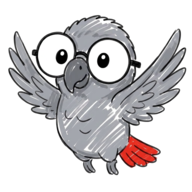
Polly arrives in Naples and is welcomed into the Stazione Zoologica Anton Dohrn, the world's oldest marine biology institute, where she meets Chiara Bianchi and a giant Pacific octopus named Pasta.

Read at your pace. The full app adds translation and saved vocabulary.
Keep it on your phone →Polly came in over the Bay of Naples in late morning. The water was the colour of green glass. Mount Vesuvius sat on the far side of the bay, half-veiled in haze, a perfectly cone-shaped mountain that had buried Pompeii in 79 AD and had not erupted since 1944. The air smelled of salt and pine and the diesel of small fishing boats.

She followed the curve of the shoreline westward. Through the streets of Mergellina she could see laundry hanging from balconies, scooters threading between cars, and a man with a wooden cart selling lemons the size of her own head.

Her destination was a building right on the water in the Villa Comunale park: a long ochre-painted Italian neoclassical structure with tall arched windows. A small brass plaque read STAZIONE ZOOLOGICA ANTON DOHRN. Below that, in smaller letters, FONDATA 1872.

Polly knew about this place. It had been founded by a German zoologist named Anton Dohrn, who had come to Naples in his twenties because the bay was the richest marine ecosystem in Europe and he wanted to study it. He had built the institute with his own family money and the help of fellow scientists. It was the oldest still-operating marine biology institute in the world. It had been studying octopuses since 1873.

She perched on a wrought-iron railing near the entrance. A young researcher in white shoes and a navy lab coat was unlocking the back door. The woman saw Polly. She did not look surprised. "Sei in ritardo," she said, smiling. "Or maybe early. Come on in."

That is how Polly walked through the back door of the Stazione Zoologica.

The building smelled of seawater, briny and clean. Long corridors ran between rooms full of tanks. Through the glass walls she could see ribbons of sardines turning together, a small octopus pressed against one corner of its tank, a sea hare moving slowly over a kelp blade.

The researcher's name was Chiara Bianchi. She had been studying cephalopod cognition at this institute for nine years. She walked quickly. "The director is in Stockholm this week," she said. "You will mostly see me and the animals. The octopuses are the smartest of our animals. Or at least the smartest of the ones we are sure are conscious. The jury is still out on the sea hares."

They came to a tall round tank in a quiet back room. A handwritten card on the side read PASTA, 2.3KG, GPO. Inside the tank, in the corner, half-folded into a coil of plastic pipe, was a giant Pacific octopus. Most of its body was the colour of the pipe. Eight arms wrapped tidily around itself. One eye, golden and rectangular-pupiled, watched them through the glass.

Chiara set her coffee on a counter. "Pasta," she said, "meet Polly."

The octopus did not move. Its skin slowly turned a soft pink at the edges of where it touched the pipe. Polly tilted her red head. The octopus tilted nothing, but its single visible eye stayed on her.

"You can perch on the rim," Chiara said. "She will not splash you. She is calm in the mornings. She gets clever in the afternoons."
Listen and follow
Hear the whole story.
Press play, then let your eyes move with the language.
You just heard Polly
Want to hear what YOU sound like?
Read a line of the story out loud. Your recording stays on your device and is never uploaded.
Not bad, right? If you were in the PollyStop app, Polly would listen to exactly that and score you right now.
Coaching, saved words, spaced repetition, and a fresh story every day.
Get PollyStop freeYou just tried the loop
Now take the story with you.
PollyStop brings listening, saved vocabulary, speaking practice, and a fresh graded story together on your phone.
Learning on Android? Join the waitlistRead this story in another language.
Same story, different language. Compare the shape and rhythm without losing the plot.
Keep reading
More English stories.
The Sea Grows Quiet
Read free
The Sea Grows Quiet
Read free
The Sea Grows Quiet
Read free
The Giant
Read free
The Giant
Read free
The Giant
Read freeKeep learning in PollyStop
Listen, save words, practise