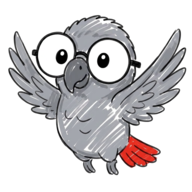
Goodbye to Pasta
Polly says goodbye to Pasta the octopus, who presses one arm against the glass exactly opposite where Polly's foot is resting. Then Polly flies out of Naples toward her next destination.

Read at your pace. The full app adds translation and saved vocabulary.
Keep it on your phone →On the seventh morning, Polly came down to the tank early. The lab was quiet. Chiara would not be in for another hour. The corridors smelled faintly of seawater and disinfectant. The institute had been waking up like this every morning for one hundred and fifty-four years.

Pasta was already at the front of the tank.

This was not normal. For six mornings, Polly had perched on the rim and the octopus had been folded in her pipe, or drifting in a corner, or hanging from the upper glass. Today the octopus was pressed against the front wall of the tank, all eight arms spread loosely against the glass, her single visible eye level with Polly's.

They looked at each other.

What passes between a parrot and a giant Pacific octopus is, almost certainly, not friendship. It might not be anything that Polly would recognise as company. The octopus might simply have been investigating the warm-blooded creature that had been around her tank for six days. The octopus's skin near her arms was a pale pulsing pink. Octopuses can read warmth through their skin. They can read movement through their suckers. They can read the chemistry of the water that has touched another body. They were collecting information.

Polly hopped along the rim. The octopus's eye tracked her, then her arms shifted slowly to follow. When Polly stopped, the eye stopped.

For seven full minutes they watched each other. No one came in. The water filter hummed softly. Polly was aware that this was not normal animal behaviour, on either side.

Then the octopus did something Polly had not seen her do all week. She unfurled one arm slowly, slowly, and pressed the very tip of it against the glass exactly opposite where Polly's foot was resting on the rim. The pad of the tip rested against the glass. The suckers along the underside spread, then stilled.

Polly tilted her red head. After a moment, she lowered her beak to the glass and touched it gently with her closed beak. Through the cold glass, on her side, there was nothing. On the octopus's side, perhaps a great deal.

The arm stayed there for one long minute. Then it slid back into the water.

Chiara came in twenty minutes later with two coffees. "You are leaving," she said, looking at Polly. It was not a question.

Polly tilted her head.

"I imagined this would happen," Chiara said. She set the coffees down. She walked to the tank. Pasta had drifted back to her pipe. Chiara tapped the glass once with one knuckle. Pasta did not move. Chiara smiled. "She is pretending not to notice. She does this when she is upset."

Polly stretched her blue-teal wings.

"Travel safely," Chiara said. "There is much of the sea I have not shown you. Most of the sea, in fact. We are just one institute on one shore." She turned to her coffee. "Come back when you can."

Polly lifted off the rim. She circled once over the tank. Pasta did not look up. Polly flew out down the long corridor of the institute, past the sardines and the kelp and the small octopus in the corner of its tank, and out the back door into the bright morning of the Villa Comunale.

The Bay of Naples opened in front of her. Vesuvius sat across the water. The sea was a colour she had spent a week learning to think of as one body, with many smart things inside it, only some of which a parrot could ever meet.

She climbed. She turned. She found the eastward wind.
You just heard Polly
Want to hear what YOU sound like?
Read a line of the story out loud. Your recording stays on your device and is never uploaded.
Not bad, right? If you were in the PollyStop app, Polly would listen to exactly that and score you right now.
Coaching, saved words, spaced repetition, and a fresh story every day.
Get PollyStop freeYou just tried the loop
Now take the story with you.
PollyStop brings listening, saved vocabulary, speaking practice, and a fresh graded story together on your phone.
Learning on Android? Join the waitlistRead this story in another language.
Same story, different language. Compare the shape and rhythm without losing the plot.
Keep reading
More English stories.
The Sea Grows Quiet
Read free
The Sea Grows Quiet
Read free
The Sea Grows Quiet
Read free
The Giant
Read free
The Giant
Read free
The Giant
Read freeKeep learning in PollyStop
Listen, save words, practise