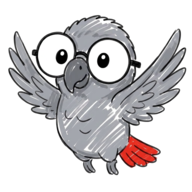
Crossing the Urals
Polly crosses the Ural Mountains, the geographic boundary between Europe and Asia, on the third day of the Trans-Siberian. She meets a fisherman heading to Lake Baikal.

Read at your pace. The full app adds translation and saved vocabulary.
Keep it on your phone →On the third morning, the train stopped at Yekaterinburg. Galina had already left it. She had gotten off in the small hours at a station Polly had slept through, with a hug and a small wave that Polly had only half-registered through the haze. Pavel was still asleep. Two new passengers had taken the empty bunks in the night: a soldier of perhaps twenty in a uniform that was too clean to have been worn yet, and an older man with grey-yellow hair and a fishing tackle box.

Polly hopped to the window.

Yekaterinburg is the largest city in the Urals. The Ural Mountains divide Europe from Asia. They are not high, more a long worn ridge than a wall. But they are old. Five hundred million years ago, when the supercontinent of Pangaea was forming, the Urals were already a major mountain range. They have been worn down for half a billion years and are still there. They are some of the oldest mountains on Earth.

The Trans-Siberian crosses the Urals through Yekaterinburg. There is a small marker at kilometre 1,777 of the line that says EUROPE on one side and ASIA on the other. Every Russian passenger Polly had met that morning had told her about this marker. Some of them got off the train at Pervouralsk, the station nearest the marker, and walked to it for photos. The conductor told her, with a small smile, that the marker was a tourist invention. The actual border, geographically, was not at a clean point on a map. The dividing line runs roughly along the watershed of the Ural River, which is itself a long arc rather than a line.

But the symbolic crossing was the point.

The train pulled out of Yekaterinburg into low hills covered in pine and spruce. The forest had changed since the day before. The white birches were still there, but mixed now with darker conifers. The land was more wrinkled. Small rivers ran in shallow valleys.

The new passenger with the tackle box opened it and laid out his lures on the small table. He arranged them by colour. He did not appear to need any of them at the moment. He just wanted them out.

"Where do you fish?" Polly asked, carefully.

He looked up. He did not seem surprised that a parrot had spoken. "Lake Baikal," he said. "In three days. Omul. The salmon of Baikal. You will not find it anywhere else in the world." He pointed at a particular green-and-silver spoon. "This is what I use."

Polly tilted her red head. The man closed the tackle box.

A few hours later, near Pervouralsk, the train slowed past a small white obelisk in a clearing. The obelisk had a metal plate on one side reading EUROPE in Cyrillic. The plate on the other side read ASIA. A small group of three tourists were taking a photo. They waved at the train. Pavel, now awake, lifted a hand from his laptop and waved back.
The obelisk slid away behind them. The pines closed back in. The train had crossed a continent the way you might cross a small street.
You just heard Polly
Want to hear what YOU sound like?
Read a line of the story out loud. Your recording stays on your device and is never uploaded.
Not bad, right? If you were in the PollyStop app, Polly would listen to exactly that and score you right now.
Coaching, saved words, spaced repetition, and a fresh story every day.
Get PollyStop freeYou just tried the loop
Now take the story with you.
PollyStop brings listening, saved vocabulary, speaking practice, and a fresh graded story together on your phone.
Learning on Android? Join the waitlistRead this story in another language.
Same story, different language. Compare the shape and rhythm without losing the plot.
Keep reading
More English stories.
The Sea Grows Quiet
Read free
The Sea Grows Quiet
Read free
The Sea Grows Quiet
Read free
The Giant
Read free
The Giant
Read free
The Giant
Read freeKeep learning in PollyStop
Listen, save words, practise