The Editor of Itself
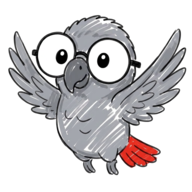
Polly learns that octopuses edit their own RNA in real time, tuning their nervous systems to their environment. Each octopus ends up with a slightly different brain made for its own life.

Read at your pace. The full app adds translation and saved vocabulary.
Keep it on your phone →On the sixth morning, Chiara made coffee for both of them and sat down in the chair beside the tank. Pasta was hanging upside down from a corner of the glass, the bell of her body pulsing gently. Her arms drifted around her like a slow flower.

"There is one more thing I want to tell you," Chiara said, "and I want to tell it slowly, because it is the strangest thing about octopuses I know."

Polly perched on the rim.

"Octopuses can edit their own RNA in real time," Chiara said. "It is something they do constantly. No other animal does this at the rate that an octopus and a few related cephalopods do."

She paused. She knew the next part required care.

DNA is the long-term blueprint of an animal. It does not change much. RNA is the working copy. The cell makes RNA from DNA when it needs to build a protein. In most animals, the RNA matches the DNA almost exactly.

In octopuses, the RNA does not match. As the RNA is being made, the cell rewrites parts of it. Most of these edits happen in the parts of the genome that build the nervous system. The nervous system of an octopus, in particular, is built and rebuilt constantly with these edits.

"Why?" Chiara said, before Polly could ask. "We have a theory. RNA editing is reversible. DNA mutation is not. An octopus can adjust its nervous system in response to the temperature of the water or the chemistry of the food it eats. It can tune its own brain on the fly. The cost is that the genome itself, the long-term blueprint, has not been able to evolve much. The species is stuck with the same DNA, more or less, for tens of millions of years. They paid for short-term flexibility with long-term stagnation."

Polly watched Pasta drift. The octopus's body pulsed slowly. The skin near the eyes flickered through a soft pulse of pinks and pale browns.

"Each individual octopus," Chiara said, "is a slightly different animal from each other one, in a way that you and I and other parrots are not. The same DNA. But the working machinery is built fresh, every life, for that water and that food. They are individual brains in a way that perhaps no other animal on Earth is."

She drank her coffee.

"It is also why," she said, "two octopuses given the same maze can solve it in completely different ways. Pasta solved the maze with two arms cooperating. We had another octopus last year who used three. We had another who waited an hour and then went straight in with the body. They are not solving the same problem with the same brain. They are each solving it with the brain they have made for themselves."

Pasta's eye opened and closed. The arms drifted.

Polly thought about her own brain. It had not been edited in real time. It had been built once, the way most brains are built, and was now simply hers. She did not envy Pasta the flexibility. But she liked very much knowing that animals like Pasta existed.

Chiara stood up. "I have to go write a grant," she said. "You stay with her for the morning, if you want."

Polly stayed.
You just heard Polly
Want to hear what YOU sound like?
Read a line of the story out loud. Your recording stays on your device and is never uploaded.
Not bad, right? If you were in the PollyStop app, Polly would listen to exactly that and score you right now.
Coaching, saved words, spaced repetition, and a fresh story every day.
Get PollyStop freeYou just tried the loop
Now take the story with you.
PollyStop brings listening, saved vocabulary, speaking practice, and a fresh graded story together on your phone.
Learning on Android? Join the waitlistRead this story in another language.
Same story, different language. Compare the shape and rhythm without losing the plot.
Keep reading
More English stories.
The Sea Grows Quiet
Read free
The Sea Grows Quiet
Read free
The Sea Grows Quiet
Read free
The Giant
Read free
The Giant
Read free
The Giant
Read freeKeep learning in PollyStop
Listen, save words, practise