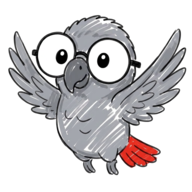
The Amur
Polly reaches Khabarovsk on the sixth day of the Trans-Siberian, sees the Amur River bordering China, and meets a rare Russian Far East crane.

Read at your pace. The full app adds translation and saved vocabulary.
Keep it on your phone →On the sixth morning, the train was running through the Russian Far East. The taiga had changed character. The trees were now Korean pine, Manchurian ash, and Mongolian oak. The forest felt closer. This is the temperate rainforest of the Russian Far East, one of the wettest forests in the world outside the tropics.

Polly was alone in the compartment. Pavel had gotten off in Ulan-Ude. The soldier had moved to another carriage. The new occupant of the upper bunk was a thin woman who slept most of the day.

A freight train passed in the opposite direction. It was nearly two kilometres long, carrying timber. Polly counted thirty-eight flatbeds before she stopped.

The train arrived at Khabarovsk in mid-morning. Khabarovsk sits on the Amur River, the eighth-longest river in the world. The Amur forms much of the border between Russia and China. From the platform, Polly could see the river through a gap between two buildings. It was wide. It was the colour of strong tea. On the far bank, through the haze, was China.

Polly hopped down and walked the length of the train.

A Russian Far East crane was standing at the edge of a small marsh near the station yards. Almost two metres tall, black and white with red around the eye. The Russian Far East crane is one of the rarest cranes in the world. Maybe three thousand left, breeding mostly in the Amur basin.

Polly tilted her head at it. The crane tilted its head back. Polly walked closer. The crane did not move.

A conductor blew a whistle. Polly hopped back to the train. She turned and looked at the crane. The crane was still looking at her. Then it lifted its long neck very slowly and walked, in deliberate steps, away into the marsh.

The train pulled out of Khabarovsk and turned south. The Pacific was less than seven hundred kilometres away now.
You just heard Polly
Want to hear what YOU sound like?
Read a line of the story out loud. Your recording stays on your device and is never uploaded.
Not bad, right? If you were in the PollyStop app, Polly would listen to exactly that and score you right now.
Coaching, saved words, spaced repetition, and a fresh story every day.
Get PollyStop freeYou just tried the loop
Now take the story with you.
PollyStop brings listening, saved vocabulary, speaking practice, and a fresh graded story together on your phone.
Learning on Android? Join the waitlistRead this story in another language.
Same story, different language. Compare the shape and rhythm without losing the plot.
Keep reading
More English stories.
The Sea Grows Quiet
Read free
The Sea Grows Quiet
Read free
The Sea Grows Quiet
Read free
The Giant
Read free
The Giant
Read free
The Giant
Read freeKeep learning in PollyStop
Listen, save words, practise